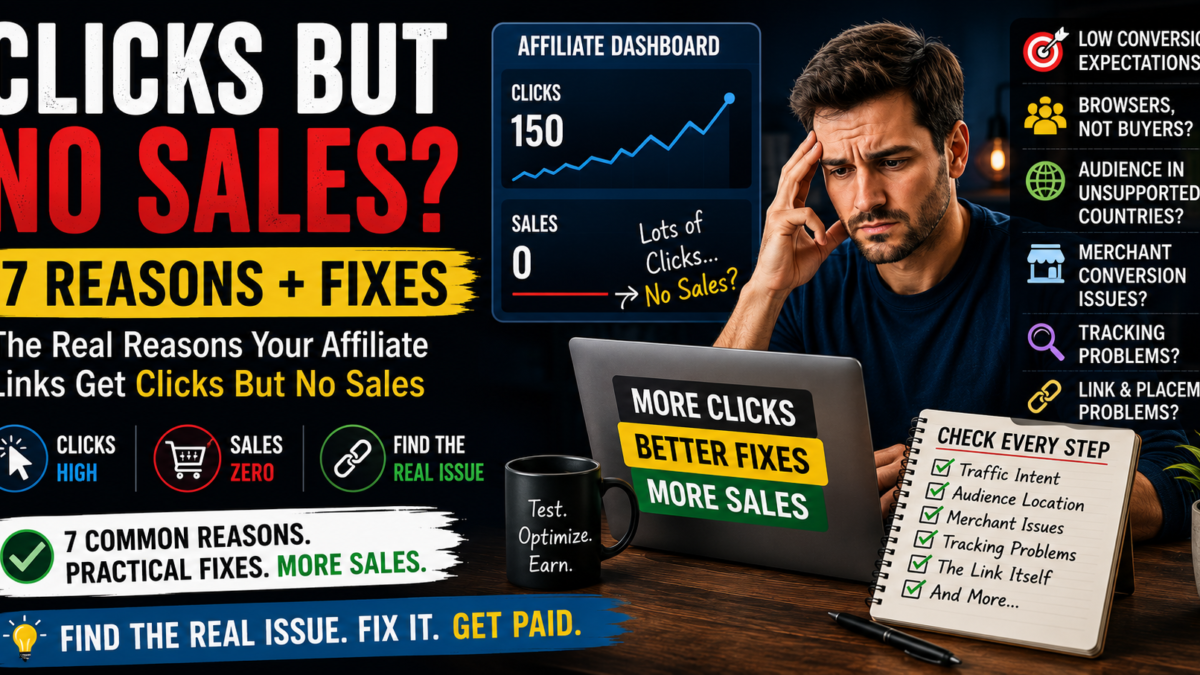
There’s a specific kind of frustration in checking your affiliate dashboard and seeing clicks pile up next to a sales column that stays at zero. Forty clicks. Ninety. A hundred and fifty. People are clearly interested enough to click, so where’s the money?
I run affiliate links on this blog through half a dozen networks, and I’ve stared at that zero more times than I’d like to admit. What I eventually learned is that “clicks but no sales” isn’t one problem. It’s five or six different problems that all look identical from the dashboard, and each one has a completely different fix. Rewriting your content won’t help if the real issue is that your readers live in countries the merchant doesn’t ship to. Switching merchants won’t help if the real issue is that you haven’t had enough clicks for a sale to be statistically likely yet.
So instead of a list of everything that could possibly be wrong, this post works like a check-up. Go through it in order. Most people find their answer in the first two or three steps.
📋 The check-up, in order
1. Do the math before you panic
2. Were they buyers or browsers?
3. Where are your clicks actually coming from?
4. Is the merchant losing the sale for you?
5. Are sales happening that you can’t see?
6. The link itself
7. FAQ
Step 1: Do the Math Before You Panic
This step saves more people than all the others combined, and almost nobody does it.
A reasonable affiliate conversion rate sits somewhere around 1% to 3%. It varies by niche and offer, and some products do better, but that range is a sane baseline. Now apply it to your own numbers. If you’ve had 100 clicks, the expected result is one to three sales. Expected — not guaranteed. Sales arrive in lumps, not evenly spaced, so getting zero from your first 100 clicks is roughly as remarkable as flipping a coin and getting three heads in a row. It happens all the time.
I once watched a link sit at well over a hundred clicks with nothing, then produce two sales in the same week. Nothing about the page changed. The numbers just caught up.
So the honest first question is: do you actually have a conversion problem, or do you have a small sample? My rough rule: under 200–300 clicks on a given link, you don’t have enough data to conclude anything. Keep publishing and come back. Over 500 clicks with zero sales, something is genuinely wrong, and the rest of this post is for you.
Step 2: Were They Buyers or Browsers?
Not all clicks carry the same intent. Someone reading “what is print on demand” who clicks a Printful link is curious. Someone reading “Printful vs competitors pricing” who clicks the same link is shopping. Same click in your dashboard, completely different odds of a sale.
Here’s how to check which kind you’re getting. Open your analytics and look at which pages your affiliate clicks come from. Then be honest about what someone reading each page was trying to do:
- Learning pages — “what is,” “how does,” beginner explainers. Readers here click links out of curiosity, poke around the merchant’s site, and leave. Low conversion is normal and mostly unfixable on these pages, because the reader wasn’t shopping. That’s fine; these pages have a different job.
- Deciding pages — comparisons, reviews, “best X for Y,” pricing breakdowns. Readers here are close to a decision. These pages should convert, and if they don’t, keep working through the checklist.
If nearly all your clicks come from learning pages, you haven’t found a bug — you’ve found a gap in your content plan. The fix isn’t touching those pages. It’s writing the deciding pages that don’t exist yet, and linking to them from the learning ones. A reader who moves from your explainer to your comparison and then clicks is worth ten cold clicks from the explainer alone.
Step 3: Where Are Your Clicks Actually Coming From?
This one gets missed constantly, and for blogs with an international readership it’s often the whole answer.
Merchants have markets. Some don’t ship outside North America and Europe. Some show different prices, or no product at all, to visitors from other regions. Some affiliate programs only pay commission on sales from specific countries, no matter where the click came from. A click from a country the merchant doesn’t serve can never become a sale for you. It was dead the moment it happened, and your dashboard will never tell you.
The check takes five minutes. Open your analytics, look at the country breakdown for the pages carrying your links, then compare it against the merchant’s actual market — their shipping page, their supported-countries list, or the offer’s geo terms inside your affiliate network. If 60% of your readers are in regions the merchant doesn’t sell to, you’ve found your leak.
What to do about it depends on your situation. You can promote merchants that genuinely serve your audience’s countries. You can favor digital products and services, which usually have no shipping borders. Or, if you’re deliberately writing for readers in one region, you can pick offers with that region in mind from the start. What you shouldn’t do is keep sending readers somewhere they can’t buy and wonder why nothing converts.
Step 4: Is the Merchant Losing the Sale for You?
Your job ends at the click. Everything after that — the landing page, the pricing display, the checkout — belongs to the merchant, and some merchants are simply bad at it. Slow pages, confusing signup flows, surprise costs at checkout. You can send them perfect, ready-to-buy traffic and watch them fumble it.
Two ways to investigate. First, walk through the purchase yourself: click your own link, and go as far toward buying as you can. You’ll feel within a minute whether the experience is smooth or whether you’d abandon it too. Second, use the network’s own data where it exists — many networks show EPC (earnings per click) or conversion figures for each program. If a merchant’s EPC is dismal across all their affiliates, the problem was never you.
The fix here is pleasantly simple: swap the merchant, keep the content. Most products worth promoting have two or three competing affiliate programs. I’ve seen the same article go from nothing to steady commissions with no change except which program the links pointed to. When we compared where a Printful sale actually earns more, the gap between platforms surprised us — merchants are not interchangeable, even when the product is the same.
Step 5: Are Sales Happening That You Can’t See?
This is the strangest branch of the diagnosis: sometimes you are making sales. You’re just not getting credit for them.
Affiliate tracking mostly runs on cookies, and cookies are fragile. A few ways credit slips through your fingers:
- The cookie expires first. Every program has an attribution window — 30 days is common, but some run 7 days, and some as little as 24 hours. Readers researching a bigger purchase often come back to buy two weeks later, straight through Google. If your program’s window is short, those sales exist; they just aren’t yours.
- Ad blockers and browser privacy settings strip affiliate parameters or block tracking outright. Some slice of your clicks was never trackable, and there’s little to do about it beyond knowing it exists.
- Someone else’s cookie overwrote yours. If the reader clicked your link, then later clicked a coupon site’s link while hunting for a discount code at checkout, that last click usually takes the commission. This one stings, and it’s rampant.
- The link itself is broken. The least glamorous cause and worth ruling out first: click every affiliate link on your top pages and confirm each one lands where it should with your tracking intact. Links rot — merchants change URL structures, programs migrate networks — and a dead link records clicks while paying nobody.
Practical responses: prefer programs with longer cookie windows when choosing between similar merchants, check your links quarterly, and accept that some leakage is the cost of doing business. If a program offers first-click attribution or lifetime customer tracking, that’s worth real money and worth favoring.
Step 6: The Link Itself
If you’ve cleared everything above and a deciding page with real volume still won’t convert, look at how the link is presented. A link dropped into text with no reason attached — “check out Printful here” — asks the reader to do your persuading for you. The links that convert sit right after the sentence that earned them: a specific claim, a price, a result, a caveat that makes the recommendation believable. Readers click differently when they’ve just been given a reason.
And say what happens next. “See Printful’s current pricing” sets an expectation the landing page immediately meets. Vague buttons create hesitant clicks, and hesitant clicks bounce.
I’ve put this section last deliberately. Link presentation is where most advice on this topic starts, and it’s usually the smallest factor. Fix the math, the intent, the geography, the merchant, and the tracking first. Polish the wording after.
FAQ
What is a normal affiliate conversion rate?
Roughly 1–3% of clicks becoming sales is a reasonable baseline for most niches. Well-matched offers on strong comparison content can beat that; links on beginner explainer pages usually run below it. Judge each page against what its readers were trying to do, not against a single site-wide number.
How many clicks should it take to get my first affiliate sale?
At typical rates, expect your first sale somewhere inside your first 50–200 clicks — but as a lumpy average, not a promise. Zero sales in your first 100 clicks is unremarkable. Zero in 500 means something in this checklist is broken.
Why do my Amazon affiliate clicks not convert?
The same checklist applies, with two Amazon-specific notes: the standard cookie lasts 24 hours, which is unusually short, and commissions only come from purchases in the Amazon store your link points to — clicks from readers in other countries typically buy nothing or buy on a different Amazon storefront where you earn nothing without link localization.
Can sales happen without showing in my dashboard?
Yes, three ways: the purchase happened after your cookie expired, tracking was blocked on the reader’s browser, or another affiliate’s click (often a coupon site at checkout) took the credit. Some of this is recoverable by choosing programs with longer attribution windows; some is just the weather.
Should I remove links that get clicks but no sales?
Not before finishing the diagnosis. A clicked link is proof of reader interest — the most valuable signal you have. Usually the right move is redirecting that interest somewhere it can convert: a better merchant, a comparison page, an offer available in your readers’ countries.
The Bottom Line
Clicks without sales feels like failure, but it’s really just an unfinished diagnosis. Run the math first — most of the time the honest answer is “not enough clicks yet,” and the cure is more publishing, not more tinkering. When the volume is real, work down the list: what the reader wanted, where the reader lives, whether the merchant can close a sale, whether the tracking held. Somewhere in those steps is your specific answer, and it’s almost never the one you assumed while staring at the dashboard.
The clicks were never the problem. They’re the proof that the hard part — earning reader trust — is already working. ☕
Affiliate disclosure: This post contains affiliate links. If you sign up or buy through our links we may earn a commission at no extra cost to you. We only recommend tools and services we’d genuinely use ourselves. Conversion figures mentioned are general industry ranges and will vary by niche and offer. See our full affiliate disclosure and editorial policy.