You don’t need a CPA license, an accounting degree, or years of experience on How to start a bookkeeping side hustle — you need to understand double-entry bookkeeping, be comfortable in a spreadsheet, and be willing to learn one piece of software properly. Skip to the honest verdict if you want the short version.
Quick note: the earnings figures below come from a mix of published rate surveys, freelance platform data, and real numbers people have shared on r/Bookkeeping — not generic “how much bookkeepers make” guesses.
What You Actually Need to Start (Less Than You’d Think)
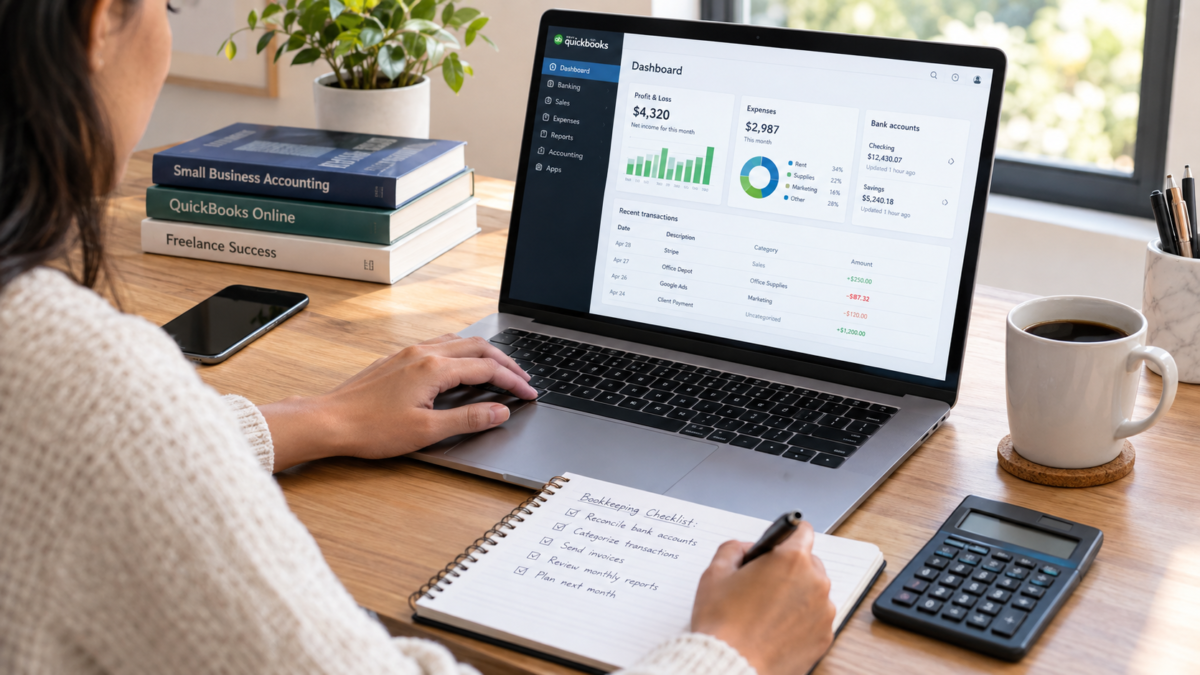
Skills: Understanding double-entry bookkeeping, comfort with Excel or Google Sheets, and ideally some familiarity with QuickBooks Online or Xero. If you’ve ever reconciled a bank statement or managed a household budget carefully, you’re closer than you think.
Certification (optional, but worth doing): QuickBooks Online ProAdvisor certification is free and takes about 20-30 hours to complete. It won’t teach you bookkeeping from scratch, but it signals competence to clients and gets you listed in Intuit’s “Find a ProAdvisor” directory — a genuine source of warm leads. Xero offers a similar free Advisor certification. Neither requires a degree or prior experience.
Software: QuickBooks Online runs around $30/month for the basic plan. Add a spreadsheet program and a simple invoicing tool, and you’re fully equipped.
Optional, more advanced credentials: AIPB’s Certified Bookkeeper designation and NACPB certification exist for those who want deeper credibility, but both require exam study and, in AIPB’s case, thousands of hours of experience — not a starting-point requirement.
What Bookkeeping Side Hustles Actually Earn
Hourly rates: Generalist bookkeepers typically charge $25-35/hour when starting out. Upwork’s average listed bookkeeping rate is around $43/hour, with experienced or specialized bookkeepers charging $60-175/hour. The gap between $25 and $75 an hour comes down almost entirely to one thing: whether you niche down.
Monthly retainer pricing (the more common structure for ongoing client work): basic services typically run $200-350/month per client, mid-range services $500-700/month, and premium or more complex accounts $1,000+/month.
Real numbers from real people: Several documented bookkeeping side hustlers report hitting their first $1,000 in the first few months. One well-known example built a business specifically serving Etsy sellers and grew it into a six-figure operation — not by doing more bookkeeping hours, but by packaging her knowledge into templates once she understood the niche deeply enough.
The Niche Advantage (Where the Real Money Is)
A generalist bookkeeper — “I do bookkeeping for anyone” — tends to land around $25-35/hour. A bookkeeper who specializes — “I do bookkeeping for Etsy sellers” or “I handle books for restaurants” — routinely charges $60-100+/hour for the same underlying skill.
The reason is simple: specializing means you learn one industry’s chart of accounts, tax quirks, and common expense categories once, then move faster with every new client in that niche. Clients in that industry also refer you to others in the same industry, because they trust you already understand their specific world.
Where to Actually Find Your First Clients
The QuickBooks ProAdvisor directory. Not a flood of leads, but genuinely warm traffic — people actively searching for bookkeeping help who find you through Intuit’s own listing.
Local CPAs and accounting firms. Many accountants would rather not handle the month-to-month bookkeeping grind for their clients. Offering to take that work off their plate is one of the most consistent ways bookkeepers build a steady early pipeline.
Freelance platforms (Upwork, Fiverr). Slower to build trust than a referral, but a reliable way to get your first few clients with zero existing network.
Your own network first. Several real bookkeepers report landing their very first client through casual conversation — a local networking event, a Facebook group, or simply mentioning what they were building to people they already knew.
What Reddit Actually Says
The recurring theme across r/Bookkeeping threads from people starting out: you genuinely don’t need a degree, but confidence and experience — not credentials — are the real early barrier. One commenter with 16 years in the field and an accounting degree put it plainly: once you have the basics (ProAdvisor cert plus a foundational bookkeeping course), it’s entirely about experience and continuous learning from there.
The most consistently recommended paid resource in these threads is The Bookkeeping Side Hustle Guidebook by Kate Johnson — a bookkeeper who built her own business starting in 2017 and now runs a large community specifically for people doing this. It’s referenced repeatedly as a practical, real-world starting point by people with no formal accounting background.
A Quick Note for UK and Australian Readers
The certification path shifts slightly outside the US. In the UK, AAT (Association of Accounting Technicians) qualifications are the more commonly recognized credential alongside Xero certification, which has strong market share there. In Australia, the Australian Bookkeepers Association’s own rate survey found quality bookkeepers charging around $60-75/hour on average, with unqualified “backyard bookkeepers” charging as little as $35/hour — and clients often paying more later to have that cheaper work corrected by an accountant. The core advice (niche down, get software-certified, start with warm local leads) holds regardless of country.
The Honest Verdict
Bookkeeping is one of the more realistic side hustles on this site to actually reach solid part-time income with — no license, no degree, and a free certification path that takes a weekend. The honest catch is that the jump from $25/hour to $75/hour isn’t about working harder, it’s about picking a niche early rather than staying a generalist. Start with the free QuickBooks ProAdvisor certification, take on one or two clients through your own network or a local accountant’s overflow work, and let your niche reveal itself from whichever clients you enjoy working with most.
FAQ
Do you need a degree to start a bookkeeping side hustle?
No. You need to understand double-entry bookkeeping and be comfortable in accounting software, which can both be self-taught or learned through a free certification like QuickBooks ProAdvisor.
How much can you realistically make as a bookkeeping side hustle?
Generalists typically start around $25-35/hour or $200-350/month per client on retainer. Specialized, niched-down bookkeepers commonly reach $60-100+/hour.
What’s the fastest way to get your first client?
Your own network and local CPA firms looking to offload overflow bookkeeping work tend to convert faster than cold freelance platform applications.
Is bookkeeping side hustle work legitimate, or is it mostly hype?
It’s legitimate — demand for it doesn’t dip, since every small business needs their books handled whether or not they want to do it themselves.
Affiliate & Referral Disclosure: This post doesn’t currently include affiliate links for bookkeeping software or courses — it’s meant as honest starting-point education. No hype. Just truth. Sip. Click. Earn.