AI Chatbot Side Hustle: What You Can Realistically Charge Your First Client
You’ve seen the video. Some guy in a rented Lambo or a clean home office says he’s making $30,000 a month “building AI chatbots for local businesses,” and all you need is 30 minutes and a no-code tool. You watch it twice, half-believing it, half-certain you’re missing the part where it actually gets hard.
Here’s the honest version: building and selling simple AI chatbots to small businesses is a real, legitimate side hustle. People do get paid for it. But the number that actually shows up in a beginner’s first month looks nothing like the video, and the gap between the hype and the real numbers is exactly why so many people quit before landing their first client.
What this side hustle actually is, stripped of the hype
You’re not writing custom AI models or doing enterprise software development. For a beginner, this is: using a no-code chatbot builder to set up a simple FAQ-answering, lead-capturing, or appointment-booking bot for a small local business — a dentist’s office, a salon, a small e-commerce shop — then charging them for the setup and, ideally, a small ongoing fee to maintain it.
That’s it. No coding. No custom NLP model training. The tools already do the technical heavy lifting; your actual job is understanding the business well enough to set up the right conversation flow and convince them it’s worth paying for.
Why the big income numbers you’ve seen don’t apply to a beginner
A lot of “AI chatbot agency” content promises $10,000 to $50,000 a month within a matter of months. Treat that as the exception, not the baseline. Custom, full-scale chatbot agency work genuinely can command large contracts — but that tier is agencies with case studies, testimonials, and a sales process, serving mid-market and enterprise clients with real budgets. That’s not where anyone starts.
The real, grounded numbers for a beginner selling to small businesses look like this: freelance chatbot setup work across all experience levels generally runs $1,000 to $5,000 per project, according to industry pricing data — but small businesses with 1 to 50 employees typically budget only $100 to $500 a month total for something like this, and often expect to pay a smaller one-time setup fee rather than a large project cost. A beginner’s realistic first sale sits at the low end of that range, or below it: think $150 to $500 for a simple setup, not a five-figure contract.
That’s not a discouraging number. It’s an honest one, and it’s still a real result for a first client that took a couple of hours of actual work.
What tools to actually use (you don’t need to pay for anything expensive to start)
Every one of these has a genuinely usable free tier, which matters a lot when you’re proving this works before spending money on it:
- Tidio — free plan includes a set number of AI conversations per month, drag-and-drop builder, good for a simple FAQ or lead-capture bot on a small business website.
- ManyChat — strong for businesses that get most of their customer questions through Instagram or Facebook Messenger rather than a website.
- Botpress — a free plan with visual building tools plus a small monthly AI usage credit, useful once you want more conversation flexibility than a template-based tool offers.
- Chatbase — inexpensive paid tier (around $19/month) once you outgrow free tools, particularly good for bots trained directly on a business’s own website content or FAQ page.
Starting with free tiers means your only real cost while you’re finding your first client is your own time — which matters, because you shouldn’t be paying for a $30-a-month subscription before you’ve confirmed anyone will actually pay you for this.
What to actually charge (a realistic starting structure)
Skip the complicated usage-based pricing models built for larger clients. For your first several clients, keep it simple:
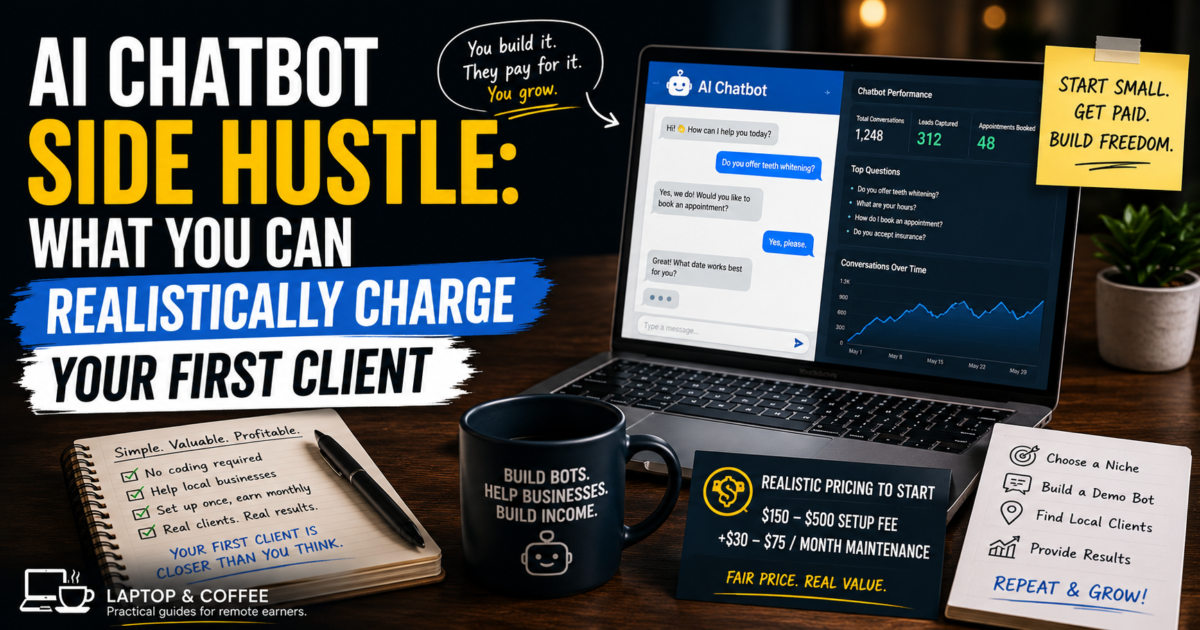
- A flat setup fee of $150–$500 for a straightforward FAQ, lead-capture, or appointment-booking bot, depending on how much back-and-forth the business needs to define their common questions and flows.
- An optional $30–$75/month maintenance fee if they want you to update the bot’s answers, review unanswered questions, and make small tweaks over time. Not every client will take this, and that’s fine — treat it as a bonus, not the core offer.
- Don’t compete purely on price. A local business isn’t comparing you against an enterprise chatbot agency; they’re comparing you against doing nothing. Price for the value of “I set this up so you stop losing messages after hours,” not against what a big agency charges a mid-market client.
As you build a couple of real case studies — actual before-and-after numbers, even something as simple as “reduced missed messages by X” — you can raise your rates. Your first client is proof-of-concept pricing, not your permanent rate.
Finding your first client without cold-emailing 200 strangers
The realistic path here is local and specific, not a mass outreach campaign:
- Pick a business type with high volume of repetitive questions — dental offices, hair salons, small restaurants, local service businesses (plumbers, cleaners) that get the same five questions constantly by phone or DM.
- Build a demo first, then reach out. Set up a working example chatbot using a real (but generic) version of that business type before you ever contact anyone. Showing a working demo converts dramatically better than describing an idea, since most small business owners don’t have a clear mental picture of what “a chatbot” actually looks like until they see one respond.
- Reach out in person or by phone before email, especially for local businesses. A short, specific pitch — “I noticed you don’t have anything answering questions after hours; I built a quick demo, want to see it?” — beats a cold email that’s easy to ignore.
- Start with someone you already have a real connection to, if possible. A family friend’s business, a local shop you’re a regular at. Warm context makes the first “yes” meaningfully easier to get.
What doesn’t work, and where beginners waste time
Trying to build something too advanced for a first client. A business with simple, repetitive questions doesn’t need deep AI reasoning — it needs its five most common questions answered reliably. Overbuilding the first project usually means it never ships.
Ignoring the maintenance conversation entirely. A chatbot that gives outdated business hours or wrong pricing information a month after launch actively damages the business’s trust in it — and in you. Even a simple “I’ll check in monthly” arrangement, paid or not for your first client, protects the relationship.
Chasing the agency-scale income numbers before you have a single client. Comparing your first $300 sale to someone else’s claimed $30,000 month is a fast way to feel like you’re failing at something you’ve barely started. Those are different stages of the same business, not the same starting point.
Buying into a “done-for-you” chatbot reseller product. You’ll come across posts describing a specific paid product or system that hands you a pre-built chatbot to resell under your own name, often paired with a suspiciously smooth story — a business owner saying yes within days, doubling clients within weeks, the reseller “barely knowing how it worked” and still closing deals. Treat this framing as a warning sign, not inspiration. These posts are frequently written to sell access to the reseller product itself, and the real skill you’re trying to build here — understanding a client’s business well enough to set up something genuinely useful — is exactly what gets skipped when someone else’s black-box tool is doing the work. Building your own simple chatbot with a free tool like Tidio takes barely longer and means you actually understand what you’re selling.
Overpromising what the bot can do. Being upfront that it handles common questions well and hands off anything complex to a human is more trustworthy — and more accurate — than implying it’s a full AI employee replacement.
The honest recommendation
If you want a clear starting point instead of a long list of options: pick one no-code tool (Tidio is the easiest true beginner starting point), build one demo chatbot for a local business type you already understand, and reach out to three real businesses this week with that demo in hand. Price your first client at $150–$300 for setup — low enough to be an easy yes, high enough to be a real transaction, not a favor.
Don’t chase the big income claims as your benchmark for whether this is working. A genuine first paying client, however small the number, is the actual milestone. Everything past that — higher prices, a monthly retainer, a second and third client — builds from having proven it once.
This chatbot work is one specific service inside a bigger category worth knowing — 5 AI Services You Can Sell to Businesses covers the other options if this particular one isn’t the right fit. And once you’re ready to formalize this into real freelance client work, First Client on Fiverr or Upwork With Zero Reviews covers how to turn a first project like this into an ongoing freelance track record.
FAQ
Do I need to know how to code to start an AI chatbot side hustle? No. Modern no-code chatbot builders like Tidio, ManyChat, and Botpress handle the technical implementation — your actual job is understanding the client’s business well enough to set up the right conversation flow.
How much should a beginner charge for their first chatbot client? A flat setup fee of $150–$500 is realistic for a simple FAQ or lead-capture bot, with an optional $30–$75/month maintenance fee. Treat your first client as proof-of-concept pricing, not your long-term rate.
Can you really make $10,000+ a month doing this? That level of income belongs to established chatbot agencies with case studies and mid-market or enterprise clients — a different stage of the business than where any beginner starts. It’s not a realistic first-month or even first-year benchmark.
What’s the best free tool to start with? Tidio is generally the easiest true beginner starting point, with a usable free tier and a simple drag-and-drop builder. ManyChat is a strong alternative for businesses that get most inquiries through Instagram or Facebook Messenger.
What kind of businesses are the best first clients? Local businesses with a high volume of repetitive customer questions — dental offices, salons, restaurants, and local service providers — tend to see the clearest, fastest value from a simple chatbot.
Are “done-for-you” AI chatbot reseller products worth buying? Be skeptical of them. Posts promoting a specific paid reseller product often read as promotional content for that product rather than genuine advice, and they skip the actual skill worth building — understanding a client’s business well enough to set up something useful. A free tool like Tidio gets you to the same result without paying for someone else’s black box.