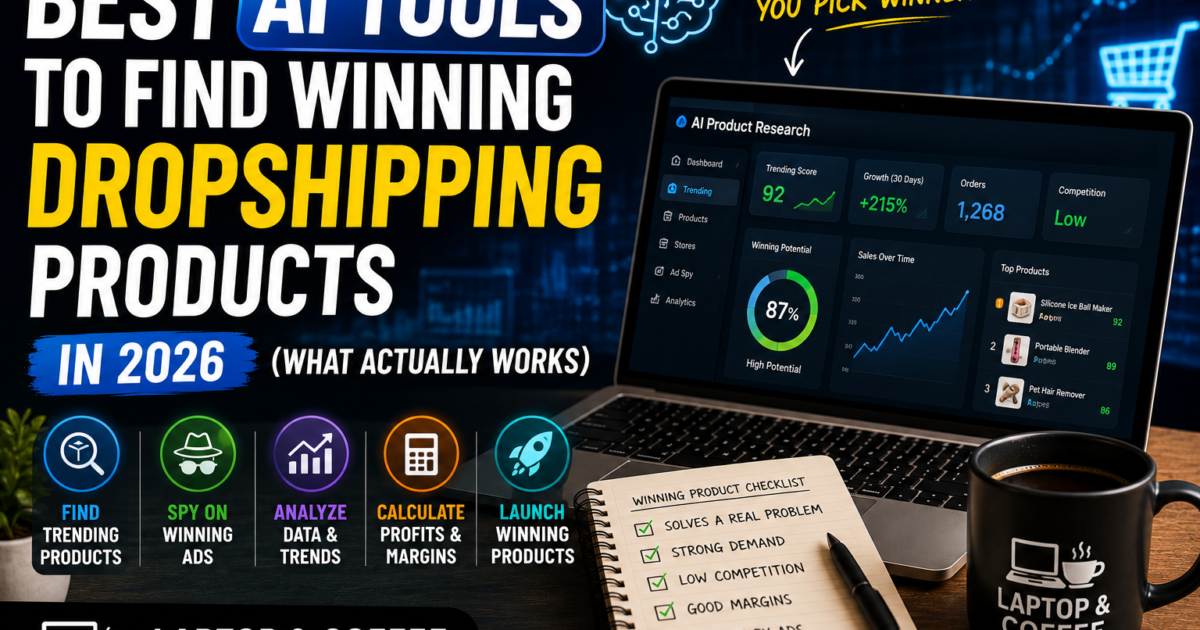
Best AI Tools to Find Winning Dropshipping Products in 2026 (What Actually Works)
It’s 1 a.m. and you’re on your fortieth AliExpress tab. You’ve bookmarked a silicone garlic peeler, a posture corrector, and something called a “cloud slipper” that’s apparently blowing up on TikTok. None of it feels like a decision. It feels like a guess with extra steps.
So you buy an AI product-research tool because the ad promised it would “find your next winning product while you sleep.” Three weeks and one failed $150 ad test later, you’re back on AliExpress at 1 a.m., except now you’re also paying $50 a month for a dashboard that told you the garlic peeler had a “94% trending score.”
Here’s the part almost nobody selling these tools will say out loud: no AI tool can find a winning product for you. What they can do is genuinely useful, just narrower than the marketing suggests. This is the honest breakdown of where AI actually helps in dropshipping product research, and where it’s just a spreadsheet wearing a chatbot costume.
What AI can’t actually do (read this before you pay for anything)
One dropshipping research firm ran their own scoring model across nearly 6,000 products and built detailed profiles on almost 300 of them to test what AI product tools were actually good at. The results were telling: AI was strong at judging practical, functional value — whether a product solves a clear problem — with a large share of products scoring well on that dimension. But not a single product scored high on “wow factor,” which happens to be the trait most closely tied to a product actually going viral.
In plainer terms: AI is good at telling you a product is useful. It’s bad at telling you a product will make a stranger stop scrolling. That second thing is still a human judgment call, and it’s the harder half of picking a winner.
There’s a second problem that’s structural, not technical: every AI research tool trained on public trend data can see the same trends you can. If a “trending score” tool flags a product as hot, thousands of other subscribers are looking at the identical dashboard. AI compresses your research time, but it doesn’t create an information advantage by itself. That’s why Shopify’s own research found something worth paying attention to: 71% of AI-attributed orders in 2025 came from long-tail, niche categories — outside the top 100 by sales volume — not from the obvious trending items every tool surfaces first.
That reframes what these tools are actually for. Not “find me the winner.” More like “help me filter and move faster, so I can spend my judgment on the harder, more specific call.”
What AI is genuinely good at in product research
With that reality check out of the way, here’s where AI tools earn their subscription cost:
- Filtering volume. Scanning thousands of AliExpress, Amazon, and Shopify listings for basic viability signals faster than any human scrolling manually.
- Trend timing. Spotting a product with fast month-over-month growth before it’s mainstream enough for manual research to catch it.
- Ad transparency. “Ad spy” style tools show you which stores are running paid ads on a product right now and how long they’ve been running them — a genuine, real signal, since nobody keeps burning ad budget on something that isn’t converting.
- Margin and demand math. Crunching cost, shipping, and estimated ad spend into a real profit picture faster than you would in a spreadsheet.
- First-draft content. Product descriptions, ad copy variations, and FAQ sections — genuinely one of the highest-value, lowest-risk uses of AI in this entire workflow.
The tools actually worth knowing about
Rather than another 20-tool wall of logos, here’s what each one is actually for and what it costs.
| Tool | Best for | What it actually does | Realistic cost |
|---|---|---|---|
| ChatGPT or Claude (paid tier) | Everyone, as a starting point | Structured product evaluation, niche brainstorming, margin estimates, first-draft ad copy and descriptions | ~$20/month, or free tier for lighter use |
| Sell The Trend | An all-in-one research + store platform | Its “Nexus” engine scores products using order velocity, social engagement, and search interest combined; includes ad-spy and competitor store analysis | Roughly $30–$40/month on annual plans, up to ~$300/month for the highest power-user tier |
| AutoDS | Research plus full automation | Cross-platform product research (AliExpress, Amazon, Walmart, CJ) with built-in order fulfillment and price monitoring — good if you want research and operations in one place | Plans starting around $27/month |
| Dropship.io | Ad and trend tracking specifically | TikTok Shop trend tracking, plus a “paste an image, find who’s selling it and what ads they’re running” search feature | Mid-range monthly subscription, tiered by feature access |
| Niche Scraper or Thieve.co | People who’d rather pay for curation than raw data | Human-reviewed “winning product” shortlists instead of a dashboard you sort yourself | Niche Scraper ~$50/month; Thieve.co ~$15/month, the more affordable way to test this style |
One honest note that applies across most of the “ad spy” category (Minea, PiPiADS, and similar): several experienced reviewers have pointed out that the “AI” branding on these tools is often more marketing than substance — the underlying function is closer to a searchable database of live ads than genuine machine-learning insight. That doesn’t make them useless, it just means you’re paying for organized access to public ad data, not a smarter opinion.
A validation checklist AI can’t replace
Whatever a tool tells you is “trending,” run it through this before spending a dollar on ads:
- Check for a genuine problem being solved, not just visual novelty. Products with real functional value tend to sustain sales longer than pure impulse-buy novelty items.
- Look at how many stores are already selling it, and for how long. A product with dozens of stores running ads for 60+ days is proven demand — but it’s also proven competition. A product nobody’s touched yet might be under-the-radar, or it might just not sell.
- Do the real margin math, including shipping and a realistic ad-spend estimate, not just the product cost. A $3 item with a $25 markup looks great until a realistic cost-per-acquisition eats most of the margin.
- Picture the actual ad. If you can’t imagine a 15-second video that would make someone stop scrolling for this specific product, that’s a real warning sign no trending score will catch.
- Vet the supplier separately. No product research tool verifies shipping reliability or product quality for you — that’s a distinct step, not a feature bundled into a “winning score.”
What doesn’t work (and who should hold off)
Stacking five research subscriptions before your first sale. One dropshipping data firm flagged this directly: piling $200–$400 a month in AI tools on top of ad spend makes the path to profitability longer, not shorter, especially before you’ve validated that you can sell anything at all.
Trusting a single “trending score” as your entire decision. These scores are a starting filter, not a verdict. Treat a high score as “worth investigating further,” not “worth listing today.”
Buying a research tool before you’ve built a store or run a single ad. If you’re pre-launch, free tools (ChatGPT’s free tier, Google Trends, manual TikTok and AliExpress browsing using a structured evaluation prompt) get you further than a paid platform will at this stage.
If you’re not yet ready to spend real ad budget testing a product, skip the paid research tools entirely for now — they solve a volume problem you don’t have yet.
A realistic starting stack
If you want a straight recommendation instead of “it depends”: start with a paid ChatGPT or Claude subscription and nothing else. Use it to evaluate products you find manually, with a structured prompt — ask it to score a specific product on problem-solving value, visual appeal, shipping risk, and ad potential, and to give you honest reasons not to sell it, not just reasons to. That last part matters: a tool that only tells you good news isn’t doing real evaluation.
Once you’ve made your first sales and know you can actually convert traffic, add one all-in-one research platform — Sell The Trend is the most complete single option if you want research, ad-spy, and store tools together instead of three separate subscriptions. Don’t add a second research tool on top of it. The bottleneck at that stage is rarely “not enough product data” — it’s usually marketing execution.
One more thing worth saying plainly: a great AI-surfaced product still dies fast with the wrong supplier behind it. If you haven’t locked that piece down yet, Best Dropshipping Supplier in 2026 walks through the three suppliers actually worth using and which one fits a first branded store versus a general one.
FAQ
Can AI actually find a guaranteed winning dropshipping product? No. AI is genuinely useful for filtering large volumes of products and spotting early trend signals, but independent testing has found it consistently fails to identify the “wow factor” that drives a product to actually go viral — that judgment still belongs to you.
What’s the best free AI tool for dropshipping product research? ChatGPT’s free tier or a low-cost paid plan (around $20/month) covers structured product evaluation, niche brainstorming, and first-draft ad copy — enough to start without a dedicated research subscription.
Is Sell The Trend worth paying for? For sellers past their first few sales who want research, ad-spy, and store tools in one platform instead of stitching together several subscriptions, yes. For someone who hasn’t made a sale yet, it’s premature.
Are “AI” ad-spy tools like Minea actually AI-powered? Some function more like organized, searchable ad databases than genuine machine-learning tools, according to several independent reviews. They’re still useful for seeing what ads are currently running on a product, just worth knowing what you’re actually paying for.
How many AI tools do I need to start dropshipping? One, to start. A paid ChatGPT or Claude subscription covers evaluation and content drafting. Add a dedicated research platform only once you’ve validated that you can convert traffic into sales.