Everyone on your feed suddenly seems to be “building apps” — a screen recording of someone typing a sentence into a chat box, and four minutes later there’s a working login screen and a dashboard. You’ve never written a line of code in your life, and it looks like the door already closed without you.
It didn’t. But here’s the honest version of what’s actually happening behind those four-minute demos, and what a real beginner can realistically build, charge, and deliver — because the gap between the demo and a paying client is bigger than the videos let on, and smaller than “you need a CS degree” makes it sound.
What vibe coding actually is
Vibe coding means describing what you want in plain English and letting an AI tool generate the actual code and interface for you. Tools like Lovable, Bolt, and Replit turned this from a novelty into something genuinely usable in the past year — you type “build me a simple booking calendar with a login screen,” and within minutes you have a working preview you can click through.
This isn’t a gimmick. Lovable alone reportedly reached $100 million in annual recurring revenue within about eight months of launch, and Replit’s revenue reportedly jumped from $10 million to $100 million in nine months after adding its AI agent. That’s real usage, not hype — but real usage from millions of people building basic prototypes is a different thing from you personally landing a paying client, and that’s the gap this guide is actually about.
The honest limitation nobody selling a course mentions
Independent reviewers who’ve actually shipped real, paid client work with these tools (not just afternoon demos) describe a consistent pattern: the tools get you roughly 70% of the way to a genuinely usable app. The first four minutes feel like magic. After that, real software development reasserts itself — bugs that need fixing, edge cases the AI didn’t anticipate, and features that break other features when you ask for changes.
This matters enormously for what you should actually try to sell. For simple, well-defined projects — a landing page, a basic booking form, an inventory tracker with a handful of fields — these tools genuinely deliver a finished, usable product. For anything involving complex business logic, payment processing, or multiple user roles, most reviewers found the tools hit a wall around 15-20 components before quality degrades. Stay inside that first category as a beginner. That’s not a limitation to apologize for — it’s the actual, sellable service.
What a beginner can realistically build and sell
Skip the “build a SaaS and sell it for $50,000” framing you’ll see elsewhere — that’s a real outcome for some people, but it’s not where anyone starts, and it requires skills beyond just prompting an AI tool. Here’s what’s genuinely achievable as a first project:
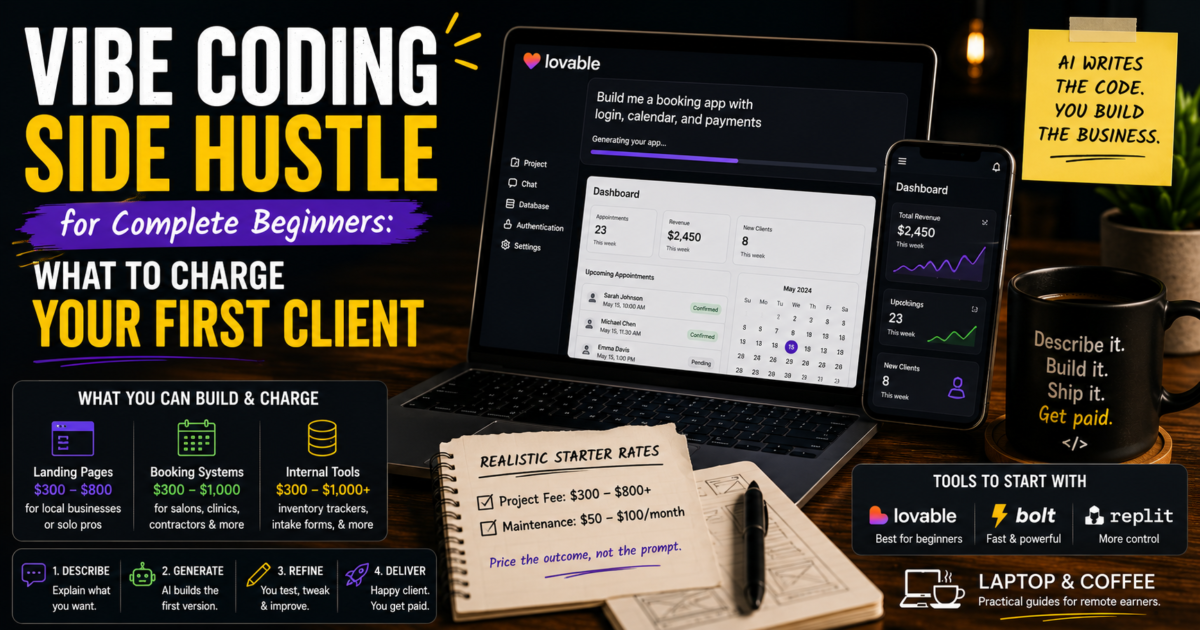
- Simple landing pages for a local business or a solo professional — $300 to $800 depending on complexity.
- Basic internal tools — an inventory tracker for a small retailer, a client intake form, a simple scheduling tool — $300 to $1,000, sometimes with a $50-$100/month maintenance add-on.
- Appointment or booking systems for service businesses (salons, contractors, small clinics) — similar range, often the highest-demand category since so many small businesses are still running this off a paper calendar or a group text.
A realistic build timeline for a first project: a few hours to get a working first version, then a couple more hours sitting with the actual business owner watching how they use it and adjusting based on real feedback. That loop — AI builds, you observe, AI refines — is where the actual value you’re providing lives, not in the initial four-minute demo.
Which tool to actually start with
For someone with zero coding background, Lovable is consistently the one independent, non-vendor comparisons point to as the best starting point. It’s built specifically for non-technical users, has the most polished output of the beginner-friendly tools, and includes a straightforward chat interface where you describe changes in plain language rather than touching code directly. It runs $25/month for the paid tier, with a limited free daily allowance to test it out first.
Bolt and Replit are reasonable alternatives — Bolt tends to build slightly faster but with more bugs to clean up, and Replit is more of a full development environment that asks more of you upfront. For a true beginner’s first project, Lovable’s smoother, more forgiving workflow is the more realistic starting point.
[Affiliate disclosure placeholder — insert per your standard disclosure block before this link goes live] If you want to try it, Lovable’s free tier is enough to build and test your first real project before you spend anything.
What to actually charge (a realistic starting structure)
Keep this simple for your first few clients, the same way we approached pricing in the chatbot side hustle guide:
- A flat project fee of $300–$800 for a simple landing page or basic booking tool, scaled up toward $1,000 for something with more moving parts like an inventory tracker.
- An optional $50–$100/month maintenance fee if the client wants ongoing tweaks and small feature additions — not every client will want this, and that’s fine.
- Price the outcome, not the four minutes it took to generate the first draft. The client is paying for a working tool that solves their actual problem, including the real hours you spend refining it with their feedback — not for watching you type a prompt.
As you complete a couple of real projects, you’ll have actual before-and-after examples to raise your rates from. Your first client is proof-of-concept pricing, the same as it would be for any new freelance skill.
Finding your first client
The same local, specific approach that works for other beginner AI side hustles works here:
- Look for small businesses running an obvious manual process — a shop tracking inventory on paper, a service business booking appointments by phone or text, a solo professional without a proper landing page.
- Build a quick demo before you pitch anyone. A working example, even a generic one, converts far better than describing the idea — most small business owners don’t have a clear mental picture of what you’re offering until they see it working.
- Reach out directly and specifically — a short, concrete pitch beats a cold email that’s easy to ignore: “I noticed you’re tracking inventory on a spreadsheet; I built a quick example of a simple tracker for a business like yours, want to see it?”
- Start with a warm connection if you have one — a family friend’s shop, a business you’re already a regular at. It lowers the stakes for both sides on a first project.
What doesn’t work, and where beginners waste time
Trying to build something with real business logic on your first project. Payment processing, multi-user permissions, and complex data relationships are exactly where these tools show their limits. A simple, well-scoped tool that actually works beats an ambitious one that breaks.
Comparing your first $300 project to someone’s claimed $20,000/month. That level of income belongs to people running multiple client relationships or a scaled micro-SaaS product — a different stage of the same skill, not a realistic first-month benchmark.
Stacking multiple paid tool subscriptions before your first client. Start with one tool’s free tier, prove you can actually deliver something, then upgrade once you have income to justify it.
Not testing what you built with the actual client before calling it done. The “AI builds, you observe, AI refines” loop only works if you actually watch a real person use the tool — skipping this step is how you end up delivering something that looks finished but breaks the first time someone outside your own head uses it.
The honest recommendation
If you want a clear starting point instead of a long list of options: sign up for Lovable’s free tier this week, build one simple project — a booking form, a basic inventory tracker, whatever matches a business type you already understand — and show it to three real local businesses. Price your first project at $300–$500. That’s a real, fair number for a first client, low enough to be an easy yes and high enough to be a genuine transaction rather than a favor.
Don’t wait until you feel like a “real developer” to start reaching out. The tools are specifically built to make that gatekeeping unnecessary for the kind of simple, genuinely useful projects a beginner can actually deliver well.
This pairs naturally with another AI-enabled service you don’t need a technical background for — AI Chatbot Side Hustle: What You Can Realistically Charge Your First Client covers a similar beginner-friendly path using no-code chatbot tools instead. And if you’re comparing this against other AI side hustles before picking one, How Much AI Side Hustles Really Pay in 2026 breaks down realistic numbers across several options.
FAQ
Do I need any coding experience to start a vibe coding side hustle? No. Tools like Lovable are specifically built for people with zero coding background, using a plain-English chat interface instead of requiring you to write or understand code directly.
How much should a beginner charge for their first vibe-coded project? A flat fee of $300–$800 is realistic for a simple landing page, booking tool, or basic internal tool, with an optional $50–$100/month maintenance fee for ongoing tweaks.
What’s the best AI coding tool for a true beginner? Lovable is consistently rated the most beginner-friendly option across independent comparisons, with the most polished output and least intimidating interface for someone who’s never coded.
Can these tools really build a complete, working app with no bugs? Not reliably for complex projects. Independent testing found these tools get you roughly 70% of the way to a finished product — simple, well-scoped projects work well, but anything with complex business logic or payment processing typically needs additional debugging or a developer’s help.
Is $20,000 a month realistic for someone just starting out? No. That level of income belongs to people running multiple client relationships or a scaled product over time, not a first-month or even first-year benchmark for a beginner.