Personal Branding for Freelancers With No Portfolio (Yes, You Can Start Now)
You open LinkedIn, type out a headline, delete it, type another one. Your “Featured” section is empty. Your portfolio link goes nowhere because there is no portfolio. Every guide you read says “showcase your best work,” and you don’t have any work to show, because nobody’s hired you yet.
So you close the tab and tell yourself you’ll come back to this once you’ve actually done something worth branding.
Here’s the problem with that plan: clients aren’t hiring the freelancer with the most polished portfolio. They’re hiring the one who seems like the safest bet for their specific problem. A portfolio is one way to prove that. It’s not the only one, and for a genuinely new freelancer, it’s often not even the most important one.
Personal branding and a portfolio are not the same thing
This is the mix-up that stalls most beginners before they start. A portfolio shows what you’ve built. A personal brand is what people expect from you before they’ve seen anything at all — how you talk about your work, what problem you clearly solve, and whether you come across as someone who has their act together.
You can build the second one without the first. In fact, some of it is easier without a portfolio, because you’re not tempted to hide behind “the work speaks for itself.” You have to actually say, in plain language, what you do and who it’s for — which is the exact thing a lot of experienced freelancers with beautiful portfolios still get wrong.
What clients are actually judging in the first 30 seconds
Before a potential client ever gets to your work samples, they’re already forming an opinion based on things that have nothing to do with your project history:
- Do you sound like you know exactly who you help? “I do graphic design” reads as uncertain. “I design pitch decks for early-stage SaaS founders” reads as someone who’s thought about this.
- Is your profile internally consistent? Same story on LinkedIn, your proposal, and your email signature. Inconsistency reads as disorganized, even if the inconsistency is meaningless.
- Do you communicate clearly in the first message? This one matters more than almost anything else at the beginner stage. A confusing, typo-filled outreach message loses a client faster than a thin portfolio ever will.
- Is there any evidence you’re a real, reachable person? A real photo, a working link, a response within a reasonable time. Low bar, and a shocking number of new freelancers don’t clear it.
None of that requires a single client project. It requires clarity and consistency, which you can build starting today.
Step 1: Write one sentence that says exactly who you help
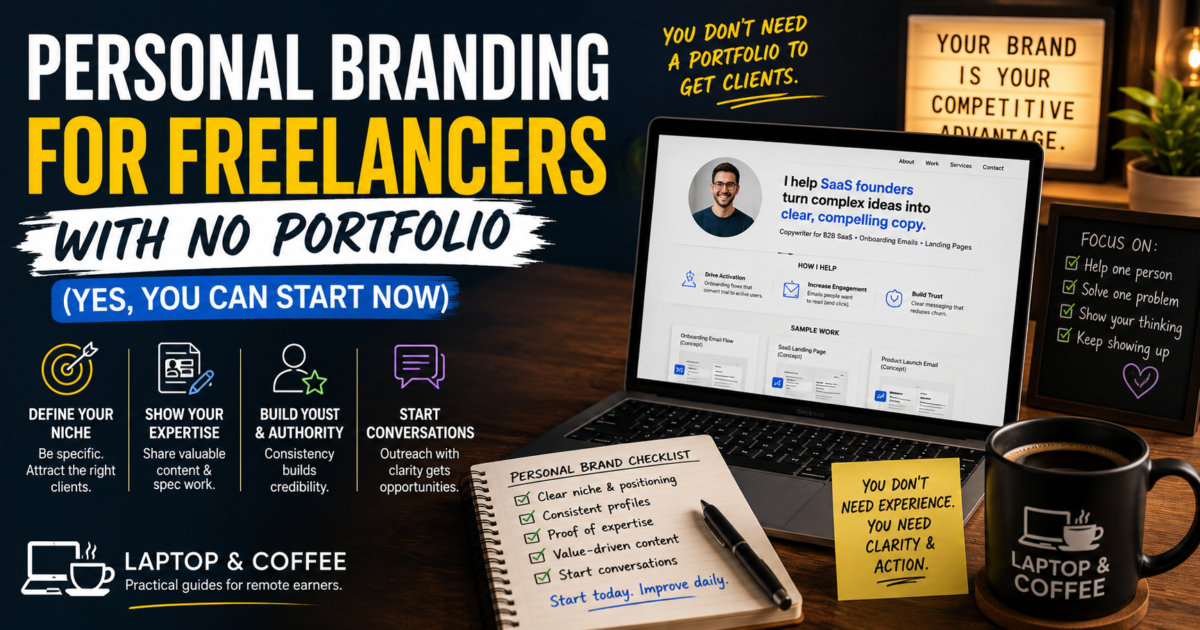
Before anything else — before LinkedIn, before a portfolio page, before a single post — write a single sentence that names your niche and your ideal client. Not “I’m a freelance writer.” Something closer to: “I write onboarding email sequences for B2B SaaS companies.”
If that feels too narrow before you’ve even had a client, that’s normal, and it’s fine to adjust it later once you learn what you actually enjoy and what pays well. What matters right now is that a specific, believable sentence reads as more credible than a vague, safe one — even from someone with zero experience. Vague reads as “hasn’t figured out what they do yet.” Specific reads as “knows their lane,” regardless of track record.
Step 2: Fix the three places clients actually look first
You don’t need a personal website on day one. You need these three things to say the same clear story:
- Your LinkedIn headline and About section. Skip the job-title default (“Freelance Writer”) and use the niche sentence from Step 1 instead. Add two or three lines about the specific outcomes you help with, even in hypothetical terms (“I help early-stage teams turn technical products into onboarding emails people actually read”).
- Your platform profile (Upwork, Fiverr, wherever you’re starting). Same sentence, same story. Clients who check both places — and many do — should see one consistent person, not two different pitches.
- Your outreach message template. Whatever you send when you apply for work should open with the same clear positioning, not a generic “I’d love to help with your project” line that could apply to anyone.
This alone puts you ahead of a large share of new freelancers, who write three different, vague versions of themselves across three different platforms.
Step 3: Build proof without a paying client
You genuinely don’t need to wait for your first invoice to have something real to show. A few approaches that count as legitimate proof, not padding:
- Spec work for a real (but non-client) purpose. Redesign an existing brand’s landing page as an exercise, write a sample email sequence for a product you actually use, build a mock social calendar for a business you admire. Label it clearly as a personal exercise — clients respect honesty about this far more than a portfolio piece pretending to be real client work.
- Free or discounted work for one real business, in exchange for a genuine testimonial. One well-documented project with a real quote from a real person outweighs five polished mockups. Keep it to one or two of these — the goal is proof, not a habit of working for free indefinitely.
- Public, ungated work. If you write, publish two or three genuinely good pieces somewhere visible instead of keeping them in a drawer. If you design, post your process, not just the final image — process posts are underused and show more judgment than a finished file alone.
The throughline: anything you can point to and say “here’s how I think” counts, even without a client’s name attached.
Step 4: Give yourself a simple visual home, without overbuilding it
You don’t need a custom website yet. A single, clean page is enough at this stage, and Canva’s free tier can get you there without any design background — a simple one-pager with your niche sentence, two or three proof pieces from Step 3, and a way to contact you. Don’t spend a week perfecting this. A clean, simple page today beats a “someday” website that never ships.
What doesn’t work (and quietly makes new freelancers less credible, not more)
Trying to sound like you have ten years of experience. Overcorrecting into corporate-sounding language or vague authority claims tends to read as try-hard rather than confident. Being clearly early-stage but specific and clear beats being vague but trying to sound seasoned.
Positioning yourself as able to do everything. “I can write, design, and manage your social media” reads as unfocused, especially with no track record yet to back the range. Pick one lane publicly, even if you’re capable of more.
Posting generic motivational content with zero connection to your actual skill. Some new freelancers try to build a following through inspirational posts instead of skill-demonstrating ones. It doesn’t build the specific kind of trust that gets someone hired — showing your thinking does.
Waiting for the brand to feel “ready” before doing any outreach. A brand with a slightly imperfect one-pager and real outreach happening beats a brand that’s still being perfected in private. The two build in parallel, not in sequence.
The honest recommendation
If you want a straight answer instead of a long checklist to sit with: do Steps 1 and 2 this week — the niche sentence and the consistent profile — before touching anything else. That alone changes how you read to a potential client more than any portfolio piece will. Then build two pieces of real proof over the following two weeks using Step 3, and put together a simple one-pager once you have them, not before.
Don’t wait for the brand to feel complete before you start reaching out for work. The two build each other — outreach gives you real feedback on what’s landing, and that feedback sharpens the brand faster than working on it alone in private ever will.
Once you’ve got your positioning sorted, the next real hurdle is turning that first outreach message into an actual client. First Client on Fiverr or Upwork With Zero Reviews walks through exactly that step.
FAQ
Can I really build a personal brand with zero client work? Yes. A personal brand is built from clarity and consistency — a specific niche statement, a consistent story across your profiles, and visible proof of how you think — none of which requires a paying client to exist.
What should I put in my portfolio if I have no client projects? Clearly labeled spec work, one or two free/discounted projects done in exchange for a genuine testimonial, and any public work (writing, designs, or process posts) that demonstrates real skill and judgment.
Should I niche down even if I don’t have much experience yet? Yes, in your positioning at least. A specific, believable niche statement reads as more credible than a vague, broad one, even from a total beginner — and you can always adjust it once you learn more about what you enjoy and what pays.
Do I need a personal website before I start reaching out to clients? No. A simple one-page site (Canva’s free tier works fine) or even just a consistent LinkedIn and platform profile is enough to start. A full custom website can come later, once you know your niche is working.
How long does it realistically take to build a credible personal brand from scratch? The core positioning (niche statement, consistent profiles) can be done in a few days. Real proof pieces take a couple of weeks. The brand keeps evolving as you take on actual client work, so treat this as a starting point, not a finished project.