Most “how to grow a Facebook page from 0” articles are written by people who grew theirs years ago — back when you could post a link and Facebook would actually show it to people. That advice is easy to give when you’re not the one starting from zero in 2026.
So I’m doing something different. I just created the Facebook page for this blog. It has 0 followers. Zero reach. Zero clicks. And I’m going to document exactly what happens as I try to grow it — every month, with real screenshots, including the embarrassing numbers.
No bought followers. No engagement pods. No “results not typical” disclaimers hiding fake screenshots. If this works, you’ll see how. If it flops, you’ll see that too — and honestly, that might be more useful.
Why I’m Doing This Publicly
There’s a whole industry built on teaching Facebook growth. Courses, webinars, “swipe files.” And almost none of it shows a live, verifiable experiment with dates you can check.
That’s the gap I want to fill. You can visit my page right now and see the follower count yourself. You can come back in 30 days and compare. There’s nowhere for me to hide, which is exactly the point.
I also have a selfish reason: writing my plan down publicly forces me to actually follow it. Accountability is a feature, not a bug.
The Starting Point: Day Zero
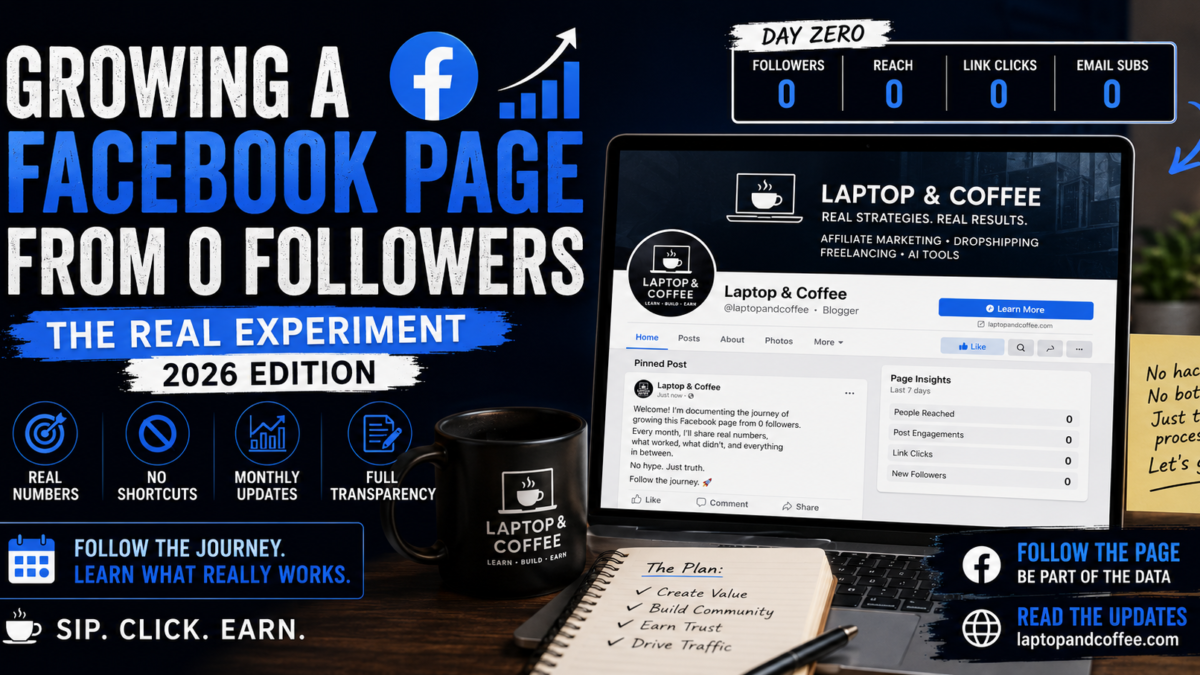
Here’s what the page looks like on day one:
The baseline. It only goes up from here. Probably.
What’s already set up before the experiment starts:
- Profile picture and cover image matching the blog’s branding
- Complete About section with the website link
- “Learn More” action button pointing to the blog
- A pinned intro post explaining who I am and what this page is about
- Four seed posts, so the page doesn’t look abandoned to the first visitor
That’s it. No audience, no head start, no personal-profile fame to lean on. Starting stats: 0 followers, 0 reach, 0 link clicks.
The Content Plan (The Part You Should Steal)
This is the exact system I’m committing to. Not “post consistently and provide value” — the actual mechanics.
Posting schedule: 2–3 posts per week
Not daily. I run two ecommerce brands and this blog — a daily posting schedule is how experiments die in week three. Two to three quality posts a week is sustainable for months, and this experiment needs months.
Four post formats, rotated
- Native value posts — a complete tip or insight that’s useful without clicking anything. These build trust before I ask for a single click.
- Question posts — genuine questions to my (currently imaginary) audience. Comments are the strongest reach signal Facebook has, so these do the heavy lifting for everything posted after them.
- Blog repurposing — when I publish a new article, it gets rewritten as a native post with a hook and a takeaway. Never just a headline and a URL.
- Behind-the-scenes honesty — what I’m working on, what broke, what surprised me. The stuff polished pages don’t post.
Links go in the first comment
Facebook demotes posts with external links, especially from new pages with no track record. So the post delivers the value, and the link waits in the first comment for anyone who wants more. Is it a workaround? Yes. Does everyone serious about Facebook do it? Also yes.
Group sharing, done carefully
With zero followers, the page itself has no distribution. Early reach has to come from relevant groups — freelancing, side income, blogging communities. The rule: lead with genuinely useful answers and content, share links only where group rules explicitly allow it. Getting banned from ten groups in week one is not a growth strategy.
The Rules I’m Setting for Myself
For this experiment to be worth anything, it needs constraints:
- No buying followers. Obvious, but worth stating.
- No engagement pods. Fake comments produce fake data.
- No ads — for now. This is an organic experiment. Paid might come later, as its own clearly-labeled phase.
- No cherry-picked screenshots. Monthly updates show the full dashboard, not the one good day.
- No quitting quietly. If I stop, I’ll write the post explaining why. Abandoned experiments teach nothing.
What I’m Measuring (And What I’m Ignoring)
Every monthly update will report four numbers:
- Followers
- Total reach
- Link clicks to the blog
- Email subscribers who came from Facebook
Notice what’s not on the list: likes. Likes are the most seductive and least meaningful metric on the platform. A post can get 200 likes and send zero people to the blog. Likes don’t pay hosting bills. Clicks and subscribers do.
My Prediction (In Writing, So I Can’t Deny It Later)
Here’s my honest guess, written before any data exists:
In 90 days: 100–150 followers, and fewer than 50 clicks to the blog.
If that sounds unimpressive, good — that’s the honest baseline for organic Facebook growth from zero in 2026. If I beat it, we’ll dig into what worked. If I miss it, that’s a finding too. Either way, you get numbers you can actually calibrate your own expectations against, instead of someone’s “0 to 10K in 30 days” fantasy.
Follow the Experiment
Two ways to watch this play out:
1. Follow the Facebook page — you’ll literally be part of the data.
2. Subscribe to the blog — every monthly update lands here first, with the full numbers and what I’d do differently.
Month 1 results drop in about 30 days. See you then — hopefully with more than zero followers.
Sip. Click. Earn. ☕