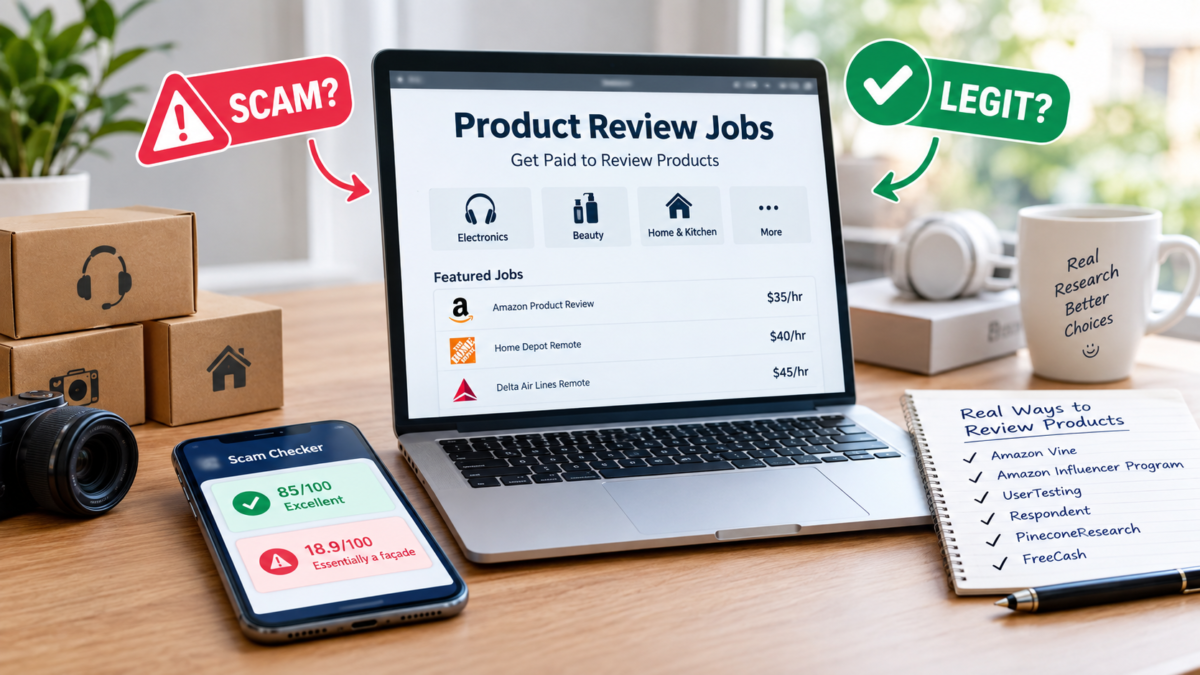
If you’ve searched “product review jobs” and landed here, you’ve probably already noticed something odd: the trust checkers can’t agree. Run the same site through two different scam scanners and you’ll get “85/100, excellent” from one and “18.9, essentially a façade” from another. That’s not you doing something wrong — the sites themselves genuinely sit in a gray zone, and it’s worth understanding why before you hand over your information.
Skip straight to what actually pays →
Quick note: some links below are affiliate links, which cost you nothing extra. Full details in the disclosure at the bottom.
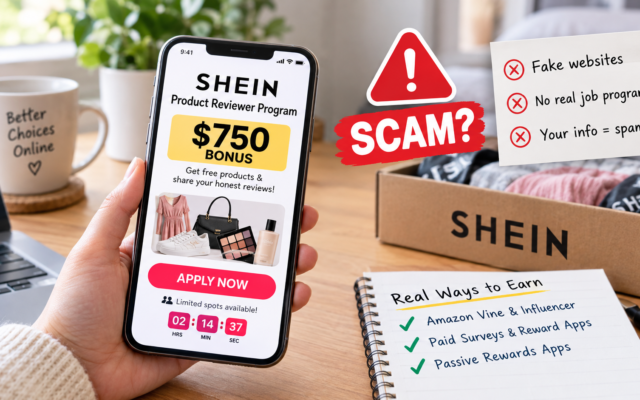
This isn’t the first time we’ve run into this exact pattern — see our Shein Product Reviewer investigation for another version of the same brand-attachment scam template.
What “Product Review Jobs” Sites Actually Are
A couple of sites use names close to “Product Review Jobs” and “Product Reviewer Jobs” as their actual brand — not just a description of the work. They present as job boards: sign up, pick product categories you’re interested in (beauty, gadgets, home goods), and get matched to paid review opportunities.
Here’s what doesn’t add up. On one of these sites, the “product review” listings sit right alongside unrelated stubs like “Home Depot Remote — $40/hr” and “Delta Air Lines Remote — $45/hr.” Real employers don’t post through a random product-review aggregator; when a big, recognizable brand name shows up next to an implausibly easy hourly rate, that’s a pattern worth being suspicious of, not reassured by.
The signup flow itself raises questions too. One documented account of signing up describes being asked about personal medical conditions — depression, asthma — as part of what’s framed as a simple product-category preference form. A genuine product-testing platform doesn’t need your health history to send you a skincare sample.
Why the Scam Checkers Disagree
Automated trust scores mostly measure surface signals — domain age, server reputation, SSL certificates, whether the site’s been flagged before. A site can score well on all of that while still running a low-value lead-gen operation, because those signals don’t actually read the content of what’s being collected or promised. That’s why you’ll see wildly different verdicts across different checkers for the exact same site — treat any single automated score as one data point, not a verdict.
Red Flags Worth Watching For
- Job listings for major, recognizable brands (Amazon, Disney, Home Depot, Delta) mixed in with generic “product review” postings — legitimate brand hiring doesn’t route through a random aggregator
- Being asked for health or medical information during what’s framed as a product-preference signup
- No clear, named parent company or verifiable business behind the site
- Vague hourly rates ($35–45/hr) attached to work requiring no experience, no portfolio, and no application process
What Actually Pays for Reviewing Products
Amazon Vine. Amazon’s own invite-only reviewer program — free products in exchange for honest reviews, no cash payout, but it’s genuinely from Amazon, not a third-party aggregator, and you’ll never be asked about your health to join.
Amazon Influencer Program. Commission-based, tied to your own storefront — a real, verifiable path if you already have some following, even a small one.
Paid usability and product testing platforms. Services like UserTesting and Respondent pay for structured feedback sessions on apps, websites, and products — a real, transparent process with a visible company behind it, not a vague “sign up and get matched” flow.
If straightforward extra cash is the actual goal rather than product reviewing specifically, these are legitimate, transparent platforms — no health questions, no mystery brand-name job stubs:
| Platform | Best for | Region |
|---|---|---|
| FreeCash | Quick tasks and offers, fast payouts | US, UK |
| Nielsen Pulse | Passive earning, runs in the background | US, mobile |
| Nielsen Computer Panel | Same trusted Nielsen brand, desktop-based | US |
| Pinecone Research | Established survey panel, double opt-in verified | Canada |
| Survey Authority | Straightforward survey signups | US |
| Survey Club | Mobile-first, iOS survey app | US, Canada |
| King Opinion | Broadest availability if the above don’t cover you | US, CA, UK + more |
| Surveoo | Alternative broad-coverage option | US, CA, UK + more |
FAQ
Are product review jobs legit?
Some paths are genuinely legit — Amazon Vine, the Amazon Influencer Program, and established usability-testing platforms. Sites branded specifically as “Product Review Jobs” or similar aggregators show real red flags worth taking seriously before signing up.
Why do different scam checkers give different verdicts on the same site?
Automated trust scores mostly measure surface-level signals like domain age and server reputation, not what’s actually being collected or promised on the site — so scores can vary widely between tools for the same site.
Are Amazon product review jobs real?
Amazon’s own Vine and Influencer programs are real and run directly through Amazon. Third-party sites using “Amazon” in job listings without being Amazon itself are worth extra scrutiny.
What personal information should a legitimate product review platform ask for?
Basic contact info and product category preferences are normal. Being asked about medical conditions or health history for a general product-review signup is not.
Affiliate & Referral Disclosure: Some links in this post are affiliate or referral links, which means we may earn a small commission if you sign up through them — at no extra cost to you. We only recommend platforms we have researched and believe are legitimate. No hype. Just truth. Sip. Click. Earn.