
It’s 11 PM and you’re three tabs deep. One review says OneForma paid them reliably for two years straight. Another says their account got deactivated overnight, no explanation, and support never wrote back. Same platform, two completely different stories.
That split is real, and it’s not random. We dug into the actual pattern behind it — who OneForma really is, what it pays, and exactly where the risk sits — so you can decide with your eyes open instead of guessing at midnight.
Only care about the trust question right now? Skip straight to Is OneForma Legit? →
What OneForma actually is
OneForma is a crowdsourcing platform that pays regular people for short tasks that train AI — labeling images, checking search results, recording your voice, translating short phrases. Think of it as a gig board, except instead of driving someone across town, you’re teaching a computer what a stop sign looks like.
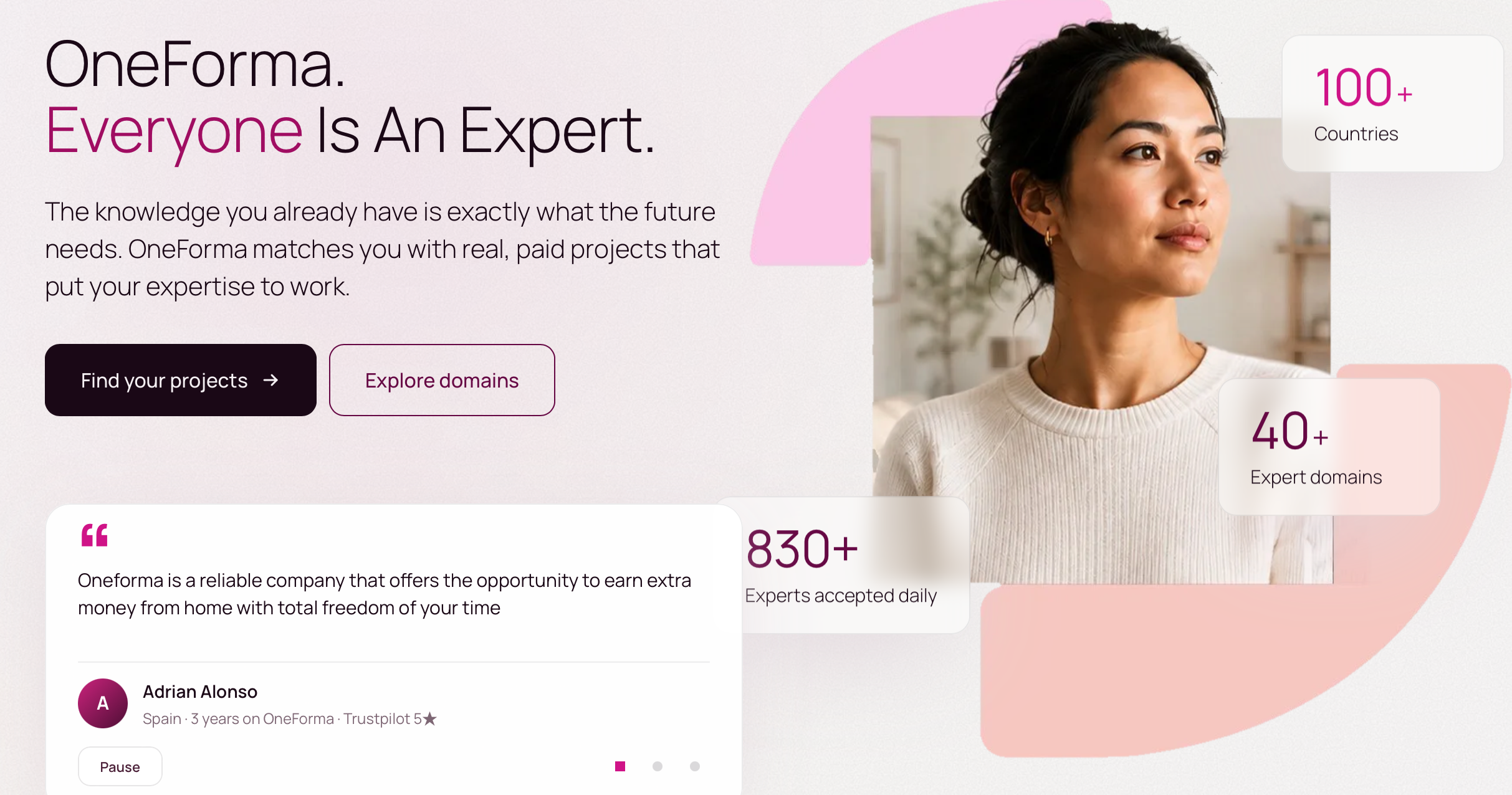
It’s owned by Centific, a global AI data services company that rebranded from Pactera EDGE in January 2023 (and before that, was just Pactera). If you spot “OneForma by Centific” or “OneForma Pactera EDGE” while researching, that’s not a scam mix-up — same company, post-rebrand. Centific is headquartered in Redmond, Washington, works with 100+ Global 500 clients, and OneForma itself leans on a contributor base north of 1.8 million people across 230+ countries working in 150+ languages. This isn’t some fly-by-night operation with a landing page and nothing behind it.
Quick note: this post doesn’t currently carry an OneForma affiliate link — we’re not paid a cent either way on this one, so there’s zero incentive to oversell it to you.
Is OneForma legit, or should you worry?
Short answer: yes, it’s a real company that pays real people. It is not a “take your money and vanish” scam. But legit doesn’t mean drama-free, and pretending otherwise would be exactly the kind of hype we don’t do here.
The good side. Plenty of long-term contributors do stick around — one Trustpilot reviewer described four straight years of a positive experience before running into a payment dispute. People who land on a well-run project and stay reachable by their project manager tend to have the smoothest experience.
The part nobody sugarcoats. OneForma’s Trustpilot page runs several hundred reviews deep and skews negative overall. The complaints cluster around three things: account deactivations that arrive with a vague reason like “suspicious activities” and little follow-up even after multiple support contacts; rate corrections that get acknowledged by a project manager but then don’t actually show up in the next payment cycle; and general slowness or silence from support when something goes wrong. One reviewer also flagged that Tipalti payouts pass transaction fees on to the worker, which is worth knowing before you pick a payment method.
To be fair, OneForma does respond to reviews publicly and pushes back on the scam framing directly: their standard reply states they “always pay for valid, approved work” and directs people to email account-review@oneforma.com to resolve issues. That’s a real channel, even if response speed is the sticking point people report most.
Our honest take: OneForma is legit but the review pattern is genuinely more concerning than most platforms in this category — closer to “proceed carefully” than “sign up worry-free.” Treat it as a side project, not your main income, and keep at least one other platform in rotation so a payment dispute or deactivation doesn’t wipe out your month.
How much OneForma actually pays
There’s no public rate card, and here’s the honest part: the spread is wider than most reviews let on. Rates are set per project, so the same task type can pay very differently depending on which project you land. Real contributor-reported figures range from around $9–$15/hour on solid annotation and transcription projects, down to fractions of a dollar per hour on poorly-scoped ones — one documented case worked out to roughly $0.115/hour. Some projects pay per segment (around $2/segment on one reported project) or in local currency instead of USD.
Translation: roughly $0.03–$0.10 per source word, depending on the language pair.
Transcription: roughly $0.50–$1.25 per audio minute on typical projects.
Voice recording: roughly $5–$20 per session, depending on script length.
AI data annotation: anywhere from under $1/hour to $12–$15/hour equivalent — read the project’s per-task or per-segment rate carefully before you commit hours to it, since the posted rate is the only number you can actually trust in advance.
Rarer languages tend to pay noticeably more because there’s less competition for qualified contributors. Payment goes out through Payoneer (the default method) or Tipalti, or PayPal — but PayPal is capped at $300 per calendar year with a $10 minimum payout balance, so if you plan to earn more than that, set up Payoneer or Tipalti from the start. Payments run on a monthly cycle, not instantly, so don’t expect same-week cash if you’re used to gig-app payouts.
How to sign up and log in
Signing up is free. If anyone ever asks you to pay to “activate” a OneForma account, that’s not the real platform — close the tab. The actual flow looks like this:
1. Create your account on the official OneForma site and fill out your profile.
2. Browse available projects. Availability varies a lot by country and language, so don’t be surprised if your list looks different from someone else’s.
3. Pass the qualification test for whichever project you want in. This is standard across the industry, not a OneForma-specific red flag.
4. Complete tasks, get them reviewed, and get paid on that project’s cycle.
Set your expectations on timing before you start: approval can involve several stages of review and reports of the full process taking months rather than weeks aren’t unusual. Applying to more than one project at once is a reasonable way to keep your wait times overlapping instead of stacked end to end.
Once you’re registered, logging back in is just your email and password through the same portal. If you ever lose access unexpectedly, that ties straight back to the deactivation pattern flagged above — worth knowing before you invest real hours into certifications.
Create a free OneForma account →
Direct link — not an affiliate link. Signing up costs nothing.
OneForma jobs and task types
“OneForma jobs” is a bit of a misnomer — you’re not hired as an employee, you’re qualifying for individual freelance projects one at a time. Once you’re in, you’ll typically see:
Search and relevance evaluation — rating how well search results match a query.
Data annotation — labeling text, images, or audio for AI training.
Transcription and voice recording.
Translation and linguistic QA.
Content moderation and data collection projects.
Transcription and voice recording tend to be the easiest entry point if you’re brand new to this kind of work. Annotation and linguistic QA usually want more specialized skill, but they pay better once you’re qualified.
☕ Related on Laptop & Coffee
OneForma isn’t the only crowdsourced AI training platform worth comparing pay and trust signals against. If you haven’t looked at how it stacks up, Is DataAnnotation.tech Legit? 2026 Review covers a platform with a cleaner support reputation, and Freelance AI Training Jobs for Beginners rounds up the realistic pay ranges across this whole category.
Is OneForma right for you?
OneForma makes the most sense as a side hustle, not a primary income plan — especially if you speak a less common language, since that’s where the pay actually gets good. It’s a reasonable starting point if you’re brand new to AI training work and want an easy sign-up with plenty of task variety.
If account stability matters more to you than task variety, weigh that deactivation pattern seriously before you put real hours into qualification tests. There’s no dashboard or support line that speeds up a resolution if your account gets flagged.
Everything in this category — OneForma included — shares the same weakness. The moment you stop working, the money stops. You’re trading hours for dollars, just from your kitchen table instead of an office. A blog works differently: written once, it keeps earning long after publish day. It takes months before the first real dollar and most people quit too early, but the cost of starting is small. Do the task work for income today, and put an hour a week into building something that doesn’t need you to keep showing up.
FAQ
Is OneForma legit or a scam?
It’s legit — owned by Centific, an established AI data services company that pays for approved work. It’s not a scam, but its Trustpilot review pattern skews negative, with recurring complaints about account deactivations and slow-to-resolve payment disputes, so go in with patience and a backup platform in mind.
Is OneForma free to join?
Yes. Signing up and browsing projects costs nothing. Never pay anyone to “activate” your account — that’s not how the real platform works.
What’s the difference between OneForma and Pactera EDGE?
None — they’re the same company. Pactera EDGE rebranded to Centific, and OneForma is Centific’s crowdsourcing platform.
How do I contact OneForma support?
Through the platform’s in-account help channels and email support tied to account and payment issues. Response times are a known weak point, so give it time and follow up rather than expecting an instant reply.
How does OneForma pay?
Through Payoneer, Tipalti, or PayPal, typically on a monthly cycle rather than instant payout. PayPal is capped at $300 per year with a $10 minimum payout, so higher earners generally use Payoneer or Tipalti instead.
Affiliate & Referral Disclosure
Laptop & Coffee is reader-supported. This post does not currently contain any OneForma affiliate or referral links — we have no financial relationship with OneForma, and nothing here changes based on whether you sign up. Some other links on this site are affiliate links, and we always say so before the link, not after. We only recommend platforms we have researched properly. No hype. Just truth. Sip. Click. Earn.