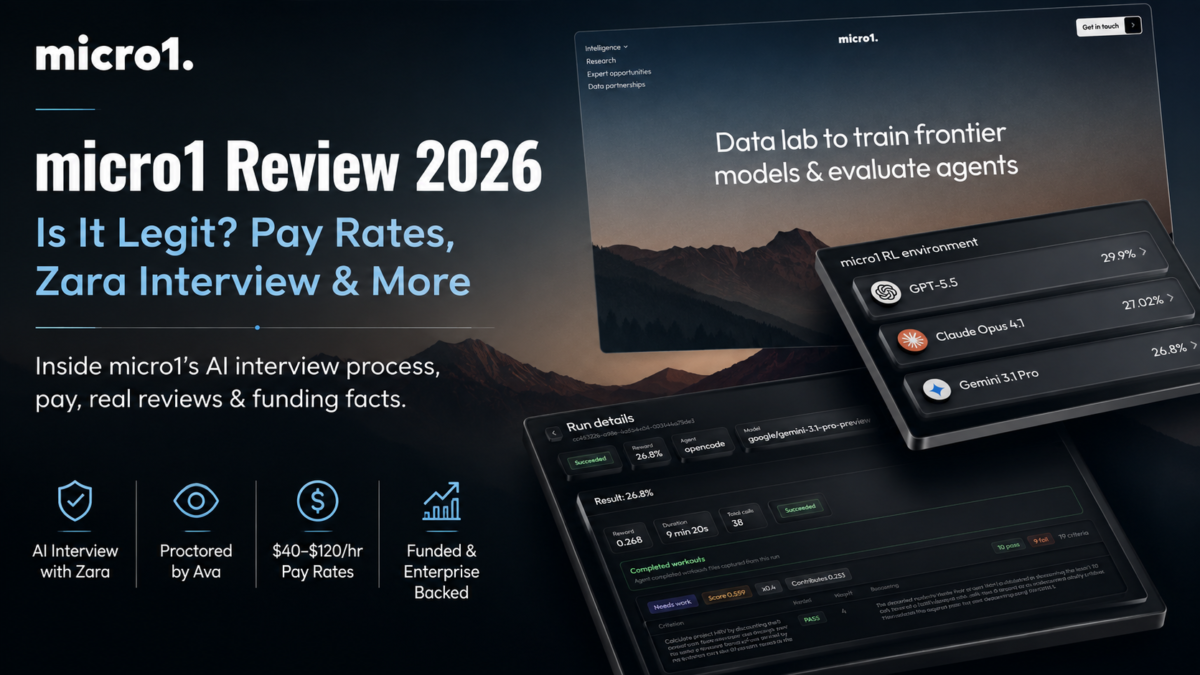
An AI avatar interviews you live, tracks your eye movements while you code, and fails you automatically if you glance at a second monitor too many times. That’s not a hypothetical — that’s the actual application process for micro1, and it’s exactly the kind of thing that makes people search “is micro1 legit” before they hand over their resume.
I dug into micro1’s funding history, how its Zara interview and Ava anti-cheat system actually work, real pay data, and what people who’ve been through the process say — including the parts that feel off. Here’s the honest breakdown.
What micro1 actually is
micro1 started in 2022 as an AI recruiting tool — an AI interviewer called Zara that screened engineering candidates for companies. It’s since pivoted hard into a different (and much bigger) business: supplying verified human experts — engineers, scientists, doctors, lawyers, linguists — whose job is to evaluate and improve AI model outputs. That’s the same category as Scale AI, Surge, and Mercor: human data for AI training, at scale.
Here’s the myth to bust up front: micro1 is not a task-based gig site where you log in and grab whatever’s available, like DataAnnotation or Outlier. It’s a vetting-first talent pool. You pass one serious interview, get “Verified,” and then you’re pushed to clients — AI labs, tech companies, Fortune 100 firms — who trust micro1’s screening enough to skip their own first round. That’s a fundamentally different model, and it changes what kind of applicant actually succeeds here.
Who’s behind it: Ali Ansari and the funding story
micro1 is led by founder and CEO Ali Ansari, a Stanford-connected entrepreneur in his mid-20s. The company’s growth is genuinely one of the fastest in this sector: it raised a $35 million Series A in September 2025 at a $500 million valuation, backed by Bain Capital Ventures and DoNotPay founder Joshua Browder joining the board. Annual recurring revenue reportedly jumped from around $7 million to over $200 million within about a year of the company’s pivot into AI training data, and by early 2026 investors were reportedly discussing a valuation as high as $2.5 billion.
Why this matters for you as an applicant: this isn’t a fly-by-night operation running out of someone’s apartment. It’s a funded, headquartered-in-Palo-Alto company with real enterprise clients including Microsoft. That doesn’t guarantee you a smooth experience — but it does answer the “is micro1 a legit company” question in the most concrete way available: real money, real board members, real clients.
The Zara AI interview, and the proctoring layer behind it
This is the part everyone actually wants to know about. The process runs in four stages:
- Resume parsing. You upload your resume; micro1’s system tags your skills (React, Python, Go, and so on) and routes you to the matching interview track.
- The Zara interview (20–30 minutes). A split-screen session — Zara’s AI avatar on one side, your live coding environment on the other. She asks adaptive technical questions: mention Kafka, and she’ll immediately ask how you handled partition rebalancing under load. You’re expected to narrate your thought process continuously; going quiet too long gets you interrupted.
- A separate proctoring layer watches the whole session. Alongside Zara, a monitoring system tracks your gaze, tab switching, and browser extensions in the background and flags mismatches between your claimed experience and how you actually perform. Some detailed accounts of the process refer to this system as “Ava” and describe a required integrity threshold of around 70% to pass — we haven’t been able to confirm that exact name or number directly from micro1, so treat it as a reported detail rather than an official spec, but the underlying mechanism (proctoring that can fail you independent of your technical answers) is corroborated across multiple candidate reports.
- Verified status. Pass, and you’re added to the talent pool and surfaced to hiring partners. You typically skip the client’s own first-round interview because they trust micro1’s vetting.
Practical prep tips, based on the corroborated parts of the process: disable any AI coding-assistant browser extensions before you start (multiple accounts describe these getting flagged), use a single monitor if you can, keep your session distraction-free, and don’t keyword-stuff technologies you can’t actually defend under follow-up questions — Zara’s adaptive questioning is specifically designed to catch that.
Real pay rates
| Role type | Typical rate | Notes |
|---|---|---|
| AI training (code tasks) | $40–$60/hr | Code review, RLHF, solution evaluation |
| Frontend / full-stack engineer | $50–$90/hr | Direct client placement via talent pool |
| ML / AI engineer | $70–$120/hr | AI lab clients, model training work |
Top-end rates go to strong interview scores matched with premium clients — new profiles typically start toward the lower end of each range. These numbers are genuinely competitive for engineers outside North America, which is where micro1 recruits most actively: Latin America, South Asia, Southeast Asia, and Eastern Europe.
Is micro1 legit?
Short answer: yes. It’s a funded, US-based company placing real developers with real clients — the AI interview format and anti-cheat monitoring are genuine, not a front for something else. But “legit” and “frustration-free” aren’t the same thing, and it’s worth being straight about both sides.
What’s solid: verifiable funding rounds, named investors and board members, documented enterprise clients, and consistent reporting across independent review sites that placements are real.
What people flag as frustrating: the matching process after you pass is opaque — there’s no dashboard showing where you sit in the placement queue, and some verified candidates wait weeks without updates. The interview itself is genuinely one of the harder formats in this space; qualified engineers do fail it, often on format rather than skill. And as with any platform requesting ID or documents, don’t upload official identification until you’ve had contact with a real person and have something in writing — that’s just sound practice with any hiring platform, not a micro1-specific red flag.
Who should sit this out
- You’re not a developer or ML/technical specialist — micro1 is heavily engineering-focused, and non-technical applicants have very limited paths here.
- You need guaranteed, on-demand work right now — this is a talent pool you get matched from, not a task queue you can log into daily.
- You want peer support or community while you work — there’s no Slack or community channel; you go through the process solo.
- You’re not ready to defend every technology you mention under live, adaptive follow-up questioning — Zara is specifically built to catch surface-level knowledge.
If any of those describe you better than “confident engineer, ready for a tough one-shot interview,” a task-based platform like DataAnnotation or Outlier is a gentler starting point.
How to apply
- Create your profile and upload your resume — be specific about your actual stack, since this determines your interview track.
- Prep your environment — single monitor, no AI coding-assistant extensions, quiet space, stable connection.
- Take the Zara interview — narrate your thinking out loud continuously, and pivot immediately to follow-ups rather than backtracking or apologizing.
- Wait for verification — if you pass, you’ll be added to the talent pool. Matching can take time, so keep other applications moving in parallel.
- Respond fast once matched — client-facing opportunities move quickly once micro1 surfaces your profile.
The honest verdict
micro1 is legitimate, well-funded, and paying real rates to engineers who can pass a genuinely tough interview. It’s not the platform for casual task-based side income, and it’s not built for non-technical applicants — it’s a one-shot vetting gate for developers and ML specialists who want access to AI-lab-level clients without going through a traditional job search. If that’s you, the Zara interview is worth preparing for seriously rather than winging. If you’re looking for something you can start earning from today with lower stakes, this isn’t the right first stop.
☕ Related on Laptop & Coffee
FAQs
Is micro1 legit?
Yes. It’s a funded, Palo Alto-based company with a $500 million valuation as of its September 2025 Series A, real enterprise clients including Microsoft, and verified developer placements across multiple regions. The interview process and anti-cheat monitoring are genuine, not a cover for something else.
What is micro1?
An AI-driven talent platform that vets engineers and domain experts through its Zara AI interviewer, then supplies verified candidates to AI labs and companies — both for direct hiring and for ongoing AI model training and evaluation work.
Who is Ali Ansari?
Ali Ansari is micro1’s founder and CEO. He built the company starting in 2022, pivoted it from AI recruiting into AI training-data work in 2025, and has led its growth from roughly $7 million to over $200 million in annualized revenue within about a year.
What is micro1’s valuation?
Its most recent confirmed valuation is $500 million, set at its Series A in September 2025. Reports since early 2026 indicate ongoing funding conversations at valuations as high as $2.5 billion, though that figure isn’t a confirmed closed round.
How hard is the micro1 AI interview?
Genuinely hard. Zara asks adaptive follow-up questions based on anything you mention, and a separate proctoring layer tracks gaze, tab switches, and browser extensions — some candidate accounts describe this needing to clear an “integrity” threshold around 70% independent of your technical score, though we couldn’t confirm that exact figure directly from micro1. Many qualified engineers report failing on format and proctoring flags rather than actual coding ability.
How much does micro1 pay?
Roughly $40–$120/hour depending on role and seniority: $40–$60/hr for AI training and code review tasks, $50–$90/hr for frontend/full-stack placement, and $70–$120/hr for ML/AI engineering work with AI lab clients.
Is micro1 only for developers?
Effectively, yes. The vetting track is built around software engineering and ML roles. Non-technical professionals have very limited opportunities on this specific platform.
Sources: micro1 (micro1.ai, micro1.ai/series-a, micro1.ai/experts), TechCrunch, Forbes, Tracxn, aitrainer.work, eesel AI, andrew.ooo, startupintros.com, CareerSwift (Medium), Capterra, Trustpilot, and an academic paper on Zara co-authored by micro1’s team (arXiv). Funding and pay figures checked 2026; interview-process details cross-checked against multiple independent candidate accounts.