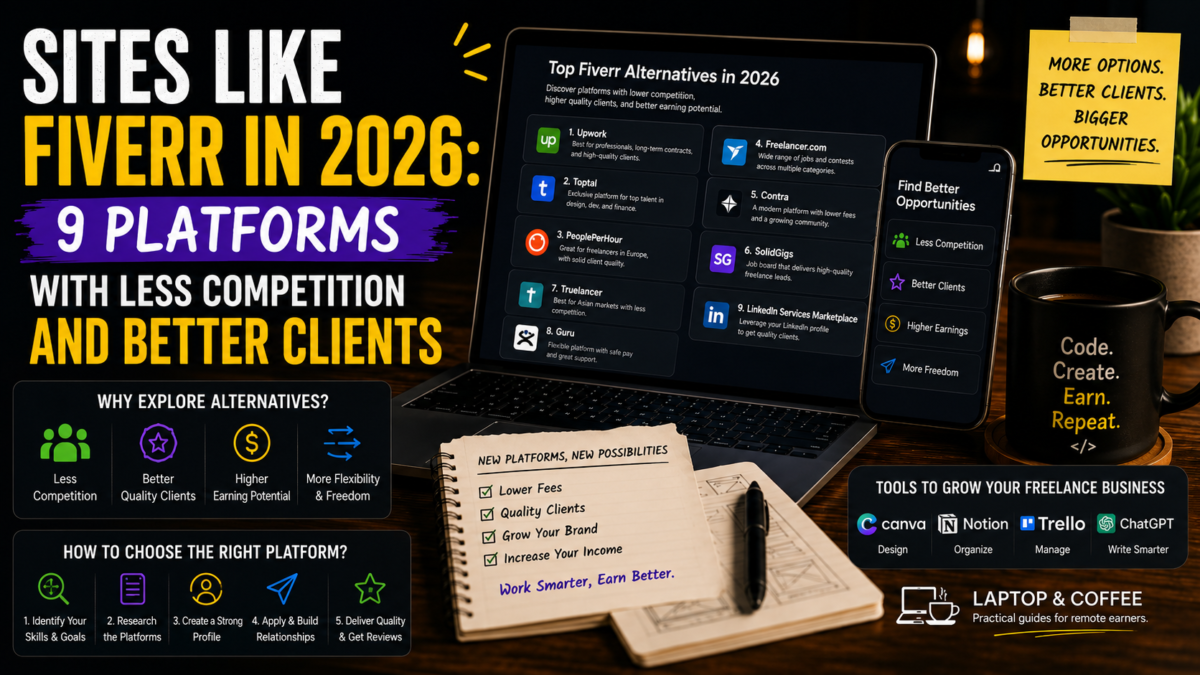
Open Fiverr right now and search “logo design.” You’ll find tens of thousands of gigs competing for the same buyers, many priced so low they barely cover the electricity bill. That’s the real reason freelancers go looking for websites like Fiverr — not because Fiverr is broken, but because standing out there has become a full-time job on top of your actual full-time job.
I’ve been on both sides of this. I sell freelance services across multiple marketplaces, and I’ve watched skilled people give up because their gig sat at zero impressions for a month. So this post is built around one simple filter: which sites similar to Fiverr genuinely give you a smaller crowd to compete against and clients who pay like professionals? I tested each platform below, dug into how its marketplace actually works, and I’m laying it out with no hype — just what you’d tell a friend.
Why Websites Like Fiverr Can Offer Less Competition (It’s Not Magic)
Before the list, it helps to understand why some platforms are less crowded, because it tells you which one will work for your situation. Websites similar to Fiverr reduce competition in four ways:
- Approval gates. Some platforms review every freelancer application. Fewer approved sellers means fewer rivals per job.
- Niche focus. A marketplace serving only SEO buyers or only design clients naturally has a smaller, more relevant seller pool.
- Serious-buyer pricing. When clients pay posting fees, subscriptions, or minimum project prices, bargain hunters leave — and the freelancers chasing $5 orders leave with them.
- Effort barriers. Platforms where winning work takes a proper proposal or portfolio filter out the copy-paste crowd automatically.
Every platform on this list uses at least one of these filters. That’s what “less competition” actually means in practice — a barrier that you can clear but the lowest-effort sellers can’t. Now let’s get into it.
9 Best Sites Similar to Fiverr for Serious Freelancers in 2026
1. Upwork — Better Clients Than Fiverr, If You Put in the Work
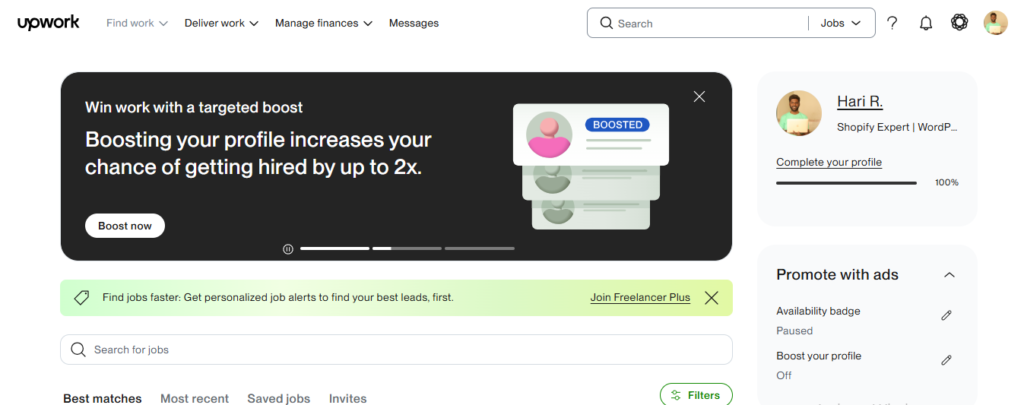
Upwork isn’t less crowded than Fiverr in raw numbers — it’s less crowded where it counts. The platform runs on proposals: clients post jobs, freelancers apply with a tailored pitch. Every proposal costs Connects (small paid tokens, $0.15 each, with most jobs needing 2–16 of them), and that tiny price tag does something remarkable — it makes lazy mass-applying expensive. Write ten genuinely targeted proposals and you’re often competing against a handful of serious applicants, not ten thousand identical gigs.
Key Features of This Website Like Fiverr
- Job feed with filters — search by budget, client history, and payment verification, so you can target clients who’ve already spent thousands on freelancers
- Project Catalog — Fiverr-style packaged services, letting you run the gig model and the proposal model from one profile
- Hourly payment protection — a built-in time tracker that guarantees you’re paid for logged hours
- Milestone escrow for fixed-price projects, plus real dispute resolution
- Fair 2026 fees — a variable service fee of 0–15% per contract (most freelancers pay around 10%), shown before you apply and locked once the contract starts
Best for: writers, developers, marketers, and virtual assistants who want long-term clients. The businesses hiring here are staffing real projects — a completely different buyer than the $5 crowd.
2. PeoplePerHour — The Approval Gate That Works in Your Favor
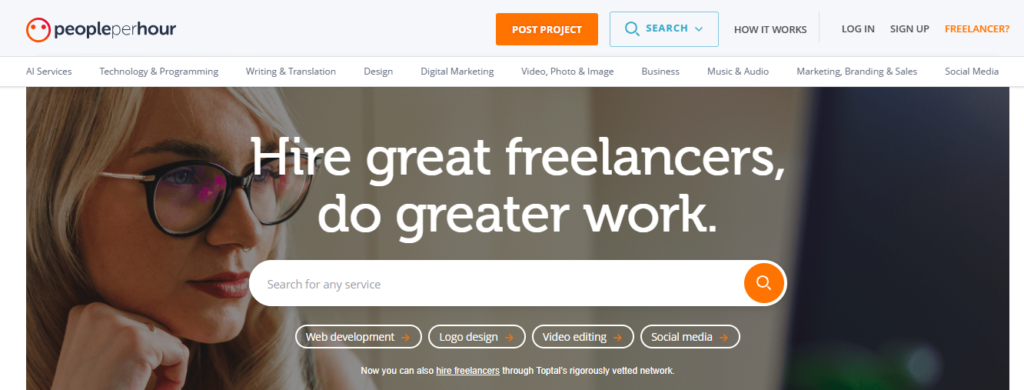
Here’s a filter Fiverr doesn’t have: PeoplePerHour reviews and approves every freelancer application. Yes, that means you might get rejected on a weak profile. It also means everyone who made it through is competing in a dramatically smaller pool than Fiverr’s open-door marketplace. The client base leans heavily toward UK and European small businesses — buyers who are used to paying professional rates in pounds and euros.
Key Features of This Site Similar to Fiverr
- Offers — pre-packaged services that work almost exactly like Fiverr gigs, so your existing gig descriptions transfer over easily
- 15 free proposals per month to bid on posted projects, with more available on paid plans
- Loyalty-based fees — roughly 20% on the first ~$335 billed to a client, dropping to 7.5%, then just 3.5% as your lifetime billing with that client grows. Long relationships get genuinely cheap
- Escrow protection on funded projects and an invoicing system built for repeat work
Best for: web designers, copywriters, and SEO specialists who want European clients and retainer-style relationships. Polish your application like it’s a job interview — because it is one.
3. Guru — The Quiet Marketplace Nobody’s Fighting Over

Guru has been around since 1998 — older than Fiverr itself — but it never chased viral growth, and that’s exactly why it belongs on this list. Fewer freelancers actively work the platform, which means each job posting attracts a fraction of the applicants you’d fight through elsewhere. Lower traffic cuts both ways, of course: fewer jobs overall. But as a second platform, the math is beautiful — less effort per win, and fees so low they feel like a typo.
Key Features
- 5–9% service fees depending on membership — among the lowest of any full marketplace, versus Fiverr’s flat 20%
- WorkRooms — dedicated spaces per project for files, messages, and milestones, which clients with ongoing work genuinely appreciate
- SafePay escrow — client funds are secured before you start
- Flexible payment terms — fixed price, hourly, task-based, and recurring retainers, a combination most websites similar to Fiverr don’t offer
Best for: programmers, engineers, admin professionals, and anyone who’d rather be a big fish in a calm pond than one of a million in Fiverr’s ocean.
4. Contra — A Newer Platform, a Smaller Crowd, and 0% Commission
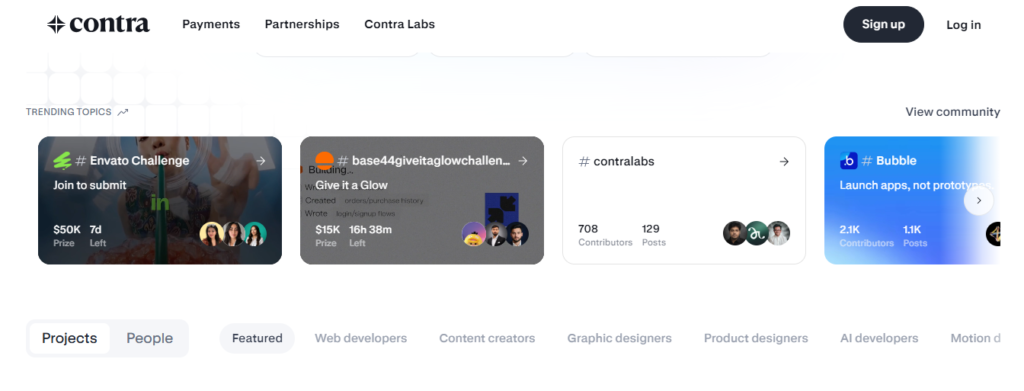
Contra is the youngest platform here, and being early matters. The freelancer pool is still small compared to the giants, the marketplace skews toward design, content, marketing, and no-code work for startups — and the clients arriving there tend to be modern companies specifically avoiding the race-to-the-bottom marketplaces. On top of that, Contra takes 0% commission from freelancers. It earns from client-side subscriptions and tools instead, so the money you quote is the money you keep.
Key Features
- Portfolio-first profiles — visual, modern pages good enough to double as your personal website
- Packaged services — gig-style listings, familiar territory if you’re coming from Fiverr
- 0% freelancer commission on everything you earn
- Flexible work types — projects, retainers, and even part-time roles with startups
Best for: designers, content creators, social media managers, and no-code builders. Don’t rely on it alone yet — the client pool is still growing — but claim your spot before the crowd arrives. Early always wins on marketplaces.
5. Legiit — The Niche Site Like Fiverr for SEO and Marketing
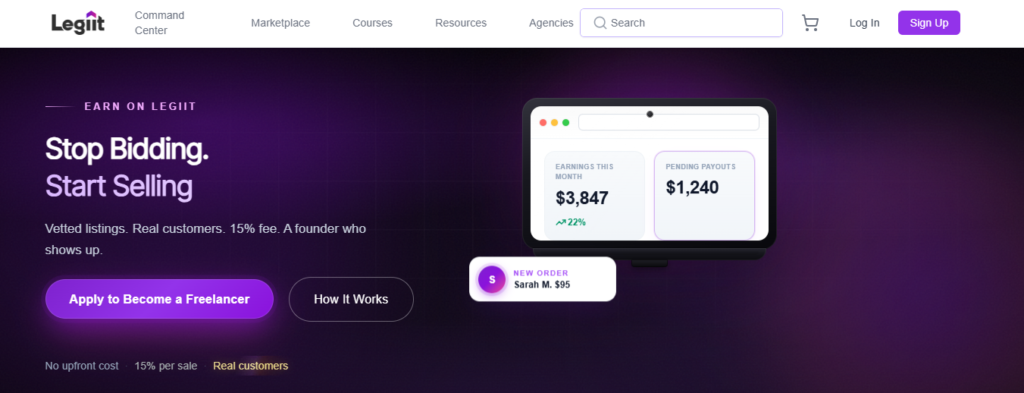
Legiit is what happens when someone builds a marketplace like Fiverr but points it at one audience: the SEO and digital marketing world. The structure will feel instantly familiar — service listings, packages, buyer reviews — but the buyers are agency owners, affiliate marketers, and website flippers. These are people who purchase the same services every month: content packages, link building, technical audits, web design. One good agency client here can quietly become recurring revenue that outearns a dozen random Fiverr orders.
Key Features
- Fiverr-style service listings with tiered packages — your existing gig copy transfers with minor edits
- A concentrated niche — far fewer sellers per category than Fiverr’s open marketplace
- Repeat-buyer client base — agencies and affiliates who order monthly, not once
- Active community — groups, events, and direct seller visibility that a mega-marketplace can’t offer
Best for: SEO specialists, link builders, content writers, and web designers serving the affiliate and agency world. If that’s your lane, this is the least crowded room you’ll find.
6. 99designs — Where Design Clients Come With Design Budgets
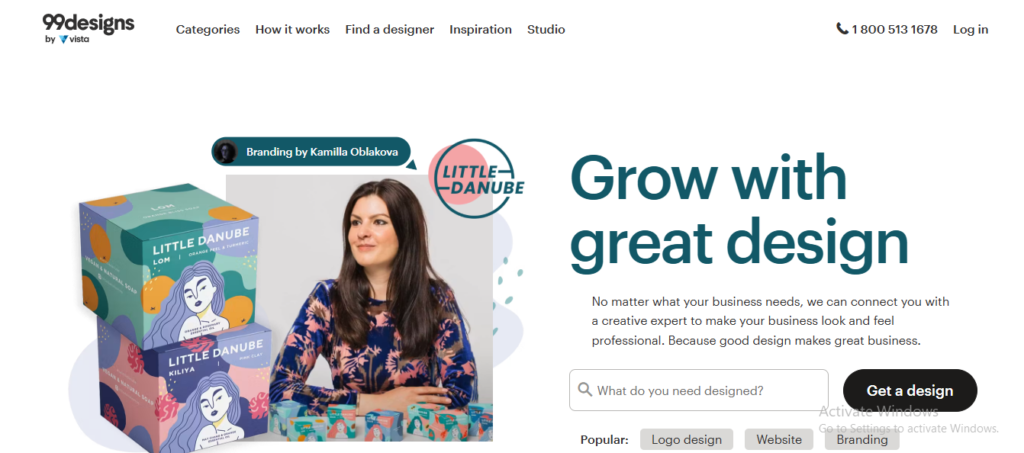
99designs filters clients with the most effective barrier there is: price. Design contests start around $299 and premium branding briefs run past $1,000, which means the $5-logo buyer never even walks through the door. Every client you meet on this website similar to Fiverr has already committed real money before seeing a single design. On the freelancer side, designers are ranked into Entry, Mid, and Top levels based on work quality — and as you climb, you’re invited to higher-paying briefs with fewer competitors.
Key Features
- Design contests — clients post paid briefs, designers submit concepts, the winner takes the prize
- 1-to-1 Projects — direct hiring, which is where repeat income actually lives
- Designer level system that rewards quality with access, not just badges
- Design-only categories — logos, branding, packaging, web, book covers — so clients arrive knowing exactly what professional design costs
Best for: logo and brand identity designers with a solid portfolio. Fair warning: losing a contest means unpaid work, so treat early contests as portfolio-building and move winners to direct projects fast.
7. Toptal — The Least Competition of Any Platform Like Fiverr (For a Reason)
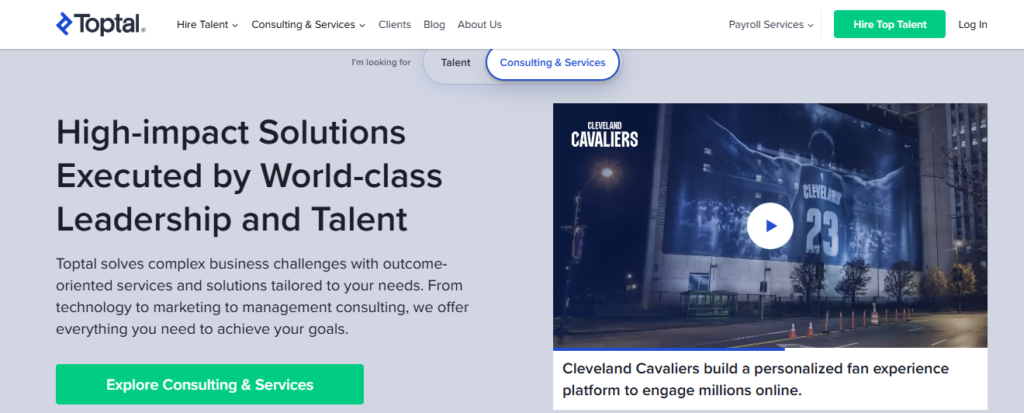
Want to see competition drop to nearly zero? Toptal accepts roughly 3% of applicants through a screening process — language evaluation, skill assessments, live problem-solving, and a test project — that takes two to five weeks. Once you’re in, there’s no bidding at all. Toptal matches you with clients directly: funded startups and enterprise companies paying rates that commonly run $80 to $230+ per hour.
Key Features
- Top-3% vetting — the ultimate competition filter, applied before you ever see a client
- Direct matching — no proposals, no gigs, no racing anyone to the bottom
- Enterprise-grade clients in software development, design, finance, and project management
- Premium rates built in — you negotiate from strength because the platform already certified your skill
Best for: senior developers, UI/UX designers, and finance experts with 3+ years of serious experience. Beginners should bookmark it as the destination, not the starting point — and that’s honest advice, not gatekeeping.
8. Freelancer.com — Crowded Overall, Underrated in the Corners
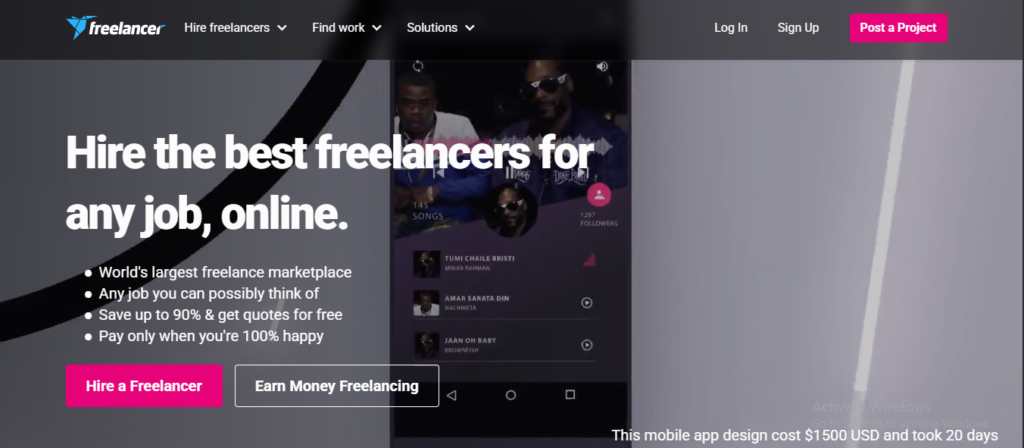
I’ll be straight with you: Freelancer.com’s popular categories are just as crowded as Fiverr’s. It earns its place on this list for the corners — specialized technical niches like CAD drafting, embroidery digitizing, GIS mapping, and scientific work, where posted projects attract a handful of qualified bids instead of hundreds. If your skill is unusual, this is one of the few websites like Fiverr where unusual is an advantage.
Key Features
- Massive category range — including technical niches most platforms don’t touch
- Contests — submit finished work to paid briefs; a real portfolio-builder for beginners
- Milestone payment system to protect fixed-price projects
- ~10% freelancer fee on projects — half of Fiverr’s cut, though watch for membership upsells and bid limits on the free plan
Best for: freelancers with specialized technical skills, and beginners using contests to build a portfolio from zero.
9. LinkedIn Services Marketplace — Zero Marketplace, Zero Gig Competition
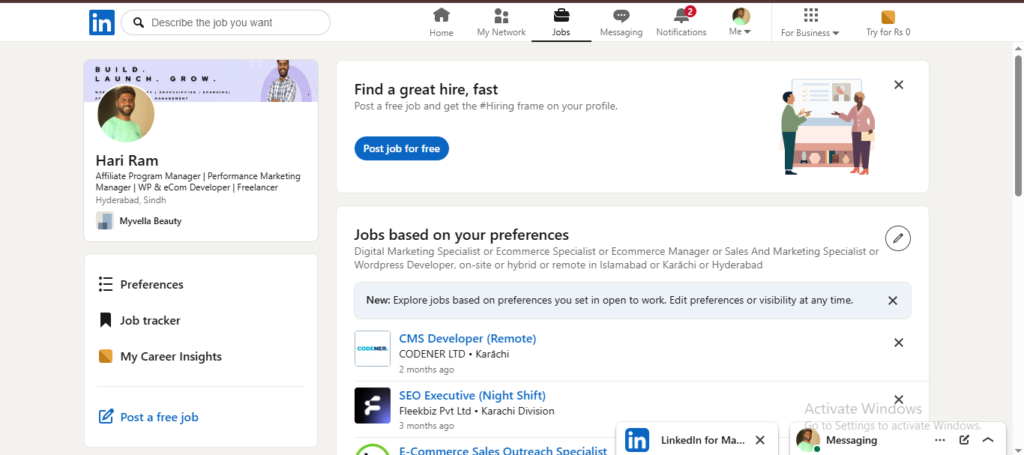
This last one bends the rules, and I’m including it anyway because it solves the competition problem completely. LinkedIn’s Services Marketplace lets you add a free “Providing services” section to your profile, making you discoverable across a network of over a billion professionals. There’s no gig ranking to fight, no algorithm burying you under cheaper sellers — clients find you, usually through search or your content. The trade-off: LinkedIn only makes the introduction. Contracts, invoicing, and payment protection are entirely on you.
Key Features
- Free service page attached to the profile you probably already have
- 0% commission — LinkedIn takes nothing from your earnings
- B2B client quality — people searching for services on LinkedIn are overwhelmingly businesses with budgets
- Content leverage — every post you publish doubles as marketing for your services page
Best for: established freelancers in consulting, marketing, writing, and development who can run their own contracts. Ten minutes to set up, costs nothing, and works while you sleep.
How to Choose Between These Websites Similar to Fiverr
Match the platform’s filter to your strength. Here’s the shortcut version:
- Great at writing proposals? → Upwork. The effort barrier is your moat.
- Strong portfolio, want European clients? → PeoplePerHour. The approval gate keeps the crowd out.
- Want low fees and calm waters? → Guru. Less traffic, less competition, more kept earnings.
- Modern creative or no-code skills? → Contra. Small pool, startup clients, 0% commission.
- SEO or marketing services? → Legiit. A niche marketplace full of repeat buyers.
- Designer with proof of skill? → 99designs. The $299+ entry price filters your clients for you.
- Senior specialist? → Toptal. Three percent get in; the rest of the internet stays outside.
- Rare technical skill? → Freelancer.com’s quiet corners.
- Already have a professional network? → LinkedIn Services. No marketplace, no competition, no fees.
And my standing rule from years of doing this: pick two — one large marketplace for volume, one filtered or niche platform for margins — and work both seriously for ninety days. Spreading yourself across five sites similar to Fiverr means being invisible on all of them.
FAQs: Sites Like Fiverr With Less Competition
Which website like Fiverr has the least competition?
Toptal, by design — its top-3% vetting removes almost everyone before they reach a client. Among platforms open to all skill levels, Guru and Legiit have the smallest active seller pools relative to available work, and Contra benefits from simply being newer than the giants.
Which sites similar to Fiverr have the best clients?
Toptal and 99designs, because both use price and vetting to filter out low-budget buyers. Upwork’s client filters come next — you can specifically target clients with verified payment methods and five-figure hiring histories, something Fiverr never lets you do.
Can beginners use these websites similar to Fiverr?
Absolutely — just pick the right ones. Freelancer.com, Legiit, Guru, and Contra are all beginner-friendly. PeoplePerHour requires an approved application, and Toptal realistically needs years of experience first. Start where the door is open, build reviews, then climb.
Should I leave Fiverr for a platform like Fiverr with less competition?
Don’t leave — diversify. Keep any Fiverr gigs that are earning while you build on one or two platforms from this list. After a few months, compare what each channel pays you per hour of effort and shift your energy accordingly. Numbers make better decisions than frustration does.
Final Thoughts: Less Competition Is a Choice, Not Luck
Every freelancer on Fiverr is fighting the same fight in the same arena. The nine websites like Fiverr above each change the arena — through approval gates, niche focus, client-side pricing, or plain old effort barriers. Your job isn’t to be better than a hundred thousand competitors. It’s to pick the room where most of them never show up.
So here’s your move: choose one platform from this list today, build the profile properly — real portfolio pieces, a specific niche, a description written for buyers rather than algorithms — and give it ninety honest days. That’s it. No hype, no shortcuts, just showing up where the competition doesn’t.
Which platform are you starting with? Tell me in the comments — and if you’ve already tried any of these sites similar to Fiverr, share how it went. Your experience might be exactly what the next reader needs to hear.