Quick Answer: Is Emergent AI Worth It?
Emergent AI is a legitimate AI app builder that turns plain-English prompts into working full-stack web and mobile apps — frontend, backend, database, login, and hosting included. It genuinely works, and it’s one of the most capable tools in its category. But its credit-based pricing burns faster than beginners expect: a simple app can eat 50–100+ credits, and just keeping an app live costs about 50 credits per month. Start on the free plan, test with one small project, and only upgrade to the $20/month Standard plan once you understand how credits disappear.
How Much Does Emergent AI Cost? (Quick Answer)
Emergent pricing runs on a credit system, not flat monthly plans. Free gets you 10 credits/month — enough for one small test build. Standard is $20/month for 100 credits, the tier most solo builders land on. Pro runs $200/month for 750 credits, and Team starts at $300/month for 1,250 shared credits. The catch: just keeping one app live costs roughly 50 credits/month on its own, so real-world spend usually runs higher than the sticker price suggests. Full breakdown of what each credit actually buys you is below.
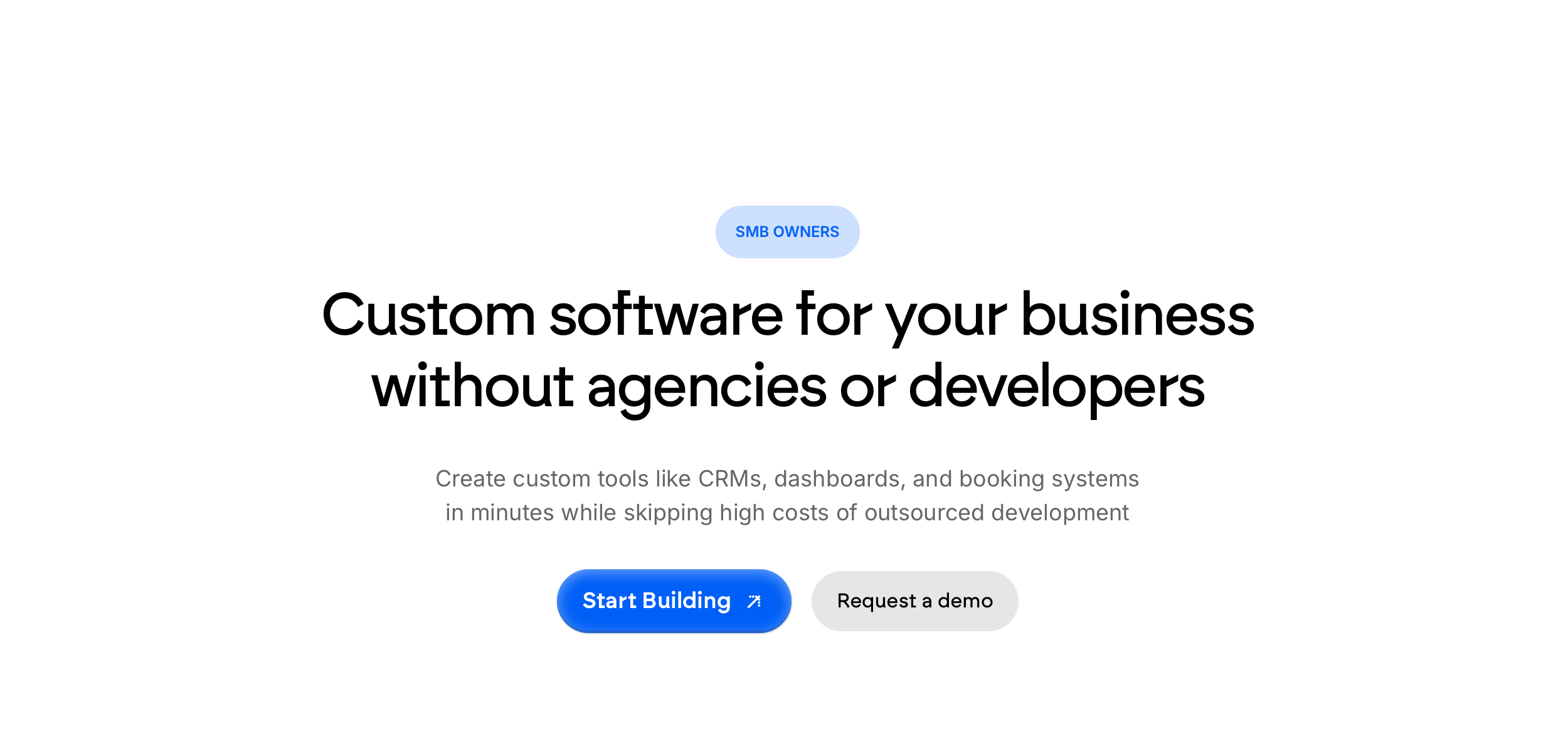 AI app builders are everywhere right now, and Emergent is one of the loudest names in the room. The pitch: describe your app idea in a sentence, and a team of AI agents plans it, codes it, tests it, and puts it live on the internet — no coding required.
I’ve built my own ecommerce stores, WordPress sites, and Shopify projects the hard way, so I’m naturally skeptical of “no-code magic” claims. I signed up for Emergent, ran it through a real test build, dug through its pricing system, and read through hundreds of user reviews — the glowing ones and the angry ones — to figure out where the truth sits.
This Emergent AI review covers what it actually does well, where it will quietly eat your money if you’re not careful, and exactly who should (and shouldn’t) pay for it.
Table of Contents
What Is Emergent AI?
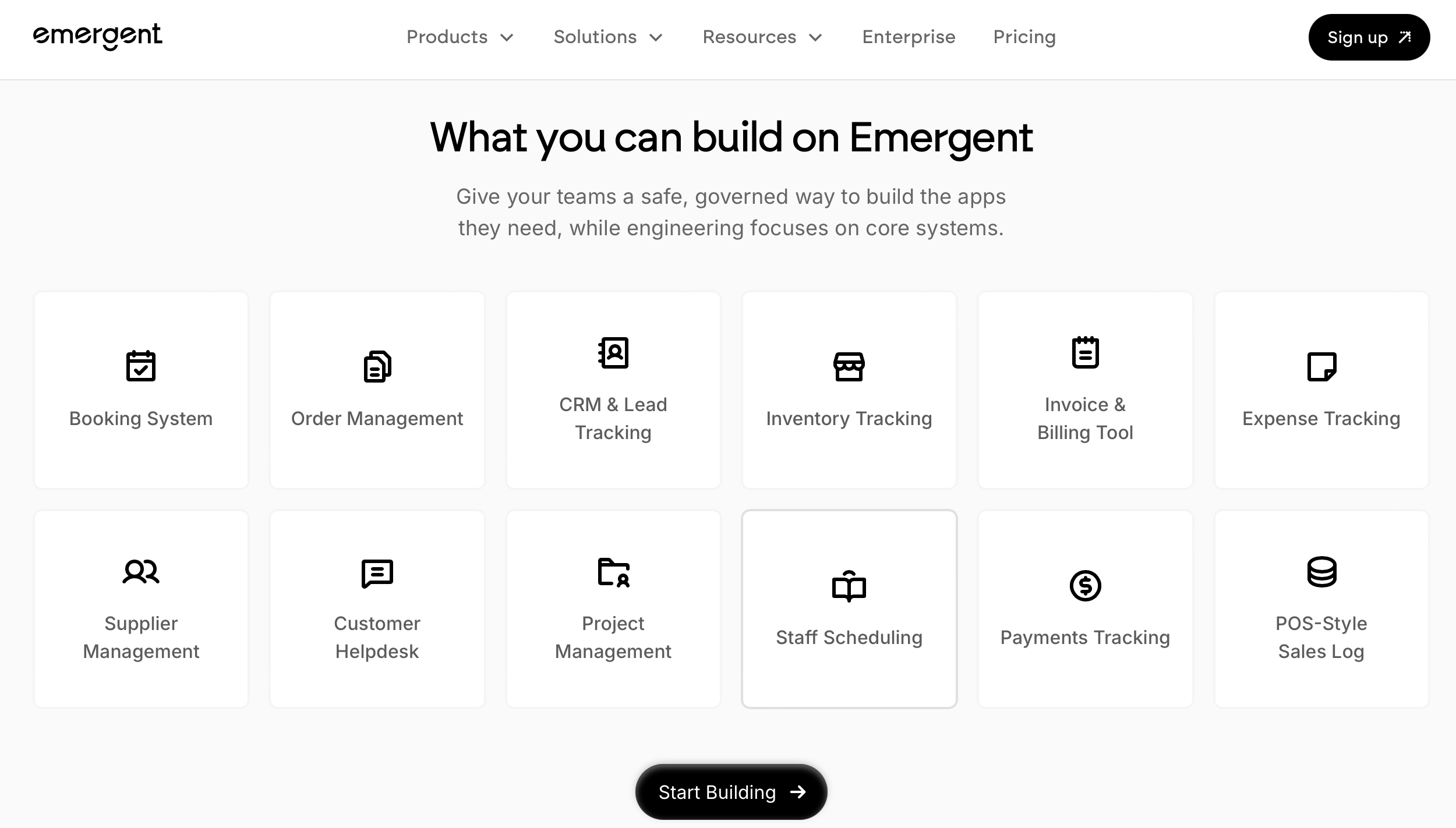
Emergent (found at emergent.sh) is an AI-powered app builder that creates full-stack web and mobile applications from natural language prompts. Instead of dragging blocks around like old-school no-code tools, you literally have a conversation: you describe the app, the AI asks clarifying questions, and then multiple AI agents work together like a small dev team — one plans the architecture, others write the frontend and backend, another tests the build.
A few facts worth knowing before you trust it with your money:
- It’s a real, well-funded company — and it just became a unicorn. Emergent raised a $130M Series C in July 2026 at a $1.5 billion valuation (up 5x from January’s $300M), led by Creaegis with SoftBank Vision Fund 2, Khosla Ventures, and Y Combinator participating. The company now reports over 12 million apps built and 200,000+ paying customers. This isn’t a fly-by-night tool — it’s one of the fastest startups to reach unicorn status in 2026.
- It builds real code, not templates. A typical Emergent app runs on a React or Next.js frontend, a Node.js or FastAPI backend, and MongoDB for the database.
- You own the code. You can export everything to GitHub and host it anywhere. No vendor lock-in — a genuinely rare thing in no-code.
- It does mobile too. It supports React Native + Expo mobile apps, with live testing on your own phone via QR code.
This guide contains affiliate links — read full disclosure here.
How Emergent Works (My Test Build)
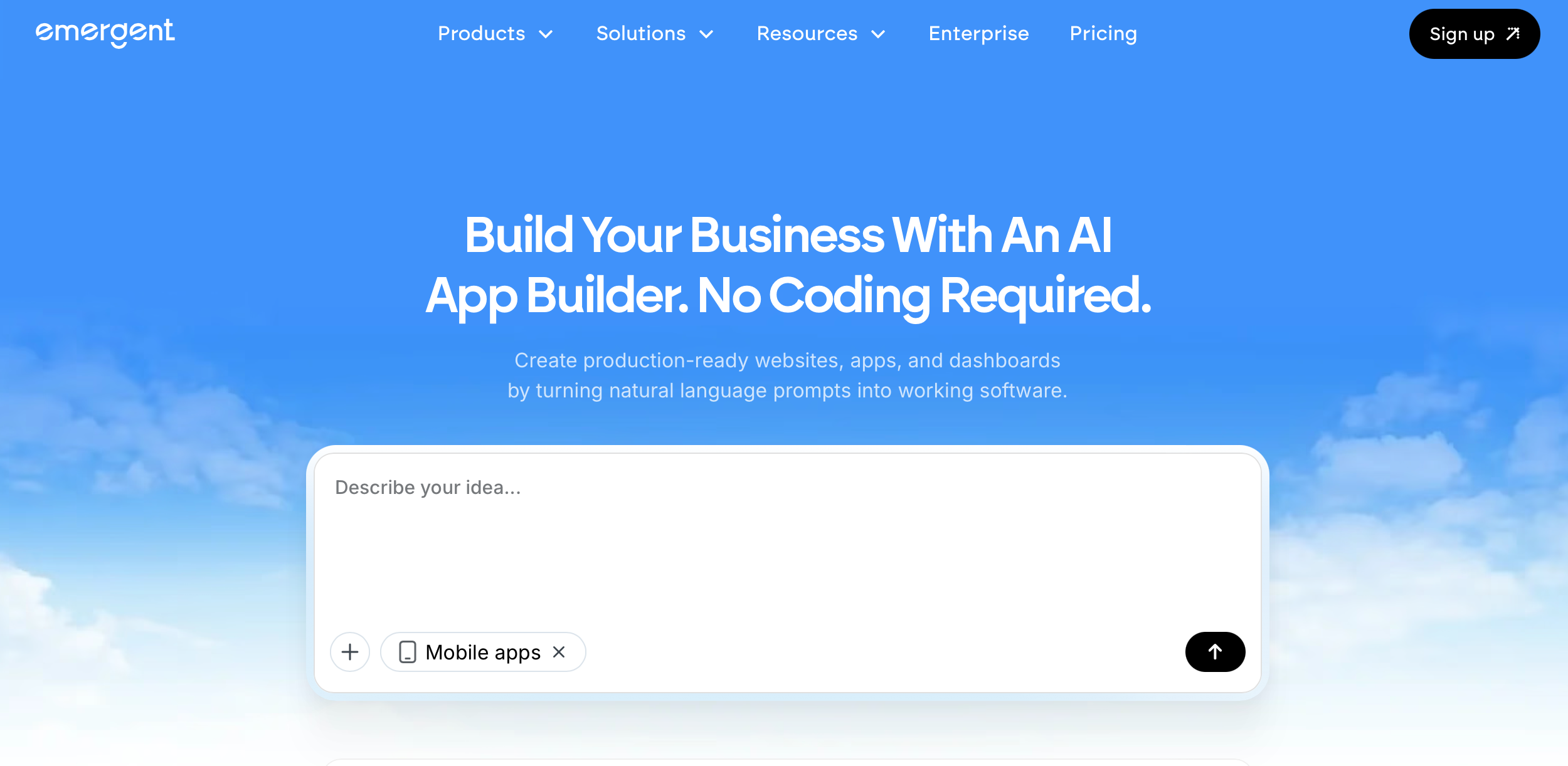
Sign-up takes under a minute — email, Google, or GitHub — and drops you straight into a dark-themed builder with one big text box: “What will you build today?”
The workflow is simple:
- Describe your app in plain English (a detailed prompt matters a lot — more on that below).
- Answer the AI’s questions. It asks about features, design, and data before building.
- Watch it build. A live preview updates in real time as the agents write frontend, backend, and database code.
- Iterate in chat. Anything wrong? You tell it, and it fixes it (this is where credits start disappearing).
- Deploy in one click to Emergent’s hosting, or export the code to GitHub.
The most impressive part — and the thing that genuinely separates Emergent from cheaper tools — is the self-testing loop. It doesn’t just spit out code and hope; it runs its own tests, flags issues it caused, and fixes several of them before showing you the result. Simple apps like a task tracker come out working in about 10 minutes; more complex builds like dashboards take 15–30 minutes.
✎ Reality check: “Working in 10 minutes” means a working first draft. Every real app I’ve seen built with these tools needs several rounds of fixes and polish afterward — and on Emergent, every round of fixes costs credits.
Emergent Pricing & the Credit System Explained
This is the section that decides whether Emergent works for you, so read it before you pay anything. Emergent doesn’t charge per app or offer unlimited usage. Everything runs on credits — every generation, every bug fix, every deployment burns them.
| Plan | Price | Credits/Month | Best For |
|---|---|---|---|
| Free | $0 | 10 | Testing the interface, one small prompt |
| Standard | $20/mo (~$17/mo annual) | 100 | Solo builders, 1–2 small projects |
| Pro | $200/mo (~$167/mo annual) | 750 | Client work, complex multi-feature apps |
| Team/Enterprise | From $300/mo | 1,250 shared | Agencies and teams of 3+ |
Prices as of July 2026 — always check the official pricing page before buying, because plans and credit allocations change.
What credits actually buy you
Here’s the part the pricing page doesn’t make obvious — rough real-world credit costs reported by users:
- Landing page with a contact form: 10–20 credits
- User authentication (login/signup): 25–40 credits
- Stripe payment integration: 35–60 credits
- Keeping your app deployed on Emergent hosting: ~50 credits per month
Do the math on that last one. On the $20 Standard plan with 100 credits, one live deployed app consumes half your monthly credits before you build anything new. This is the single biggest complaint from real users, and it’s the thing I most wish Emergent showed upfront.
⚠ The hidden cost nobody mentions: when the AI makes a mistake (and it will), fixing that mistake costs credits too. Users consistently report burning credits on repeated fix attempts for bugs the AI itself created. Budget roughly 30% more credits than you think a project needs.
What I Genuinely Liked
- It builds the whole stack, not just pretty screens. Most AI builders give you a nice UI and leave the backend to you. Emergent generates the database, login system, APIs, and hosting in one pass. For non-coders, this is the difference between a mockup and an actual product.
- The self-testing loop is real. It catches and fixes some of its own bugs before you ever see them. That alone puts it a step ahead of tools that just generate code and walk away.
- Full code ownership. GitHub export means you can take your app and leave anytime. If Emergent disappeared tomorrow, your code wouldn’t.
- Mobile apps are included. React Native + Expo support with QR-code testing on your real phone — most competitors are web-only.
- Strong integrations. Google Sheets, Airtable, Notion, Slack, Stripe, Shopify, and more connect without you touching an API doc.
- Speed for MVPs is genuinely absurd. An idea that would cost $3,000–$10,000 in freelance dev fees becomes a testable prototype for under $50 in credits. For validating business ideas, that trade is hard to argue with.
The Honest Downsides
I promised no hype, so here’s the full list — including things Emergent’s own affiliates rarely mention.
- Credits vanish faster than you expect. This is the #1 complaint across user reviews by a wide margin. Iterating, debugging, and redeploying all burn credits, and there’s no upfront menu telling you what each task will cost — you find out after the AI does the work.
- The free plan is a demo, not a trial. 10 credits is enough for one simple landing page prompt. You cannot build and deploy a real app for free. If a review tells you otherwise, it’s selling you something.
- Mixed public reputation. Emergent’s Trustpilot rating sits around 2.7/5 at the time of writing, with reviews sharply split between people who shipped real products and people furious about credit consumption and slow support. Read a page of those reviews yourself before spending serious money.
- Support is hit-or-miss. Some users report fast, helpful responses; others report being ghosted after spending hundreds of dollars. If dependable support is critical for your business, that inconsistency is a real risk.
- Fixes can break other things. As your app grows, a change in one area sometimes causes regressions elsewhere — a known weakness of AI-generated codebases in general, not just Emergent.
- You still need some technical literacy. Environment variables, auth configuration, reading an error message — complete beginners hit walls that the marketing doesn’t prepare them for.
- Back up your work externally. Some users have reported losing project access or history. Export to GitHub early and often — treat it as non-negotiable.
Emergent vs Lovable vs Bolt
| Emergent | Lovable | Bolt | |
|---|---|---|---|
| Best at | Full-stack autonomy, backend logic, mobile apps | Clean UI, design-as-you-go, visual editing | Fast prototyping, multiple AI models |
| Starting price | $20/mo | $25/mo | $20/mo |
| Mobile apps | Yes (React Native + Expo) | Web-first | Web-first |
| Code export | Yes, GitHub | Yes, GitHub | Yes |
| Weak spot | Credit burn, visual design control | Less backend depth | More hands-on fixing needed |
The short version: pick Emergent when the logic matters more than the looks — apps with databases, logins, payments, or a mobile version. Pick Lovable when you want to iterate visually on design. All of them eat credits fast on big projects, so the pricing difference matters less than your usage pattern.
Who Should Use Emergent (And Who Shouldn’t)
Emergent is a good fit if you’re:
- A non-technical founder with a clear MVP idea who wants to validate it before hiring a developer
- A freelancer or agency building internal tools, client portals, or prototypes on tight timelines
- A product manager who needs a working demo the engineering team doesn’t have time for
- A developer who wants boilerplate, integrations, and scaffolding handled so you can focus on the hard 30%
Skip it if you’re:
- A hobbyist who wants to tinker for free — the 10-credit free tier will frustrate you within an hour
- Someone who needs predictable, fixed monthly costs — credit-based pricing is inherently unpredictable
- Building something mission-critical or regulated without a developer on call — AI-generated apps still need human security and quality review before real users touch them
5 Ways to Stop Wasting Credits
- Write one detailed prompt instead of ten vague ones. A well-structured first prompt can build most of your app in a single pass. Ten lazy prompts means ten rounds of credit-burning corrections.
- Plan your app in ChatGPT or Claude first (free), then feed Emergent the spec. Users who write their full feature list, page structure, and data model elsewhere before prompting consistently report far lower credit usage.
- Batch your change requests. “Fix the button color, add a search bar, and change the header text” in one message costs less than three separate messages.
- Don’t deploy until you’re actually done. Hosting costs ~50 credits/month per live app. Keep it in preview while iterating.
- Export to GitHub after every milestone. Free insurance against losing work, and it lets you move to cheaper hosting later.
Final Verdict: 3.9/5
The bottom line:
Emergent is one of the most capable AI app builders available in 2026 — the full-stack generation, self-testing, mobile support, and code ownership are genuinely ahead of most competitors. The technology deserves the hype.
The credit system doesn’t. Go in expecting to spend more than the sticker price, manage your credits like cash, back everything up to GitHub, and treat the output as a strong first draft rather than a finished product. Do that, and Emergent can compress months of development into a weekend. Ignore it, and you’ll join the frustrated reviewers on Trustpilot.
Try Emergent Free (10 Credits) →
Test it with the free plan before spending anything — that’s what it’s for.
Frequently Asked Questions
Is Emergent AI legit?
Yes. Emergent is a Y Combinator-backed company founded by ex-Google, Amazon, and Dropbox engineers, and it raised a $70M Series B in January 2026. The product genuinely builds working apps. The complaints you’ll find online are mostly about credit consumption and support response times, not about the tool being fake.
Is Emergent AI free?
There’s a free plan with 10 credits per month, but that’s only enough to test one or two simple prompts. Building and deploying a real app requires a paid plan — realistically 50–100+ credits for even a basic project.
How much does Emergent AI cost?
Paid plans start at $20/month for 100 credits (Standard) and go up to $200/month for 750 credits (Pro), with team and enterprise options above that. Annual billing saves roughly 17%. Your real cost depends on usage, since every AI action consumes credits.
Can I build an app on Emergent without coding experience?
Yes, for the initial build — you describe the app in plain English and the AI generates everything. But expect a learning curve around things like login configuration and reading error messages. Complete beginners can ship simple apps; complex apps still benefit from some technical literacy or a developer friend.
Do I own the code Emergent creates?
Yes. You can export your full codebase to GitHub and host or modify it anywhere. This is one of Emergent’s biggest advantages over locked-in no-code platforms.
Is Emergent better than Lovable?
They’re strong at different things. Emergent is better for full-stack logic, backend-heavy apps, and mobile; Lovable is better for visual design control and iterating on the look of a web app. If your app is mostly a pretty frontend, try Lovable free; if it needs databases, logins, and payments, Emergent.
Affiliate Disclosure: This post may contain affiliate links. If you sign up for Emergent through a link on this page, I may earn a commission at no extra cost to you. This never affects my opinion — the downsides above are real, and I’d rather you skip a tool that’s wrong for you than earn a commission on your regret.