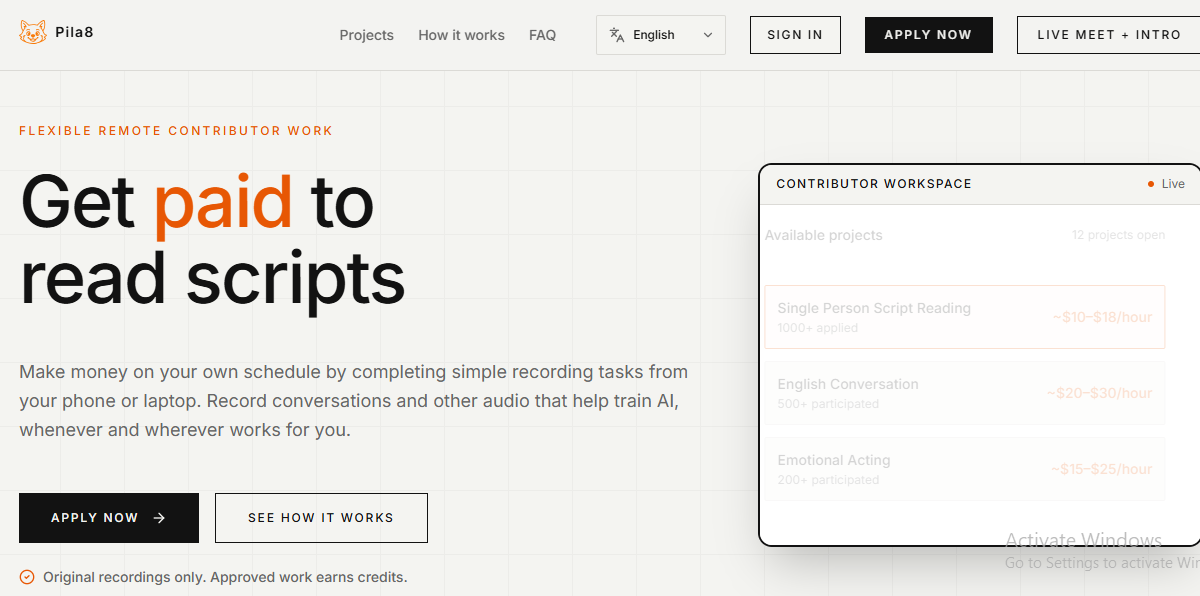
You’ve probably seen Y Combinator-backed platforms hyped as automatic goldmines. Then you land on Pila8 and find Trustpilot reviews split between “great gig, got paid smoothly” and “they ghosted me for 45 days.” So the obvious question: is Pila8 legit? We dug into the company and answered whether Pila8 is legit for real., or is the silence itself the red flag?
Here’s what we found digging into the company, real pay rates, payment timelines, and how the application actually works.
This post may contains affiliate and referral links — see the full disclosure at the end.
What is Pila8?
Pila8 is legit as an entry-level option, but don’t expect specialist-tier pay.
Is Pila8 legit for beginners? Yes. For experts? Probably not.
Pila8 is a voice recording platform that pays people to help train AI voice models. You read scripts from prompts, record your voice, submit the audio, and get paid per minute of approved recording. That’s it. No complex labeling tasks, no annotation software — just audio data.
The company behind it is BeSimple AI, a Y Combinator-backed startup founded in 2025 by Bill Wang and Yi Zhong based in Redwood City, California. They raised a $3M seed round in November 2025 and launched Pila8 in 2024. Unlike platforms like DataAnnotation or Outlier that focus on text-based AI training (writing evaluation, prompt ranking), Pila8 bets on something harder to source: diverse human speech.
Here’s why voice data matters: AI voice models need to understand accents, dialects, environmental noise, different tonalities, and edge cases. You can’t crowd-source that the way you crowdsource text annotation. Pila8 solves this by building a global network of voice contributors across 14+ languages — English, Spanish, Portuguese, German, French, Japanese, Arabic, Indonesian, and others.
What makes Pila8 different from generic annotation work: You’re not staring at a queue of tasks. You pick available scripts (a category opens, you record from it), upload, wait for QA, and move on. It’s simpler, more structured, but also slower-moving because voice quality matters. A rejected text annotation might cost you 5 minutes. Rejected audio costs you the whole recording session.
Beyond voice recording, Pila8 also runs LLM red-teaming projects (where you probe AI models for weaknesses) and AI response evaluation tasks. They also launched video uploads in March 2026 — record yourself on video from provided prompts, get a 5x multiplier on payouts if approved.
Quick note: If voice recording sounds too simple and you want serious hourly rates, check Mercor (specialist roles pay $150–$450/hr) or DataAnnotation (text-based evaluation at $20–$40/hr). Pila8 is the entry-level option for voice work specifically.
Is Pila8 legit or a scam? (The Real Answer)?
The short answer: Pila8 is legitimate, but inconsistent.
Here’s what makes it real:
- ✅ Y Combinator backing — Institutional validation matters. YC companies aren’t flawless, but they’re not running off with your data on day one.
- ✅ Real company registration — BeSimple AI is a registered Delaware entity with publicly named founders (Bill Wang, Yi Zhong) and an actual office.
- ✅ Transparent onboarding — Phone verification, country confirmation, identity checks. No anonymous sign-ups.
- ✅ Real payment processing — Stripe (US, EU, many countries) or Dots (153 countries including India, Kenya, Nigeria). No wire-transfer-only scams.
- ✅ No signup fees — You don’t pay to join, unlock access, or unlock payment methods.
- ✅ Verified work volume — Pila8 published that contributors have submitted 2,200+ hours of approved recordings. That number is real and auditable.
But here’s where the legitimacy cracks:
Trustpilot shows a 3.3/5 rating with wildly polarized reviews. Some say “got paid smoothly, great gig.” Others say “waited 45 days for payment and support went silent when I asked why my recordings were rejected.” That’s not normal platform variance — that’s a sign of inconsistent execution.
The most cited complaints aren’t “Pila8 stole my money.” They’re:
- Payment delays: 30-day holding period before your first withdrawal. Then another 5-7 days for processing. People report 40-50 days before seeing money.
- Quality rejections without feedback: Audio gets rejected. Email says “doesn’t meet quality standards.” No detail, no path to improve.
- Slow support response: When people ask “why was I rejected?”, support takes 2-3 weeks to respond (or doesn’t).
- Task availability inconsistency: Scripts available one week, nothing the next week for a month.
One reviewer on Trustpilot said it plainly: “They collected 2,200 hours of voice data from us and when we ask about payment, they go silent.”
The honest verdict: ‘is Pila8 legit’: Pila8 is not a scam in the “crypto exit” sense. The company is real, the founders are real, people do get paid. But it’s operating like a scaling startup where the backend hasn’t caught up with the growth. If you apply today, you’re banking on their support team and payment processing improving. That might happen. Or you might be one of the people who waits 45 days, gets frustrated, and abandons the platform before first payout.
Quick note: No signup fees, no “unlock payment” upsells, and no request to buy training materials — those are the real scam red flags. Pila8 doesn’t have any of them. The problem isn’t fraud. It’s customer service at scale.
How much does Pila8 pay? (And is the pay worth it if Pila8 is legit?)
Base rate: $0.10 per minute of approved audio.
Here’s how the math works: You record a 5-minute script. Audio gets approved. That’s 5 credits. 10 credits = $1. So that 5-minute recording pays you $0.50.
Sound low? It is. But context matters. A typical recording session might be 15-30 minutes of actual talking (spread across multiple short prompts — you’re not reading one long script). That’s $1.50-$3 per session if everything gets approved immediately. With bonus multipliers (more on that below), it can hit $5-15 per session.
What does that translate to hourly? If you record for 60 minutes and everything gets approved, that’s 60 credits = $6. So roughly $6/hour baseline. With multipliers and bonus campaigns, people report $5-25/hour in good weeks.
The multiplier game: Pila8 runs promotional multipliers. New language categories open with 2x bonuses. Video content gets 5x multipliers. New contributors sometimes get early-bird bonuses. One contributor tracked their earnings and noted that during high-multiplier campaigns, their per-minute rate hit $0.30-$0.50 instead of $0.10.
But don’t plan your budget around multipliers. They expire. A multiplier that was 5x last month might be 1x next month as Pila8 collects the data they need.
Realistic monthly earnings (if you’re consistent):
- Light contributor (2 sessions/week): $50-100/month
- Regular contributor (4-5 sessions/week): $100-250/month
- Active contributor (daily, with multipliers): $300-600/month
The catch: These numbers assume scripts are available, your audio gets approved, and you don’t hit quality walls. Task availability varies. Some weeks you have 20 scripts to choose from. Other weeks, nothing.
Payment method and timing: Payouts go through Stripe (most countries) or Dots (for countries Stripe doesn’t reach). You can withdraw weekly once you’re past the initial 30-day holding period.
But here’s the timeline reality:
- Week 1: You record and submit audio
- Week 2-3: Audio waits for quality review
- Day 30: First payout eligibility (30-day holding period ends)
- Day 35-45: Your first actual payment hits your account (depends on Stripe/Dots processing)
Multiple contributors on Trustpilot reported 40-50 days before seeing their first dollar. Budget for that.
Honest money reality: Pila8 is not a “make $500/month” platform. It’s a “make $50-200/month if you’re consistent and don’t hit rejection walls” platform. If you need urgent cash, this isn’t it. If you want a low-friction side gig that takes 30 minutes a day and doesn’t require any skills, it’s worth testing.
How to apply to Pila8
Step 1: Create your account. Go to pila8.com and sign up. Email, password, done. No credit card, no application fee.
Step 2: Verify your identity and location. Phone verification (SMS code). Select your country. Pila8 needs to know where you are for payment and tax purposes.
Step 3: Profile setup. List your languages and accents. Native English? Add that. Bilingual? List all languages. Have a slight accent? Note it. Pila8 matches scripts to contributors based on these details. If you speak Tagalog with a Manila accent, you get different scripts than a German speaker with a Berlin accent. That specificity is why your voice matters.
Step 4: List your recording equipment. Microphone type (USB headset? Laptop mic? Professional mic?). This doesn’t disqualify you — they just track what contributors are using.
Step 5: Complete a sample recording. Pila8 gives you a script (1-3 minutes long). You record yourself reading it clearly, in a quiet space, and submit it. This is your audition.
Step 6: Wait for approval. Typical timeline: 2-7 days. Sometimes up to 2 weeks if they’re processing a backlog. They’re listening for audio quality, proper pronunciation, and whether you followed the script exactly.
Step 7: Start recording. Once approved, scripts open up in your dashboard. Pick categories, record, upload. Rinse and repeat.
What they’re listening for in your sample:
- Clean audio: No background noise (traffic, AC hum, dogs barking, roommates). Bedroom closet works fine if it kills echo.
- Proper volume: Not whispering, not shouting. Normal conversational level.
- Accurate pronunciation: If the script says “thorough,” don’t say “through.” They’re strict about this.
- Pacing: Don’t rush. Don’t pause awkwardly. Read naturally.
- Following instructions exactly: If the script says “pause here,” pause. If it says “read with enthusiasm,” sound enthusiastic.
Red flags that get samples rejected: Multiple takes spliced together (they can hear the edits). Background noise. Not following the script word-for-word. Obvious non-native pronunciation when the task requires native speakers.
Equipment you actually need: Honestly? A phone or laptop with a working microphone. A $10 USB headset from Amazon is better than built-in laptop audio. A $50 USB microphone is really good. A $200 professional mic is overkill. Quiet space matters more than expensive gear.
Unlike DataAnnotation or Outlier (which require you to pass written assessments or live interviews), Pila8 is sample-based. You show your voice, they say yes or no. No second chances usually. If your sample gets rejected, you can reapply after 30 days, but there’s no formal appeals process.
Pila8 vs. Remotasks, Appen, and Toloka
Pila8 focuses on voice recording and audio data. It’s newer, selective on samples (30-50% acceptance rate based on reports), has payment delays, but work is straightforward if you’re approved. Pay is $0.10/min ($5-15/session typical). Best for: people with quiet recording spaces and patience with waiting periods.
Remotasks (owned by Scale AI) does image labeling, audio annotation, and text evaluation across many projects. More established (15+ years), faster onboarding, but pay is inconsistent ($3-15/hr) and work availability depends on client demand. Best for: people who want variety and don’t mind clicking/typing instead of speaking.
Appen is a crowdsourcing veteran (20+ years). They run search quality tasks, ad relevance evaluation, data annotation across dozens of projects. More stable than Remotasks, more work volume, but requires passing assessments. Pay ranges $5-25/hr depending on project. Best for: people who want established credibility and consistent task flow.
Toloka specializes in micro-tasks (quick labels, surveys, simple decisions). Very beginner-friendly, quick to start, but pay is micro-level ($1-3 per task). Best for: testing the space or supplementing other income with minimal friction.
Who should pick Pila8? You have a quiet space to record. You’re okay waiting 40+ days before your first payout. You speak clearly. You want simple, non-technical work. You prefer “do one task, get paid” over task queues. You don’t mind inconsistent script availability.
Who should skip Pila8? You need cash fast (the holding period kills that). You live in a noisy environment. You’re not a native or near-native speaker in the languages they’re hiring for. You hate slow support response times.
FAQ
Is Pila8 legit?
Yes. It’s Y Combinator-backed, has real founders, and pays people real money. The catch: payment delays and inconsistent support are common. Treat it as legitimate but unproven at scale.
Is Pila8 a scam?
No. The most common complaints aren’t “they stole my voice” but “they rejected my work silently” or “payout took 45 days.” Those are frustrating execution problems, not fraud.
How much does Pila8 really pay?
$0.10 per minute of approved audio. That’s roughly $5-15 per recording session (depending on session length and bonuses). Multiply that by available scripts and you get $50-300/month if you’re active. No multipliers, no shortcuts — that’s the math.
How long before I see my first payment?
Plan on 40-50 days minimum. Record Week 1 → audio reviewed Weeks 2-3 → 30-day hold ends Day 30 → payment processes (5-7 days) → money in account around Day 40-50. Faster is possible; slower is common.
What if my recording gets rejected?
You don’t get paid for it. Pila8 sends an email saying it doesn’t meet quality standards. Usually no detailed feedback. If you ask why, support can take 2-3 weeks to respond. You can keep recording other scripts while waiting.
Can I do this on my phone?
Technically yes — Pila8 has an app. But you really need a quiet space and a decent microphone. Built-in phone mics are noisy. If you’re serious, use a laptop and a $20 USB headset.
What languages does Pila8 accept?
Currently: English, Spanish, Portuguese, German, French, Japanese, Arabic, Indonesian, Korean, Italian, Mandarin Chinese, Polish, Dutch, Swedish, and a few others. Check their careers page before applying — not all languages are always open, and acceptance rates vary by language demand.
How selective is Pila8?
Sample acceptance rates aren’t published, but based on Trustpilot reviews, it seems like 30-50% of sample submissions get approved. That’s tighter than Toloka but looser than DataAnnotation. Your odds depend on your accent, English clarity (if applying for English), and audio quality.
Can I do Pila8 with other platforms?
Yes. Many people run Pila8 + Toloka + Appen simultaneously because individual platform payouts are modest. The time commitment is low enough that combining them makes sense.
Is there a minimum amount to withdraw?
No stated minimum, but you have to wait 30 days from your first approved recording. After that, you can withdraw any amount (above $0.01 realistically).
What countries can use Pila8?
Pila8 works in most countries via Stripe (150+ countries) or Dots (153 countries). Check their payment method compatibility for your country before spending time on the application.
Is Pila8 legit? The direct answer.
Yes. Pila8 is legit — it’s a real company with registered founders, real payment processing, and people getting paid.
The question isn’t is Pila8 legit,” it’s “is Pila8 legit for me?
That depends on your patience with payment delays and inconsistent task availability.
The bottom line
Pila8 passes the legitimacy bar — real company, real founders, real people getting paid. It’s Y Combinator-backed, which matters. What it hasn’t passed is the reliability bar. Payment delays, inconsistent support, and silent rejections are common enough that you can’t treat this like established platforms like Outlier or DataAnnotation.
If you have a quiet room, a working microphone, and patience with waiting periods, it’s worth trying as a supplemental income stream. Spend two weeks recording, see if you like the work and if your samples get approved. If they do, and you don’t mind the payment delays, it’s a low-friction side gig.
If you need cash fast, hate slow customer service, or live in a loud environment, skip it and go straight to Remotasks or Appen.
If you want serious money ($40+/hour), you’re bilingual or have domain expertise, check Mercor or Welo Data instead. Pila8 is entry-level voice work. It knows what it is.
Final word: Pila8 is legitimate. Not perfect, but legitimate. Treat it as a test, not a salary replacement, and you’ll set your expectations right.
☕ Related on Laptop & Coffee
If Pila8’s entry-level pay feels light and you’ve got real expertise instead of just free time, it’s worth comparing against higher-paying specialist platforms: our full Mercor review covers roles paying $150–$450/hr for law, medicine, and engineering. And if you want the complete breakdown of AI training platforms side by side before deciding where to spend your first application, Best AI Training Platforms for Internationals walks through the full landscape.
Already rejected from Pila8? Check Workada — team-based structure, same price range, $18-22/hr with guaranteed 40-hour-per-week caps (vs. Pila8’s inconsistent availability).
Affiliate & Referral Disclosure: Laptop & Coffee is reader-supported. This post contains affiliate links and personal referral links, which means we may earn a commission or referral reward if you sign up through them — at no additional cost to you. It never changes what you pay, and it never changes what we tell you. We state the downsides before every sign-up link, and we only recommend platforms we have researched properly. No hype. Just truth. Sip. Click. Earn.