Type “AI jobs remote no experience” into Google and you’ll get two kinds of results: lists that read like they were written by an AI that’s never actually filled out one of these applications, and job boards padded with roles that have nothing to do with AI at all. Neither one tells you what’s actually true.
Here’s the honest version, checked directly against each platform’s own live job postings rather than secondhand roundups. Yes, real companies pay real people with zero AI background to do AI-related work from home right now. No, it’s not the six-figure “AI job” the salary calculators promise you. And it’s a lot broader than “rate some chatbot answers” — there’s genuine paid work in text annotation, video labeling, voice and language review, and reviewing academic subject matter from physics to finance. Which version fits you depends entirely on your background.
Skip straight to: which platform actually fits you →
What “AI jobs with no experience” actually means
Nobody is hiring a total beginner to build or code AI models — that’s a Machine Learning Engineer role, and it takes years to get. What companies are hiring beginners and non-technical experts for is checking the AI’s work: reading, watching, or listening to what a model produced and telling it, in plain language, whether that was right, wrong, or off-target.
Outlier AI’s own homepage puts the distinction well: “No AI experience needed.” Not “no experience needed” full stop — specifically no AI experience. Outlier is explicit that it wants “domain expertise across a wide range of fields,” typically undergraduate-level as a floor, with graduate students, master’s holders, and PhDs preferred for the higher-paying tiers. That one line explains almost every confused review you’ll read about this space: the bar isn’t a resume in tech, it’s demonstrated knowledge in something — language, math, writing, chemistry, film, whatever your background actually is.
Quick note: a few of the links below are affiliate or referral links. Full disclosure is at the bottom of this post — no surprises.
Every category these jobs actually come in
Most “no experience” roundups only cover one of these. There are genuinely six distinct categories, verified directly against live listings.
Text data annotation and RLHF. The original category and still the biggest — labeling text, ranking chatbot answers, writing tricky prompts to test a model. Outlier AI and DataAnnotation.tech’s General tier live here; DataAnnotation’s own FAQ sets the bar at “a bachelor’s degree or equivalent real-world experience,” no coding needed.
Video annotation. A category most beginner guides skip entirely, but it’s real and genuinely open to non-experts: Alignerr’s live Video Annotation Specialist role pays $40–120/hr to segment video into shots and scenes, tag camera angles and movement, and flag unclear footage — officially listed as “no professional video or AI experience required,” just a sharp eye for visual detail. Even a casual interest in film or photography helps, but isn’t required.
Audio and voice work. Alignerr also runs a steady stream of native-language audio transcription and transcript-editing roles — Hindi, Mandarin, Spanish, German, Portuguese, French, Italian, and more — paying $15–35/hr, open to anyone with native fluency and no AI experience. If voice work specifically interests you, my Pila8 review covers the dedicated voice-recording side of this category.
Academic and professional subject-matter review — physics, chemistry, biology, math, and beyond. This is the tier most “no experience” content misses completely, and it’s one of the best-paid. Mercor’s live STEM Expert listing hires specifically for physics, chemistry, mathematics, and biology backgrounds at $75/hr, open to current students as well as graduates. DataAnnotation’s STEM tier (math, physics, biology, chemistry) pays $50–100+/hr for a master’s/PhD or a bachelor’s plus 10+ years of experience.
SME Careers casts an even wider net — confirmed roles spanning marine biology, psychology, history, linguistics, engineering, agriculture, law, medicine, and finance, alongside math and data science, with a visible progression track (Data Trainer → QA Analyst → QA Lead → Project Manager). None of this requires AI experience — it requires the academic or professional background you likely already have.
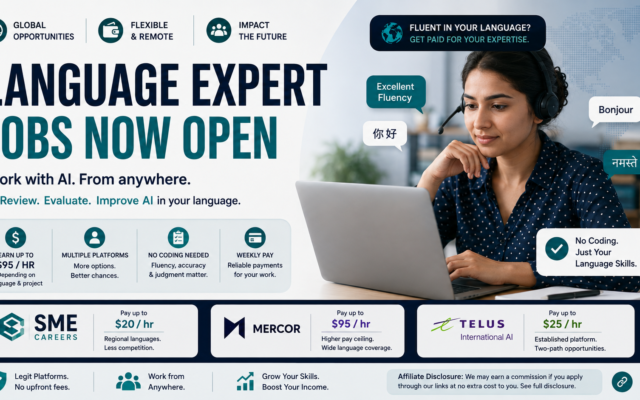
Language expert work. Reviewing AI-generated content in a language besides English, evaluating translation and reasoning accuracy, writing corrected explanations. SME Careers, Mercor, Alignerr, and TELUS International’s AI Community all run this work in parallel. Full pay-by-language breakdown in Language Expert Jobs for AI Training.
Search and ads quality rating. The closest thing to an actual “Google AI job” — roles like Personalized Internet Assessor and Ads Quality Rater, hired through TELUS International or Appen to grade Google’s and Bing’s results. Lower ceiling than the categories above, but one of the easier ones to get into.
Technical/coding — the micro1 tier. Not really a “no experience” fit, and worth naming as the one platform every other roundup miscategorizes (more on that below).
Find your path: which platform actually fits you
| Your situation | Best fit | Pay range | Full breakdown |
|---|---|---|---|
| No professional background, first AI job ever | Outlier AI, Appen / TELUS classic rater | $10–$35/hr | Full beginner’s guide → |
| Strong writing/reasoning, no specific expertise | DataAnnotation.tech (General tier) | $20–30+/hr | Starter Assessment walkthrough → |
| Academic/STEM background (math, physics, chemistry, biology, engineering, and similar) | DataAnnotation (STEM tier), Mercor, SME Careers | $50–$150+/hr | Mercor review → |
| Fluent in a language besides English | SME Careers, Mercor, Alignerr, TELUS AI Community | $10–$95/hr | Language Expert Jobs guide → |
| Sharp eye for visual detail, even just a casual interest in film/photo | Alignerr — Video Annotation Specialist | $40–$120/hr | Alignerr review → |
| Developer or ML engineer, okay with a tough live interview | micro1 | $40–$120/hr | micro1 review → |
If you have zero professional background at all. Start with Outlier AI or an Appen/TELUS rater role. Full mechanics of the assessment, and which platform to apply to first, are in Freelance AI Training Jobs for Beginners — that post is the deep dive, this one is the map.
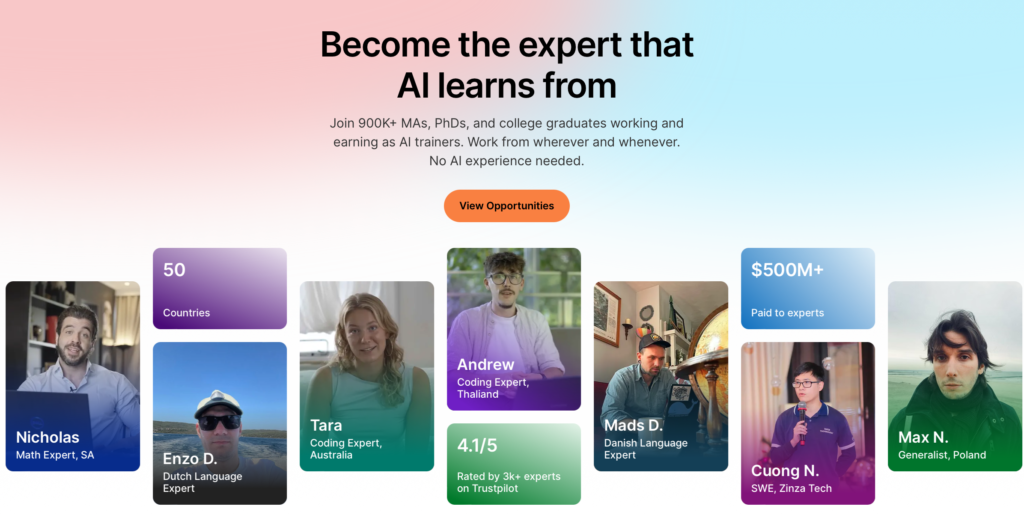
If you have any academic or professional background — and this is worth reading even if you don’t think of yourself as an “expert” — don’t default to the beginner tier. A biology degree, a decade in accounting, a nursing license, an engineering background: all of these are worth more on Mercor, DataAnnotation’s STEM tier, or SME Careers than a generalist rate anywhere else. SME Careers in particular hires across 86–90 countries, with confirmed hires out of India, Nigeria, Kenya, Egypt, Pakistan, Indonesia, the Philippines, and Vietnam — unusually broad for this tier of work. Read the full SME Careers review before applying, since the advertised pay isn’t quite the real pay (more below).
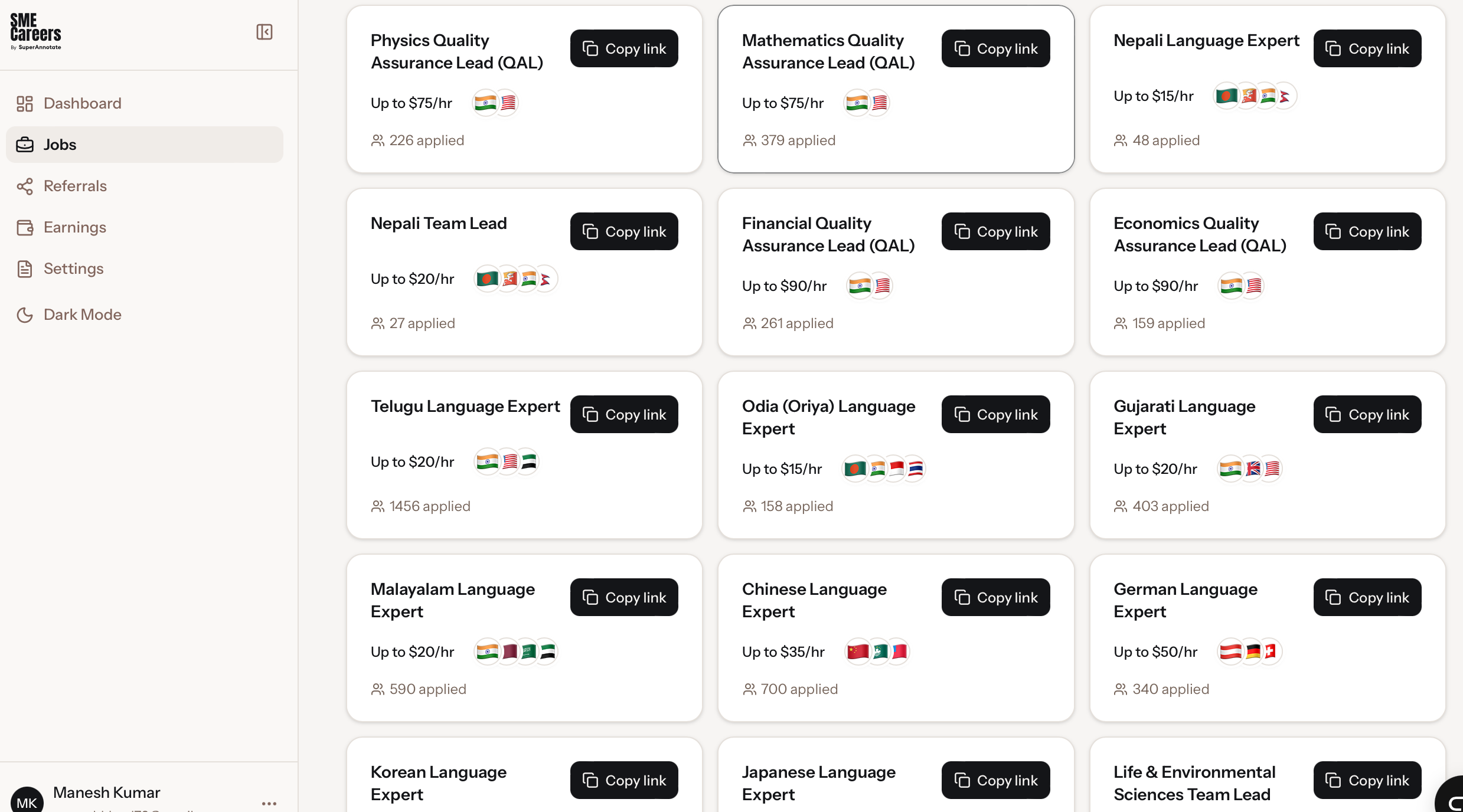
If you’re fluent in a language besides English, this is genuinely one of the more accessible entry points, and it’s not limited to one platform. Pay and competition vary sharply by language — on SME Careers, a Telugu Language Expert role recently drew 1,426 applicants, while a Nepali Team Lead role at higher pay drew just 13. If your language isn’t one of the heavily represented ones, that’s a real advantage. Full tables in Language Expert Jobs for AI Training.
If you notice things other people miss visually — even without any professional photo or video background — Alignerr’s Video Annotation Specialist role is worth a look and is genuinely underused by job seekers, because almost nobody searching “AI jobs no experience” thinks to look for it. See the full Alignerr review for the application process.
If you’re a developer or ML engineer, micro1 belongs on your list — but be clear-eyed about what it is. Every “no experience” roundup lumps micro1 in with the beginner-friendly platforms, and that’s a genuine mistake worth naming directly: micro1 isn’t a task-based gig site you log into and grab work from. It’s a vetting-first talent pool. You pass one serious, adaptive AI interview (a live avatar called Zara, with a proctoring layer watching your screen the whole time), and if you clear it, you’re surfaced to clients including AI labs and Microsoft. Real pay is strong — $40–120/hr — but non-technical applicants have very limited paths here.
Full breakdown in the micro1 review. If you’re technical and want a second high-ceiling option, AI red teaming jobs are worth a look too.
If you want the closest thing to an actual “Google AI job.” You won’t be employed by Google directly, but search and ads quality rating is real, paid work grading Google’s and Bing’s results, hired through TELUS International or Appen. See the TELUS International AI review for current pay and how the application works.
Do you actually need a degree? Here’s the honest answer
Mixed, and the language platforms use is genuinely inconsistent, so read past the headline on any listing.
Closest to no background question at all: Appen and TELUS classic rater roles don’t ask about subject expertise — they ask about following instructions consistently and knowing the culture/language you’re rating in.
Asks for expertise, not a credential: Outlier’s own site is explicit that qualifications vary by opportunity, with undergraduate-level expertise as a typical floor and graduate-level preferred for top tiers — but it’s expertise it’s screening for, not a diploma. A self-taught coder or a widely-read amateur mathematician can clear this bar without a degree in hand.
Explicitly states a degree-or-equivalent bar: DataAnnotation’s General tier officially requires “a bachelor’s degree or equivalent real-world experience.” Its STEM tier goes further — a master’s/PhD in math, physics, biology, or chemistry, or a bachelor’s plus 10+ years of professional experience. Mercor’s STEM Expert listing asks for a bachelor’s, master’s, or PhD in a STEM field or currently pursuing one, plus at least a year of relevant academic, research, or industry experience.
Not a degree question at all — a skill question: micro1 never mentions a degree anywhere in its process. What it gates on is whether you can defend real, working technical knowledge under live adaptive questioning.
What matters more than a degree on nearly every platform: your written English, your ability to follow a rubric exactly, and your assessment score. A high school graduate who reads instructions carefully will out-earn a master’s degree holder who rushes the assessment. That’s how the scoring actually works, on every platform checked for this post.
Does this work outside the US? (Worldwide eligibility, honestly)
Country restrictions are the single biggest filter in this space, and any list claiming to be complete is already a little out of date. Here’s the pattern that holds up, checked against each platform’s own site:
Broadly international: Outlier AI operates across 50 countries by its own count. Alignerr’s live job board shows roles targeting dozens of specific cities and countries simultaneously for the same language, and states over 100,000 experts on the platform. Mercor and SME Careers are similarly broad — SME Careers is the standout at 86–90 countries, with confirmed hires from Pakistan, Nigeria, Kenya, Egypt, Indonesia, the Philippines, and Vietnam, not just the usual US/UK/EU pool.
US-only or near enough: DataAnnotation.tech currently limits itself to the US, UK, Canada, Australia, and New Zealand. Handshake AI requires US work authorization. If you’re outside those countries, skip the assessment and save yourself the time.
The realistic move if you’re outside the US: apply to two or three broadly international platforms in parallel, since task availability on any single one can dry up without warning. Don’t take any “eligible countries” list as permanent, including this one — check the platform’s own application page before investing an hour in an assessment.
What these jobs actually pay (and why you should ignore the $127k headlines)
You’ll come across salary aggregator sites claiming the “average” pay for a remote no-experience AI job is well into six figures. That number is almost certainly senior AI engineer or AI researcher salary data, mismatched onto an entry-level search term. Nobody is paying a beginner $127,000 a year to rate chatbot answers. Ignore any number that big.
The advertised-vs-real gap shows up on individual platforms too. SME Careers’ job board advertises rates as high as $60–$100+/hr for specialized roles, but contributors who’ve actually worked a project report figures closer to $15–$20/hr to start, climbing toward $130+/hr only for rare, in-demand domains. Treat any headline number, on any platform, as a ceiling for scarce expertise — not a starting rate.
The verified range, category by category:
General text annotation: $10–$35/hr on Outlier and Appen/TELUS. Full mechanics in the beginner’s guide.
DataAnnotation General tier: around $20–30+/hr once you clear the Starter Assessment.
Video annotation: $40–120/hr on Alignerr — officially confirmed, genuinely no experience required.
Audio/voice and language work: $15–35/hr on Alignerr’s transcription roles, up to $95/hr on Mercor for complex multilingual work. Full detail in the language expert guide.
Academic/STEM and professional review: $50–100+/hr on DataAnnotation’s STEM/Coding/Professional tiers, a confirmed $75/hr on Mercor’s STEM Expert listing, and $15–150+/hr on SME Careers depending on how in-demand your specific field is.
Technical/engineering (micro1): $40–120/hr, gated behind a genuinely difficult live interview.
The part every honest guide should tell you and most don’t: task availability is inconsistent everywhere, on every platform in this post. You can be fully approved and still have weeks with almost no work available, because tasks only exist when client companies have active projects. Budget your expectations around “useful side income,” not “guaranteed paycheck,” for at least your first few months.
How to tell a real listing from a scam
This exact search — “AI jobs, remote, no experience” — is one of the most heavily targeted phrases in job-scam ads right now, precisely because it’s what real beginners search for. Full platform-by-platform detail lives in AI Training Platform Red Flags; here’s the short version.
Any request for money ends the conversation. Training fees, “certification” costs, equipment deposits — real platforms pay you, full stop.
Vague job descriptions are a shield, not an accident. A real listing says “label conversational data for customer service chatbots” or “segment video into shots and scenes.” A scam listing stays vague about what you’d actually be doing.
An assessment that produces content the company could use for free is not a real assessment. Real tests are generic and hypothetical.
Watch for impersonation of well-known names specifically. TELUS’s name gets impersonated often enough to call out directly — legitimate communication only comes from addresses ending in @telusinternational.ai or @telusdigital.com. Lookalike domains and unsolicited WhatsApp offers claiming to be TELUS, or any platform in this post, should be treated as fraudulent.
Software you’re told to install before a single paid day. Never install anything for a “job” you haven’t been formally hired for through the company’s own website.
How to actually start this week
Pick your category from the table above first, then apply to two platforms in it — not ten. Applying everywhere at once means ten half-finished assessments and no real progress on any of them.
Take the assessment somewhere quiet, on a real computer, and don’t rush it. These are graded on accuracy and rubric-following, not speed — rushing is the single biggest reason beginners fail their first assessment.
Don’t use ChatGPT to answer the assessment. Ironic given the industry, but every major platform explicitly checks for this, and it’s an instant, permanent disqualification.
Apply to a second platform while you wait. Approval can take anywhere from a day to a month — work the queue instead of sitting idle.
Frequently asked questions
Are there real entry-level AI jobs with zero experience required?
Yes — general text annotation, video annotation, and search/ads quality rating are the categories that genuinely ask for no prior AI background, just a passed assessment. “AI engineer” is a different category requiring real technical training.
Is there a video annotation job I can do with no experience?
Yes — Alignerr’s Video Annotation Specialist role is officially listed as requiring no professional video or AI experience, paying $40–120/hr to segment and label video footage. It’s one of the most overlooked entry points in this space.
Are there AI training jobs for physics, chemistry, biology, or math backgrounds specifically?
Yes, and they’re some of the best-paid roles in this space. Mercor runs a live STEM Expert listing for exactly those four fields at $75/hr; DataAnnotation’s STEM tier covers the same subjects at $50–100+/hr; SME Careers extends even further into marine biology, engineering, and other academic and professional domains.
Do I need to “train” for these jobs before applying?
No formal training or certificate is required to apply. The platforms train you once you’re accepted — the assessment tests judgment and instruction-following, not prior knowledge.
Is there a real Google AI job I can do remotely with no experience?
Not directly through Google. What exists is search and ads quality rating, hired through TELUS International or Appen to evaluate Google’s and Bing’s results — real work on Google’s product, not employment with Google itself.
Is micro1 good for someone with no experience?
Only if “no experience” means no AI-specific experience — you still need to be a genuinely skilled developer or ML engineer who can defend that skill live. If you’re not technical, start with Outlier AI or DataAnnotation instead.
Do these jobs work if I don’t live in the US, or does my city matter?
Your country matters far more than your city. If you’re remote-eligible on a platform, it makes no difference whether you’re searching from Chicago, Austin, Miami, Phoenix, Portland, Detroit, or anywhere else. What actually changes access is which country you’re in — a handful of platforms (DataAnnotation, Handshake AI) restrict to specific countries, while others (Outlier, Alignerr, Mercor, and especially SME Careers at 86–90 countries) are broadly international.
☕ Related on Laptop & Coffee
Freelance AI Training Jobs for Beginners — the deep dive on data annotation and RLHF mechanics
How to Pass the DataAnnotation Starter Assessment
Outlier AI Assessment: What It Tests, Why People Fail
Is SME Careers Legit? SuperAnnotate Explained
Is Alignerr Legit? ·
Mercor Review ·
Is Pila8 Legit?
TELUS International AI Review ·
Handshake AI Review
Language Expert Jobs for AI Training
micro1 Reviews: Is It Legit? ·
AI Red Teaming Jobs
AI Training Platform Red Flags
Affiliate & Referral Disclosure: Some of the platform links in this post are affiliate or referral links, which means I may earn a small commission if you sign up through them — at no extra cost to you. Every pay figure, degree requirement, and eligibility note above was checked directly against the platform’s own site or live job postings, not marketing copy. No hype. Just truth. Sip. Click. Earn.