You just spent fifteen minutes talking to a woman named Zara. She asked good follow-up questions, she repeated herself politely when your connection lagged, and she seemed to actually listen. Then the screen said “Thanks, we’ll be in touch” — and that was it. No score. No transcript. No idea if you did well.
Then you go looking for answers and realize Zara isn’t a person at all. She’s an AI interviewer, and you just got evaluated by software for a job that pays real money. So naturally you start searching “is Alignerr legit” and “zara ai interview questions” at midnight, same as everyone else who’s sat in that exact silence.
Here’s what’s actually going on — what Alignerr is, how the whole process works end to end, what it really pays, and the honest answer on legitimacy, sourced from both sides instead of just the marketing page.
Already mid-application and just want the pay numbers? Skip straight to what Alignerr actually pays →
What Alignerr Actually Is
Alignerr is the contributor-facing marketplace built on top of Labelbox, an enterprise AI data infrastructure company that serves large AI labs and Fortune 500 clients. When you see “Alignerr | Powered by Labelbox” in a listing, that’s not a partnership badge — Labelbox owns and runs the platform. Labelbox itself is backed by well-known investors including Andreessen Horowitz and Google’s Gradient Ventures, which is worth knowing before you decide whether this is a real company or a fly-by-night operation. It is a real company. That doesn’t automatically make every individual worker’s experience smooth, and we’ll get into exactly where the friction shows up.
Contributors on Alignerr work on AI training and evaluation tasks — rating and ranking AI-generated responses, open rewrite tasks, coding evaluations, and specialist projects in fields like finance, law, and medicine. It’s the same general category of work as DataAnnotation or Outlier, just routed through Labelbox’s client relationships instead.
Quick note: some links in this post are referral links, which means we may earn a reward if you sign up and qualify — at no extra cost to you. We only recommend platforms we’ve researched properly.
Haven’t applied yet?
Read the whole process below before you start the Zara interview — you get very limited retakes, so it pays to know what’s coming.
Apply to Alignerr →
Referral link — we may earn a reward if you qualify, at no cost to you.
How to Apply: The Full Process Step by Step
Alignerr’s application isn’t a single form — it’s a sequence of gates, and each one has to clear before you see the next. Here’s the order, based on the platform’s own onboarding flow:
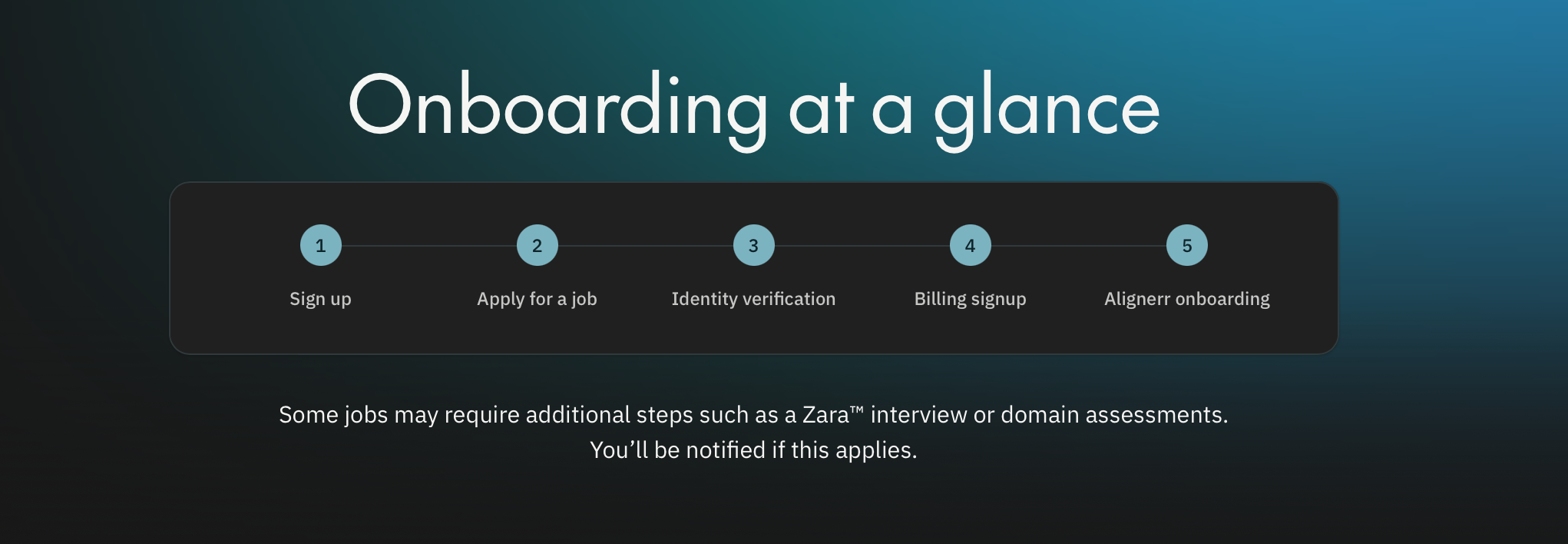
1. Sign in with Google. Desktop or mobile both work, though Chrome is the recommended browser.
2. Upload your resume. The platform auto-fills your profile from it in about 30 seconds. Review everything it pulled — especially your location, since project eligibility is tied to it.
3. Set your skill and domain preferences. Be specific here. These tags are what the matching algorithm uses later to route you to actual projects, so vague tagging means fewer task invitations down the line.
4. Verify your identity. Alignerr partners with Persona — the same identity verification service used by companies like Airbnb — for phone and ID verification. You’ll either use a saved ID or photograph one on the spot. This is a standard anti-fraud step, not a red flag.
5. The Zara AI interview. Covered in full detail below — this is the step everyone has questions about.
6. Domain-specific assessment (if your role requires one). Technical and specialist tracks often add a written or coding assessment on top of Zara.
7. Contract and payment setup. If you’re approved, you’ll get an email invitation to join the contributor community and set up your contract and billing through Deel.
Onboarding can take anywhere from a few days to several weeks, and — this is the part nobody puts in the marketing copy — passing every gate doesn’t guarantee you’ll actually see project invitations right away. More on that in the legitimacy section.
The Zara AI Interview: What to Actually Expect
A few things worth knowing before you click start. Zara isn’t proprietary Alignerr technology — she’s built by a company called Micro1 and licensed out to multiple platforms as an identity-and-communication screen. Alignerr uses her for two specific reasons: matching your face on camera to the ID you already verified, and testing whether you can actually communicate clearly, which a multiple-choice test can’t measure.
The interview runs about 15 minutes, real-time and adaptive — she asks follow-up questions based on what you actually say, not a fixed script. What she asks depends heavily on the track you applied for:
Generalist, Writer, and K12-style roles: expect behavioral and soft-skill prompts. A common pattern is being asked to explain a complex topic — gravity, inflation, that kind of thing — as if to a five-year-old. That’s not small talk; it’s directly testing the summarization judgment these platforms are built around.
Technical roles (coding, math, specialist domains): expect verbal technical questions where you narrate your reasoning out loud — explaining a system design choice, walking through a debugging approach, that sort of thing.
A few practical notes for the session itself:
Speak in complete sentences, not fragments. Zara is real-time but has real latency, so long pauses can feel awkward — that’s normal, not a sign something’s wrong. If you need a second to think, say so out loud rather than going silent.
Use a quiet room and stable internet. Background noise and connection drops are two of the most commonly reported reasons for a flagged session.
Don’t read from a script. Anti-cheating detection is a real part of what she’s evaluating, and scripted answers read differently than natural speech.
Have your resume details ready in your head, not just on paper. Questions are often anchored to what you uploaded, so you should be able to speak fluently about your own background without checking notes.
What Alignerr Actually Pays
Published rates break down roughly like this, based on current listings and consistent community reporting:
Generalist task authoring: $20–$25/hr
Specialized roles: $25–$40/hr
Credentialed experts (software engineering, accounting, and other established professions): $50–$100+/hr
The standout number is the WorldSim Eval Batch — a project-specific evaluation that pays $100 just for completing it, leading into ongoing work around $90/hr for the right technical background. It’s not something you’ll see on your dashboard by default; it opens on a rolling basis and only for approved accounts.
Now the part the recruitment ads leave out. Some Alignerr voice work is advertised around $40–$45/hr but billed Per Finished Hour — meaning you’re paid for one hour of finished, approved output, not one hour of your actual time. If a “finished hour” of voice work genuinely takes you five real hours to produce, that $45/hr figure is actually closer to $9/hr of real labor. Always ask, before you commit meaningful time to any project, whether the rate is per hour worked or per finished hour — they are not the same thing, and the gap can be enormous.
Payment runs through Deel, and while some sources describe a weekly schedule and others biweekly, biweekly is the more consistently reported cadence across worker accounts. Either way, you’re paid for approved work, not simply completed work — if a task gets flagged or a project pauses before review, your payment for it can be delayed.
Is Alignerr Legit? The Honest Verdict
Both things below are true at the same time, and the useful question isn’t “scam or not” — it’s understanding where the real risk sits before you invest hours.
What supports legitimacy: Alignerr is run by a real, funded company with real enterprise clients. Payment processes through Deel, a reputable international payroll platform. Plenty of contributors report being paid on time, on schedule, for real work. The application process — ID verification, background-adjacent checks, a live interview — is thorough in a way that scam operations generally don’t bother with, because thoroughness costs them money and effort for no payoff.
What the community reports consistently flag: silent account deactivations after work has been submitted, with no explanation given. Withheld earnings reported in the $800–$3,000 range on some accounts. Project-specific issues — including at least one case of a Discord community disappearing along with contributors’ labeling history. And one detail worth knowing specifically: at least one worker reports being removed from Alignerr’s own subreddit after posting about unpaid work, which matters because it means the platform’s own community space isn’t neutral ground for judging sentiment — you have to weight outside reviews (Glassdoor, Trustpilot, independent Reddit threads) more heavily than anything hosted by Alignerr itself.
The honest takeaway: Alignerr is real, and plenty of people are paid well and on time. It’s also volatile — task availability is unpredictable even after approval, and a meaningful number of workers report payment friction serious enough to track carefully. Keep a personal log of hours, tasks submitted, and approval status for every project. Don’t assume the platform’s dashboard is the only record that matters.
☕ Related on Laptop & Coffee
If Alignerr’s country restrictions or payout gates rule you out, our Best AI Training Platforms for Internationals guide breaks down which platforms are actually open worldwide and which payment rails work when PayPal doesn’t. And if you’re stacking platforms — which is the smart move in this niche — our Outlier AI assessment guide and DataAnnotation legitimacy review cover the other two big names side by side with this one.
Who Should Sit This One Out
If you need predictable weekly income starting now, Alignerr’s feast-or-famine task flow makes it a poor primary income source — treat it as one faucet in a stack, not the whole system. If you’re not willing to go through ID verification and a live video interview, this isn’t the platform for you; there’s no way around either step. And if you’re the type who’ll be genuinely rattled by an unexplained silent deactivation after weeks of good work, know that going in — it’s a documented pattern, not a hypothetical.
Waiting to Hear Back? Here’s a Plan B
Onboarding can stretch for weeks, and there’s no dashboard tracker that speeds it up. Sitting in silence with no backup plan is a bad strategy. Paid survey panels won’t make you rich — think beer money, not a salary — but they accept almost everyone and pay small amounts reliably while you wait:
🌍 US, Canada, UK and more: King Opinion — sign up with just your email and start matching with surveys the same day.
🌍 US, Canada, UK and more: Surveoo — very similar setup to King Opinion. Join both, keep whichever pays better.
🌏 Everywhere else, or no PayPal: FreeCash — tasks and games instead of pure surveys, $5 minimum payout, crypto withdrawal available. Full review here: Is FreeCash legit?
One rule: never pay to join a survey panel. Every legitimate one is free.
The Uncomfortable Truth About All Hourly Online Work
Alignerr, surveys, all of it — the moment you stop working, the money stops. You’re trading hours for dollars from your kitchen table instead of an office, and as this whole review shows, the queue can dry up with zero warning.
Think of it like fetching water in a bucket versus building a pipe. The bucket pays today. The pipe takes months to build and pays nothing at first — then it flows whether you show up or not. A blog is a pipe. This very page is one.
The honest cons: a blog takes months before the first real dollar, most people quit too early, and you’ll need to learn as you go. It’s the slower, harder, better game. But the cost of starting is genuinely small — hosting runs a few dollars a month, less than one hour of Alignerr’s generalist rate.
Our recommendation, and the host this blog runs on: Hostinger. Do the hourly work for income today — and put one hour a week into building your pipe.
FAQ
Is Alignerr legit?
Yes, in the sense that it’s a real, funded company (powered by Labelbox) that does pay contributors. It’s also genuinely volatile — task availability is unpredictable, and a meaningful number of workers report withheld pay and unexplained account deactivations. Legit and inconsistent aren’t mutually exclusive here.
What is the Zara AI interview?
A 15-minute, real-time video interview conducted by an AI interviewer built by Micro1 and used by Alignerr to verify your identity match and communication skills. Questions are adaptive and depend on your track — behavioral for generalist roles, verbal technical questions for coding and specialist tracks.
How long does the Alignerr Zara AI interview take?
About 15 minutes, though some technical-role sessions run closer to 15–30 minutes depending on how many follow-up questions come up.
How do I apply for Alignerr jobs?
Sign in with Google, upload your resume, set your skill and domain preferences, complete Persona ID verification, then pass the Zara interview and any domain-specific assessment your track requires. Approval leads to a contract and Deel payment setup.
What does Alignerr pay?
Generalist work runs $20–25/hr, specialized roles $25–40/hr, and credentialed experts $50–100+/hr, with the WorldSim Eval batch reaching roughly $90/hr for qualifying technical contributors. Watch for Per Finished Hour billing on voice work — advertised rates there can collapse to a fraction of that once real time is accounted for.
Is Alignerr available in my country?
Alignerr is broadly international but not universally open — eligibility is tied to the account details you verify during signup, and it can change as client projects start and stop. Check the signup page directly rather than relying on any list, including this one.
Affiliate & Referral Disclosure
Laptop & Coffee is reader-supported. This post contains affiliate links (including survey panel offers and web hosting) and, where noted, referral links, which means we may earn a commission or referral reward if you sign up through them — at no additional cost to you. It never changes what you pay, and it never changes what we tell you. We state the downsides before every sign-up link, and we only recommend platforms we have researched properly. No hype. Just truth. Sip. Click. Earn.