Most articles about MaxBounty are written by people who have never logged into the dashboard. You can tell, because they promise $500 a day by next Tuesday. This is not that article.
I run an approved MaxBounty publisher account and I’ve promoted CPA offers through my own niche blogs — travel offers, ecommerce offers, and lead-generation campaigns. Some of it worked. Some of it flopped. In this guide I’ll walk you through exactly how MaxBounty affiliate marketing works, how to get approved (the interview is real), how the tracking system works, and the free and paid traffic methods I’d actually recommend — including the ones I’d skip.
Quick Answer
MaxBounty affiliate marketing means earning commissions through MaxBounty, a CPA (Cost Per Action) network with 20,000+ campaigns. You join for free, pass a phone interview, pick an offer, generate a tracking link with Sub IDs, and send traffic to it. You get paid a fixed amount per lead or sale — often $20 to $100+ per action — with weekly payments once you cross the $100 minimum threshold.
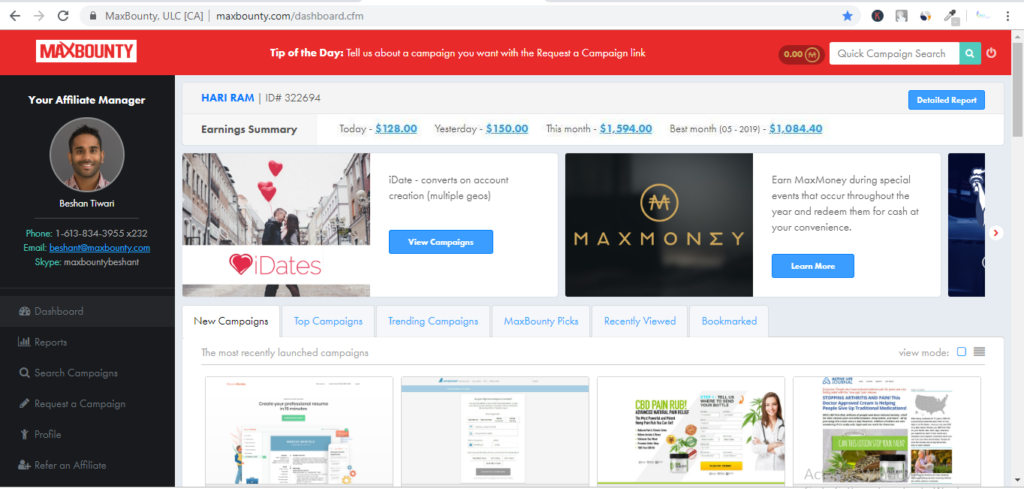
A screenshot from my own MaxBounty publisher dashboard.
Table of Contents
- What Is MaxBounty Affiliate Marketing?
- How CPA Is Different From Normal Affiliate Marketing
- MaxBounty Features That Actually Matter
- Step-by-Step: How to Make Money With MaxBounty
- Free Traffic Methods (Slow but Zero Risk)
- Paid Traffic Methods (Fast but You Can Lose Money)
- Free vs Paid Traffic: Comparison Table
- The Honest Downsides Nobody Mentions
- FAQ
What Is MaxBounty Affiliate Marketing?
MaxBounty is a CPA affiliate network that has been running since 2004, which makes it one of the oldest surviving networks in the industry. That longevity matters — CPA networks that don’t pay their affiliates don’t last 20+ years.
Here’s the simple version of how it works. On one side, MaxBounty has advertisers — companies that want leads, sales, app installs, or sign-ups. On the other side, it has publishers (that’s you, the affiliate). MaxBounty sits in the middle: it hosts 20,000+ campaigns, handles the tracking, and pays you a fixed amount every time someone completes the required action through your link.
That “action” can be different things depending on the campaign:
- A lead — someone fills a form or enters an email (typically lower payouts, easier conversions)
- A sale — someone buys a product (higher payouts, harder conversions)
- A trial or sign-up — someone starts a free trial or creates an account
- An install — someone downloads an app
Verticals cover almost everything: finance, health, ecommerce, travel, dating, sweepstakes, insurance, software, and more. Whatever niche your blog or audience is in, there’s almost certainly a stack of MaxBounty campaigns that fit it.
How CPA Is Different From Normal Affiliate Marketing
If you’ve only done classic affiliate marketing (Amazon-style percentage commissions), CPA works differently in three important ways:
1. You get paid per action, not per percentage. A classic affiliate program might pay you 5% of a $40 product — that’s $2. A CPA campaign might pay you $35 flat for a single qualified lead where nobody even spent money. This is why CPA payouts look shockingly high compared to Amazon-style programs.
2. Sometimes the visitor doesn’t need to buy anything. Lead-generation campaigns pay when someone submits a form. Convincing someone to type their email into a free quote form is dramatically easier than convincing them to pull out a credit card.
3. The advertiser defines strict rules. Each campaign lists allowed traffic types (SEO, social, email, PPC, native, etc.) and banned ones. Break those rules and your conversions get reversed — or your account gets banned. Read the campaign terms every single time. I mean it.
MaxBounty Features That Actually Matter
Built-in tracking system (with Sub IDs)
You don’t need to buy third-party tracking software to start. MaxBounty’s built-in tracking generates your unique link for every campaign, and — this is the part beginners skip — you can append a Sub ID to that link. A Sub ID is just a label you attach so you know exactly where a click came from.
Example: promoting the same offer from a blog post and a Pinterest pin? Use s1=blogpost on one link and s1=pinterest on the other. When a sale comes in, your dashboard shows which Sub ID produced it. Now you know which traffic source deserves more of your time — and which one is dead weight.
💡 Tip from experience: Tag everything with Sub IDs from day one — every article, every ad, every pin. The most common beginner mistake I see is sending mixed traffic to one untagged link, making $60, and having zero idea which effort earned it. That’s not a business, that’s a slot machine.
Accurate reporting: clicks, leads, sales, and Sub IDs
The dashboard shows clicks, leads, sales, conversion rate, and earnings per campaign — and you can break all of it down by Sub ID. Tracking accuracy is one of MaxBounty’s genuine strengths; over two decades, their reputation for not “shaving” conversions is better than most networks in this space.
A dedicated affiliate manager (a real human)
Every approved publisher gets assigned an affiliate manager. This is not a chatbot. Your AM can tell you which campaigns are converting well right now, get you approved for restricted offers, sometimes negotiate a payout bump once you have volume, and answer questions when a campaign’s terms are unclear. Beginners almost never message their AM. Message your AM. It’s the closest thing to a cheat code this industry has.
High payouts and weekly payments
Because it’s CPA, payouts per action are high — many campaigns pay $20–$100+ per conversion, and some physical-product offers pay 40%+ effective rates, which is far above what typical affiliate programs offer on physical goods. Payment terms: your first payment arrives on net-15 terms, and after that you’re paid weekly once you cross the $100 minimum. Payment methods include Payoneer, wire, ACH, and check — Payoneer is the practical choice for most international affiliates, including those of us outside the US.
Step-by-Step: How to Make Money With MaxBounty
Step 1: Apply as a publisher — and take the application seriously
Sign-up is free at maxbounty.com, but MaxBounty rejects a lot of applicants. The application asks how you plan to promote offers. Do not write “social media” and leave it there. Write something specific and true, like: “I run a travel blog monetized with SEO content. I plan to promote travel and finance CPA offers inside my articles and through Pinterest.” Specific, verifiable answers get approved. Vague ones get rejected.
Step 2: Pass the phone interview
Yes, a real interview — usually a short phone or Skype call from an affiliate manager. This scares people off, but it’s a 5–10 minute conversation, not an exam. They ask what niches you work in, how you’ll drive traffic, and whether you understand you can’t spam. Answer honestly. This interview is exactly why MaxBounty’s offers are higher quality than networks that accept anyone with a pulse.
💡 Tip: If they call and you miss it, email your assigned AM to reschedule. Applications often die simply because people never pick up an unknown international number. Watch for a call after you apply.
Step 3: Pick ONE offer that matches traffic you can actually get
With 20,000+ campaigns, the temptation is to promote ten offers at once. Don’t. Pick one. Here’s my filter:
- Match your audience geo. Most high-paying campaigns only accept US/UK/CA/AU traffic. If your audience is elsewhere, filter campaigns by the geos you can actually reach.
- Check allowed traffic types. If a campaign bans social traffic and Pinterest is your plan, move on.
- Beginners: start with lead-gen. A $25 email-submit or quote-form offer converts far more often than a $90 sale offer. Early conversions teach you the game and keep you motivated.
- Ask your AM what’s converting well this month in your niche. They know. It’s literally their job.
Step 4: Generate your tracking link and add Sub IDs
Open the campaign, generate your link, and add a Sub ID for each placement you’ll use. One offer, promoted in three places, means three links with three different Sub IDs. Thirty seconds of setup that saves you months of guessing.
Step 5: Build a bridge — don’t send cold clicks to raw links
The affiliates who lose money send cold traffic straight to an offer page. The affiliates who profit put something in between: a blog post, a review, a comparison article, a short landing page, or a video that pre-sells the offer. This “bridge” warms the visitor up, filters out people who’d never convert, and — critically — most ad platforms won’t let you run direct affiliate links anyway.
Step 6: Send traffic (the next two sections)
This is where 90% of the work lives, so it gets its own sections below.
Step 7: Read your stats weekly and cut what’s not working
Once traffic flows, check your Sub ID report weekly. Double down on the sources producing conversions, kill the ones producing only clicks. Making money with MaxBounty affiliate marketing is not one big win — it’s a loop: test, read data, cut losers, scale winners, repeat.
Free Traffic Methods (Slow but Zero Risk)
“Free” traffic isn’t free — you pay with time instead of money. But you can’t lose cash, and the assets you build keep working for years. Here’s what’s worth your hours:
1. SEO blog content (my main method)
This is what I do. You write articles targeting keywords with buying intent — “best [product] for [problem]”, “[service] review”, “is [offer] legit” — and place your CPA links inside them. It takes 3–6 months for Google to trust a new site, which is why most people quit. But an article that ranks can send targeted visitors every single day for years without you touching it. One good post can outearn a hundred random social posts.
What works: pick a tight niche, answer real questions honestly (including the downsides — readers can smell hype), and match every article to a specific MaxBounty offer before you write it.
2. YouTube
YouTube is a search engine, and video reviews convert extremely well for CPA because viewers feel like they know you. You don’t need to show your face — screen recordings, slideshows with an AI voiceover, or tutorial-style videos all work. Put your tracking link in the description with a clear call to action in the video. Videos, like blog posts, keep earning long after you publish them.
3. Pinterest
Massively underrated for CPA, especially in health, home, finance, and travel niches. Pinterest is also a search engine — pins can drive traffic for months. Best practice: pin to your blog article (the bridge), not directly to the offer, since bare affiliate links get pins throttled or removed.
4. TikTok and Instagram Reels (organic)
Short-form video can explode overnight — one viral video can send thousands of clicks for $0. The catch: you can’t put links in TikTok captions, so you route people to a link-in-bio page that leads to your bridge page. It’s high-effort (you need consistent posting) and traffic dies fast when you stop, but for offers aimed at younger audiences it’s the fastest free method there is.
5. Quora, Reddit, and niche forums
Answer real questions in your niche, genuinely and in detail, and link to your blog article where relevant. Two warnings: never drop raw affiliate links (instant ban on Reddit, and most campaigns forbid it anyway), and don’t post link-stuffed answers. Ten genuinely helpful answers with one natural link beat a hundred spammy ones — and the spammy ones get your accounts nuked.
6. Email list
Not a traffic source — a traffic multiplier. Add an email opt-in to your blog from day one. Every subscriber is a visitor you can bring back for free, forever. When you find a new converting offer, you email your list instead of starting traffic from zero. Every serious affiliate I know says the same thing: “I wish I’d started my list earlier.”
Paid Traffic Methods (Fast but You Can Lose Money)
Paid traffic flips the equation: results in days instead of months, but every mistake costs real money. My honest rule: don’t touch paid traffic until you can afford to lose your entire test budget — because while you’re learning, you probably will. Budget at least $200–$500 for testing before expecting profit, and treat every dollar spent as buying data, not sales.
1. Facebook & Instagram Ads
The most powerful targeting in the industry — age, interests, behavior, lookalikes. Great for ecommerce, lead-gen, and free-plus-shipping style offers. The hard truth: Facebook is hostile to affiliate marketers. Direct affiliate links get ads rejected and accounts banned. You must run traffic to your own landing page or blog first, keep your page legitimate, and follow their ad policies to the letter. Start at $10–$20/day per ad set, test 3–5 different creatives, and kill anything that doesn’t convert within its first $30–$50 of spend.
2. Google Ads & Microsoft (Bing) Ads
Search ads catch people at the exact moment they’re looking for a solution — the highest-intent traffic that exists. Bid on “buyer” keywords and send clicks to your bridge page. Two cautions: campaign terms often ban bidding on the advertiser’s brand name (check every time), and Google’s affiliate policies are strict, so a proper landing page with real content is mandatory. Bing deserves a mention because clicks are often 30–50% cheaper than Google with an older, higher-income audience that suits finance and insurance offers well.
3. Native ads (Taboola, Outbrain, MGID)
Those “sponsored content” boxes under news articles. Native works well with advertorial-style bridge pages — a story-driven article that leads into the offer. It scales enormously once you find a winner, but it’s not beginner-friendly: minimum budgets are higher, and you’ll typically burn a few hundred dollars testing headlines and images before anything clicks. Do this after you’ve profited elsewhere, not first.
4. TikTok Ads
Cheaper clicks than Facebook right now, and the ad format (native-feeling vertical video) suits impulse offers, apps, and ecommerce. You’ll need to produce or generate video creatives, and creative burns out fast — expect to refresh ads every one to two weeks. Good second platform once you’ve validated an offer on cheap traffic.
5. Push and pop traffic — mostly avoid
You’ll see gurus pushing cheap “push notification” and “popunder” traffic at $0.001 per click. It’s cheap because it barely converts, and many MaxBounty campaigns explicitly ban it, which means reversed conversions and account risk. I’m mentioning it so you know what it is when someone tries to sell you a course on it. Skip.
💡 The compliance rule that protects your account: Before spending one rupee or dollar on ads, re-read the campaign’s allowed traffic types, and if anything is unclear, ask your affiliate manager in writing. Running banned traffic doesn’t just waste money — it can void your earnings and end your account. The AM exists precisely so you never have to guess.
Free vs Paid Traffic: Which Should You Choose?
| Factor | Free Traffic | Paid Traffic |
|---|---|---|
| Money needed | $0 (plus hosting if blogging) | $200–$500 minimum test budget |
| Time to first results | Weeks to months | Days |
| Risk | Only your time | Real money lost while learning |
| Longevity | Content earns for years | Stops the moment ads stop |
| Scalability | Limited by your output | Nearly unlimited once profitable |
| Best for | Beginners, tight budgets | Affiliates with a proven offer + budget |
My honest recommendation: start with free traffic — SEO content plus one social channel — and reinvest your first CPA earnings into paid testing. That way the market pays for your ad education instead of your savings.
The Honest Downsides Nobody Mentions
Every MaxBounty review online is suspiciously glowing. Here’s the other side, from someone actually using the platform:
- Approval is genuinely strict. Vague applications get rejected, and the phone interview filters out casual applicants. Good for offer quality, frustrating if you’re brand new with nothing to show.
- Campaigns pause or vanish without warning. An advertiser can cap or kill a campaign overnight. If your entire income rides on one offer, you can wake up to zero. Always have a backup offer identified.
- Most top campaigns want US/UK/CA/AU traffic. If your audience is mostly in South Asia, Africa, or Latin America, your usable campaign list shrinks a lot. You’ll need to build content that attracts Tier-1 audiences.
- Conversions can be reversed. Fraudulent or non-compliant leads get clawed back. Follow campaign rules and this rarely bites you — ignore them and it will.
- The $100 threshold and net-15 first payment mean your first money takes a while to actually land in your account. Plan for that.
- It is not passive at the start. Expect months of unpaid work before consistent income. Anyone telling you otherwise is selling a course.
FAQ: MaxBounty Affiliate Marketing
Is MaxBounty free to join?
Yes. Joining as a publisher is completely free. You never pay MaxBounty anything — they earn from the advertiser’s side. Anyone asking you to pay for “MaxBounty access” is scamming you.
Is MaxBounty legit and does it actually pay?
Yes. MaxBounty has operated since 2004 and pays weekly (after a net-15 first payment) once you reach the $100 minimum, via Payoneer, wire, ACH, or check. A CPA network doesn’t survive 20+ years by stiffing affiliates.
Can I join MaxBounty without a website?
It’s possible — some affiliates get approved with a YouTube channel or established social presence — but a website dramatically improves your approval odds and gives you a compliant place to send paid traffic. A basic WordPress blog costs a few dollars a month and pays for itself.
How much can a beginner realistically earn?
Honestly: $0 for the first one to three months while you build traffic. After that, $100–$500/month is a realistic first milestone with consistent effort, and it compounds from there. The “$1,000/day screenshot” crowd is either experienced media buyers with big ad budgets or people selling you something.
What is a Sub ID in MaxBounty?
A label you attach to your tracking link (like s1=pinterest) so the dashboard shows exactly which placement, article, or ad produced each click and conversion. It’s the difference between guessing and knowing.
MaxBounty vs Amazon Associates — which is better?
Different games. Amazon pays small percentage commissions on a huge product range with instant approval. MaxBounty pays large fixed CPA amounts on curated campaigns with strict approval. For a content site targeting Tier-1 traffic, one CPA conversion can equal fifty Amazon commissions — but Amazon is easier to start with.
Affiliate Disclosure: This article is for educational purposes. Some links on this site are affiliate links, meaning I may earn a commission if you sign up or purchase through them — at no extra cost to you. I only recommend platforms I have personally used. Earnings shown are my own results and are not a guarantee of what you will earn; income from affiliate marketing depends on your effort, traffic, and offers.