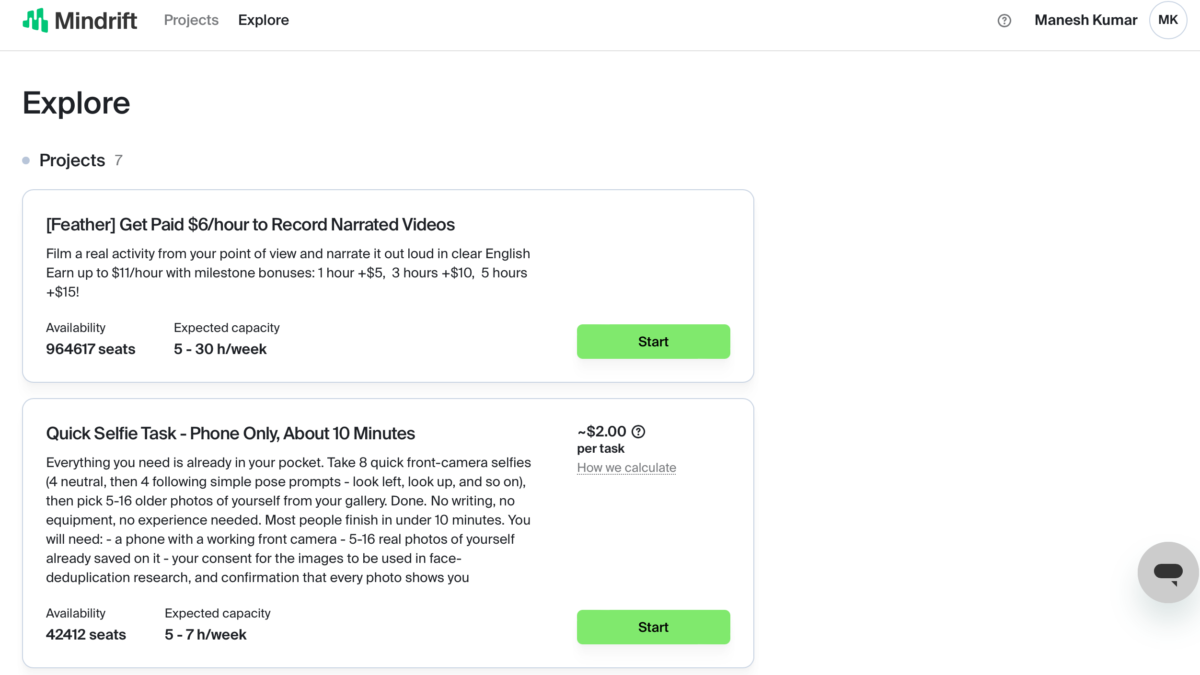
Quick answer: Mindrift is legit — it’s run by Toloka, an AI data company operating since 2014. But the “$15 to $100+/hr” number you’ll see everywhere is describing two different platforms bolted together under one name. The open Explore board pays per task, cents to a few dollars, no application needed. The specialist High-priority board pays $50–$200/hr, but it’s gated behind a CV, assessments, and ID verification. Most reviews don’t separate these clearly. This one does.
Disclosure: I haven’t found a confirmed referral program for Mindrift as of this writing, so nothing below is a paid link — this is a straight research-based review, same as I’d want before signing up for anything myself.
Who actually runs Mindrift
Mindrift is two platforms in one — this is the part people miss
The pay, honestly
How to apply, step by step
Mindrift vs Outlier vs micro1 vs Mercor
Who should sit this out
FAQ
Worth a look: If Mindrift’s specialist track feels out of reach right now, micro1 hires domain experts across engineering, finance, healthcare, legal, and more — no prior AI experience required — with roles paying $55 to $400/hour depending on your field. Worth running alongside Mindrift, not instead of it.
Check open micro1 roles →
This is a referral link — I may earn a bonus if you sign up, at no cost to you.
You’ve seen Mindrift mentioned in every “best AI training platforms” roundup for the last year, usually in one line, usually vague: “run by Toloka,” “pays up to $100/hr,” “good for internationals.” None of that tells you what actually happens when you sign up. So here’s the full picture — pieced together from Mindrift’s own FAQ, contributor reports across multiple independent reviews, and the pattern that keeps repeating once you dig past the marketing page.
Who Actually Runs Mindrift
Mindrift is owned by Toloka AI, an Amsterdam-based data and AI training company that’s been operating since 2014 — long before “AI trainer” was a job title anyone recognized. If you’ve used Toloka before under its older, more generic crowdsourcing brand, Mindrift is the same company wearing a newer, expert-focused label. That history matters here more than it does for newer entrants: Toloka has been paying contributors for over a decade, which is a longer track record than most names in this space.
On the platform itself, contributors are called “AI Trainers” — a deliberately broad term that covers everyone from someone rating chatbot replies in their spare time to a physicist reviewing whether a model’s reasoning about quantum mechanics actually holds up.
Mindrift Is Two Platforms in One — This Is the Part People Miss
This is the single most confusing thing about Mindrift, and it’s why the pay figures you’ll find online contradict each other so badly. Some sites say “$15 to $100 an hour.” Others say “a few cents a task.” Both are true. They’re just describing two completely different tiers that happen to live under the same login.
Explore (all-access tasks). No application, no waiting. You register and start immediately. Tasks are short, generally simple, and paid per task rather than per hour — anywhere from a few cents to a few dollars each. This is the tier that makes Mindrift look instantly accessible, and it genuinely is. What it doesn’t tell you upfront: a task priced at $15 that actually takes three hours to do properly is a $5/hr job, not a $15 one. Check the estimated time against the payout before you commit to a batch, the same way you’d check a Fiverr gig’s real turnaround before quoting it.
High-priority (specialist projects). This is where the real money sits — $50 to $200/hr for people with a genuine domain skill: coding, design, law, medicine, a STEM PhD, advanced language pairs. Getting here means submitting a CV, passing project-specific assessments, and verifying your identity. It’s a real application process, not a formality.
The honest framing: if you don’t have a specialist skill to lean on, Mindrift is decent pocket money and not much more. If you do, your entire strategy should be qualifying for the High-priority board as fast as possible — not grinding Explore tasks and wondering why the hourly math never works out.
The Pay, Honestly
Cross-checking multiple independent reviews against Mindrift’s own FAQ, here’s the range that shows up consistently:
- Generalist Explore work: roughly $15–$30/hr equivalent in higher-cost-of-living countries, often less once you account for tasks that run long.
- Specialist High-priority work: $50–$200/hr, depending on domain, client demand, and your assessed skill level.
- Payout schedule: twice a month, on the 5th and 20th, through Payoneer or Tipalti. No minimum balance required to withdraw.
- No signup fees, ever. Same rule as every legitimate platform in this space — anyone asking you to pay to access tasks is not Mindrift.
One nuance worth flagging clearly: Mindrift doesn’t publish a single flat rate the way some competitors advertise a headline number. Pay is set per project, tied to your country and your verified skill level, and you see the rate before you accept a task. That’s actually a point in its favor — no ambiguity about what a specific batch pays once you’re looking at it, even if the marketing copy upstream is vaguer than it should be.
How to Apply, Step by Step
1. Sign up at mindrift.ai. Create your account and build out your profile — the same rule applies here as everywhere else in this niche: vague skills get vague task matching.
2. Start on Explore if you want to test the platform. No application, no wait. This is also a reasonable way to get a feel for Mindrift’s task style before investing time in the specialist track.
3. Apply to a specialist project when one matches your background. This means a standard Workable-based application, a CV, and project-specific assessments — a meaningfully different flow from Mercor or micro1’s AI-avatar interviews. If you’ve been put off by those, Mindrift’s process will feel more familiar.
4. Verify your identity. Standard anti-fraud step, same as every serious platform in this category.
5. Once approved, tasks appear on your dashboard. Quality is monitored, and consistent, accurate work is what unlocks access to better-paying projects over time — not speed.
Mindrift vs Outlier vs micro1 vs Mercor
| Mindrift | Outlier | micro1 | |
|---|---|---|---|
| Entry barrier | Low (Explore) or moderate (specialist) | Unpaid onboarding assessment | AI-avatar interview (Zara) |
| Typical pay | $15–$30/hr generalist, $50–$200/hr specialist | $15–$50+/hr, region-tiered | $20–$120/hr, up to $400/hr for niche domain experts |
| Payout | Twice monthly, Payoneer/Tipalti | Weekly, PayPal among methods | Bi-weekly, via Deel |
| Country access | Broadly open, varies by project | Requires ID + local mobile number; not every country supported | Actively recruits LATAM, South Asia, SE Asia, Eastern Europe |
For the full breakdown of how Outlier’s assessment actually works, see my Outlier AI Assessment guide. For micro1’s interview process and pay by field, see the micro1 review.
Who Should Sit This Out
Skip Mindrift, at least for now, if you need income today and have no specialist skill to offer — the Explore tier is real but thin, and you’ll spend more energy than it’s worth chasing a decent hourly rate out of per-task pricing. It’s also not the platform for anyone hoping to click into easy, guaranteed daily work; task supply is batch-based here the same as everywhere else in this space, and specialist projects open and close with client demand.
It’s a strong fit if you already have a real, verifiable skill — coding, design, a licensed profession, an advanced degree — and are willing to sit through a real application process to reach the board where the money actually is.
Outlier AI Assessment: What It Tests, Why People Fail
Best AI Training Platforms for Internationals
AI Data Labeling Platforms List
Freelance AI Training Jobs for Beginners
The realistic way to think about any single platform in this space, Mindrift included: it’s a bucket, not a pipe. One good bucket can carry a lot of water, but relying on exactly one means every dry spell is a crisis instead of an inconvenience. Qualify here, keep one or two other platforms warm alongside it, and let whichever one has work that week carry the load.
FAQ
Is Mindrift legit?
Yes. It’s run by Toloka, an AI data company operating since 2014, and charges no signup fees. Payouts are confirmed across multiple independent reviews via Payoneer and Tipalti.
How much does Mindrift pay?
Roughly $15–$30/hr for generalist Explore-tier work, and $50–$200/hr for specialist High-priority projects that require an application and assessment.
Do I need coding skills for Mindrift?
No — coding is only required if your specific project calls for it. Mindrift explicitly frames “AI Trainer” as covering writing, healthcare, physics, and other non-technical domains too.
Is Mindrift available internationally?
Broadly, yes — Mindrift recruits globally. Project availability still depends on client demand and language requirements in your specific country, so check current openings on mindrift.ai directly rather than assuming.
How is Mindrift different from Outlier or micro1?
Mindrift uses a standard CV-and-assessment application for its specialist track, not an AI-avatar interview like Mercor or micro1’s Zara. Its Explore tier also has no application at all, which neither Outlier nor micro1 offers.
Affiliate & Referral Disclosure: Laptop & Coffee is reader-supported. This post contains a referral link for micro1, which means we may earn a bonus if you sign up through it, at no extra cost to you. No confirmed referral relationship with Mindrift exists as of publication — links to mindrift.ai are direct, with no financial benefit to us either way. We state the downsides before every sign-up link, and we only recommend platforms we’ve researched properly. No hype. Just truth. Sip. Click. Earn.
Sources: Mindrift FAQ (mindrift.ai), independent contributor reviews from Self-Made Success, RemoWork, Work Proxy, and RemoteBridge AI (2026).