Disclosure: This post contains affiliate links. If you sign up through them, we may earn a commission at no extra cost to you. It doesn’t change our math or our verdict — see our Affiliate Disclosure.
You’ve picked print-on-demand. You’ve picked Printful. Now comes the question that actually decides whether you make money in your first six months: do you plug it into Etsy or build your own Shopify store?
Most articles answer with vibes. This one answers with fee math — the same $25 t-shirt sold on both platforms, every cost counted, down to the exact number of monthly orders where the answer flips.
The 30-second verdict
Start on Etsy if you have no audience and no ad budget. You’ll pay higher per-sale fees, but Etsy brings you buyers — and buyers you don’t have to find are worth the cut.
Move to (or start on) Shopify if you already have traffic — a blog, a social following, an email list — or you’re doing roughly 18+ orders a month. Below that, Shopify’s subscription eats what its lower fees save.
Either way, Printful works identically: it connects natively to both, fulfills automatically, and doesn’t care where the order came from.
The real difference isn’t fees — it’s who brings the customer
Etsy is a marketplace. Millions of buyers are already there searching “funny plant t-shirt.” When they find yours, Etsy takes a slice of the sale — that’s what its fees actually buy: traffic you didn’t have to earn.
Shopify is a platform. It gives you a professional store, a best-in-class checkout, and total control — and zero visitors. Every person who lands on a new Shopify store got there because you did something: ran ads, wrote content, posted on social, built an email list. The subscription is cheap; the traffic is the real cost.
Keep that in mind as you read the fee tables, because raw fee comparisons quietly ignore it — and it’s the reason most new Shopify POD stores make $0 in month one while mediocre Etsy listings still catch a few sales from search.
Every fee, side by side (2026)
| Cost | Etsy | Shopify (Basic) |
|---|---|---|
| Monthly cost | $0 | $39/mo ($29/mo billed annually) |
| Listing fee | $0.20 per listing, renews every 4 months or on each sale | None — unlimited products |
| Transaction fee | 6.5% of the total order — item price plus shipping | $0 with Shopify Payments (2% surcharge only if you use a third-party gateway) |
| Payment processing | 3% + $0.25 (US rate; varies by country) | 2.9% + $0.30 online (US rate) |
| The ambush fee | Offsite Ads: 15% of the sale when a buyer arrives via Etsy’s external ads. Optional under $10k/year revenue — mandatory at 12% above it | Your own ad spend — whatever you choose, but rarely $0 for a new store |
| Traffic | Built in — Etsy search brings buyers to you | 100% yours to generate |
Sources: Etsy’s fee policy and Shopify’s pricing page, checked July 2026. Both platforms change rates — always confirm before you launch.
The same $25 shirt, sold on both platforms
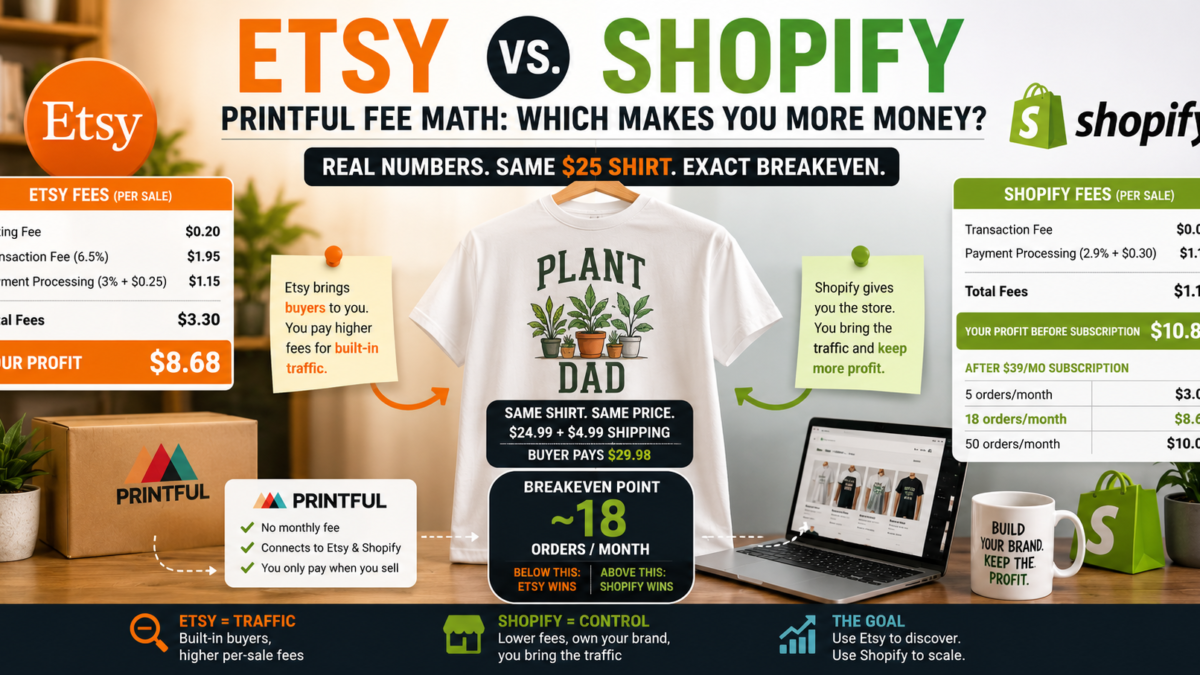
Let’s sell one Printful t-shirt — a Bella+Canvas 3001, the default POD tee — priced at $24.99 + $4.99 shipping, so the buyer pays $29.98.
Printful charges you the base product plus shipping to your customer. For this example we’ll use $13.00 product + $5.00 US shipping = $18.00 fulfillment cost. Printful’s prices vary by print area, color, and destination, so check the live catalog for your exact setup.
On Etsy
- Listing fee: $0.20
- Transaction fee: 6.5% × $29.98 = $1.95 (yes, Etsy takes its cut of your shipping charge too)
- Payment processing: 3% × $29.98 + $0.25 = $1.15
- Total Etsy fees: $3.30 (11% of the order)
Your profit: $29.98 − $18.00 − $3.30 = $8.68 per shirt.
Unless the buyer came through an Offsite Ad. Then add 15% × $29.98 = $4.50 in fees, and your profit drops to $4.18 — cut in half. Under $10k/year you can switch Offsite Ads off in Shop Manager; past $10k you can’t, though the rate drops to 12%. Price with this in mind from day one.
On Shopify
- Transaction fee: $0 (using Shopify Payments)
- Payment processing: 2.9% × $29.98 + $0.30 = $1.17
- Total Shopify per-sale fees: $1.17 (3.9% of the order)
Your profit: $29.98 − $18.00 − $1.17 = $10.81 per shirt — $2.13 more than Etsy on every single sale.
But now subtract the $39/month subscription:
- At 5 orders/month: $10.81 − ($39 ÷ 5) = $3.01 per shirt — worse than Etsy
- At 18 orders/month: $10.81 − ($39 ÷ 18) = $8.64 — the breakeven point with Etsy
- At 50 orders/month: $10.81 − ($39 ÷ 50) = $10.03 — clearly ahead
The number to remember: ~18 orders a month. Below it, Etsy’s higher per-sale fees still cost less than Shopify’s subscription. Above it, every additional order widens Shopify’s lead. And this math is generous to Shopify — it assumes your traffic is free. If you’re paying for ads to get those orders, the real breakeven is higher.
What the fee math can’t show you
Etsy owns your customers. You don’t get their emails for marketing, and Etsy can (and does) show competing products on your own listing page. You’re renting shelf space in someone else’s shop. If your account gets suspended — it happens to POD sellers more often than Etsy admits — your income stops that day.
Shopify compounds; Etsy doesn’t. Every Shopify sale can add an email subscriber you can sell to again for free. Every retargeting pixel gets smarter. Every content page you build keeps ranking. On Etsy, sale #500 costs you the same fees as sale #1, and the audience still belongs to Etsy.
Etsy’s buyers convert; your Shopify traffic might not. An Etsy searcher typing “funny plant t-shirt” is holding their wallet. Cold Instagram traffic hitting a brand-new Shopify store converts at 1–2% on a good day. Traffic quality, not platform features, is why beginners’ Shopify stores fail.
The path we’d actually recommend
This isn’t really an either/or question — it’s a sequencing question.
Phase 1: Validate on Etsy (months 1–6). Zero fixed costs, real buyers, honest feedback. Your only job is finding designs people actually pay for. The fees are tuition.
Phase 2: Add Shopify once you clear ~18–20 orders a month. Don’t close the Etsy shop — Printful connects to both stores at once and syncs your products, so Etsy keeps selling while your own store grows. New Shopify stores currently get 3 months at $1/month, which makes the trial period nearly free.
Phase 3: Shift the center of gravity. Slip a card in every Etsy package pointing to your own store. Build the email list. Over time, Etsy becomes your discovery channel and Shopify becomes your profit channel — the setup where you keep the most of every dollar.
Whichever platform you pick, the fulfillment side is the same decision.
Printful is free to join, has no monthly fee, and connects natively to both Etsy and Shopify — you only pay when something sells.
FAQ
Can I use Printful with Etsy and Shopify at the same time?
Yes. Printful treats each as a separate connected store under one account, and fulfills orders from both automatically. Running both is the standard playbook for sellers in transition.
Do I pay Printful anything monthly?
No. Printful charges only the base product and shipping cost when an order comes in — the account itself is free. Your platform costs (Etsy fees or the Shopify subscription) are separate.
Is the Shopify Starter plan ($5/month) a shortcut?
Not for this. Starter gives you checkout links for social selling, not a real storefront. For an actual POD store, Basic at $39/month is the entry point.
Which is better for a beginner with a small budget?
Etsy, and it isn’t close. $0.20 per listing versus $39/month plus an ad budget — Etsy lets you test designs for the price of a coffee. Just price your products knowing Etsy’s fees run roughly 11% per sale (more if Offsite Ads catch you), and switch Offsite Ads off while you’re under $10k/year if the margins don’t support it.
What about Printful vs. Printify?
Different question — that’s about which fulfillment company prints your products, not where you sell them. We compared them in detail here: Printful vs. Printify: which is actually better?
Numbers in this post reflect US rates as of July 2026 and change over time — verify current fees on Etsy’s and Shopify’s official pricing pages before launching. Spot something outdated? Tell us and we’ll fix it — that’s policy.