For years, the answer to “can I sell on Etsy from Pakistan?” was a frustrating no — followed by risky workarounds involving VPNs, borrowed foreign addresses, and accounts that could vanish overnight. Half the internet still gives you that answer. Quora threads still say Etsy is blocked here. Guides published last year still teach the VPS trick.
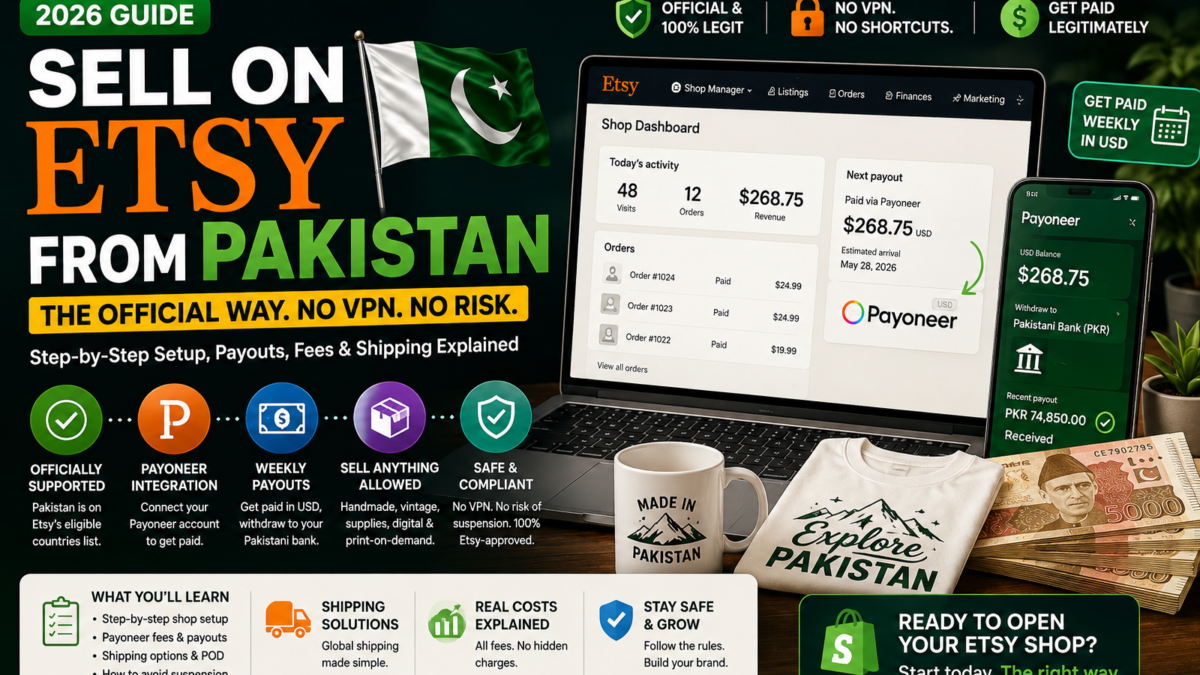
All of it is outdated. Etsy officially supports sellers in Pakistan now — Pakistan is on Etsy’s own eligible countries list, with payments handled through Payoneer. No VPN. No cousin’s address in the UK. No praying your account survives the week.
This guide covers the real, official setup — plus the parts the announcement posts skip: what Payoneer actually costs you on every withdrawal, the verification traps that get accounts suspended even when you’re legitimate, and the honest answer to whether shipping from Pakistan makes sense at all (spoiler: for physical products it’s the hardest part, and there’s a smarter route).
This guide contains affiliate links — full disclosure at the end.
📋 In this guide
1. The official status (and why old guides are dangerous now)
2. What you need before you start
3. Step-by-step: opening your shop from Pakistan
4. How the money actually reaches you (and what it costs)
5. The shipping problem — and the no-inventory route around it
6. How Pakistani sellers get suspended (avoid these)
7. FAQ
The Official Status: Pakistan Is on Etsy’s List
Don’t take my word for it — take Etsy’s. Pakistan appears on Etsy’s official Countries Eligible for Etsy Payments page, in the group of countries that accept payments through a Payoneer Payment Account — alongside India, UAE, Egypt, Brazil, and others. Etsy’s Payments Policy says the same thing in legal language: sellers resident in Pakistan onboard to Etsy Payments by registering with Payoneer.
This matters for one big reason: the old workarounds are now pure risk with zero benefit. If you register with a relative’s UK address and run the shop through a VPS — the method half the older guides still teach — you’re violating Etsy’s account-ownership rules to obtain something you can now get legitimately. Etsy’s detection has real teeth, and a suspended shop loses its listings, its reviews, and any funds in limbo. There is no longer any reason to take that gamble.
What You Need Before You Start
- Your CNIC — Payoneer’s verification asks for a government-issued ID, a selfie, and proof of address. Every detail must match your Etsy account exactly. Mismatched documents are the #1 cause of stalled verifications.
- A Pakistani bank account in your own name — where your PKR withdrawals will land.
- A Payoneer account — or you’ll create one during Etsy enrollment. If you freelance on Upwork or Fiverr, you may already have this.
- A debit or credit card — Etsy requires a valid card on file for billing (your listing fees and Etsy’s cut are charged here or deducted from sales).
- Something to sell — handmade goods, vintage items (20+ years old), craft supplies, digital downloads, or print-on-demand products. Nothing outside those categories survives on Etsy, and reselling AliExpress items gets shops closed.
Step-by-Step: Opening Your Etsy Shop From Pakistan
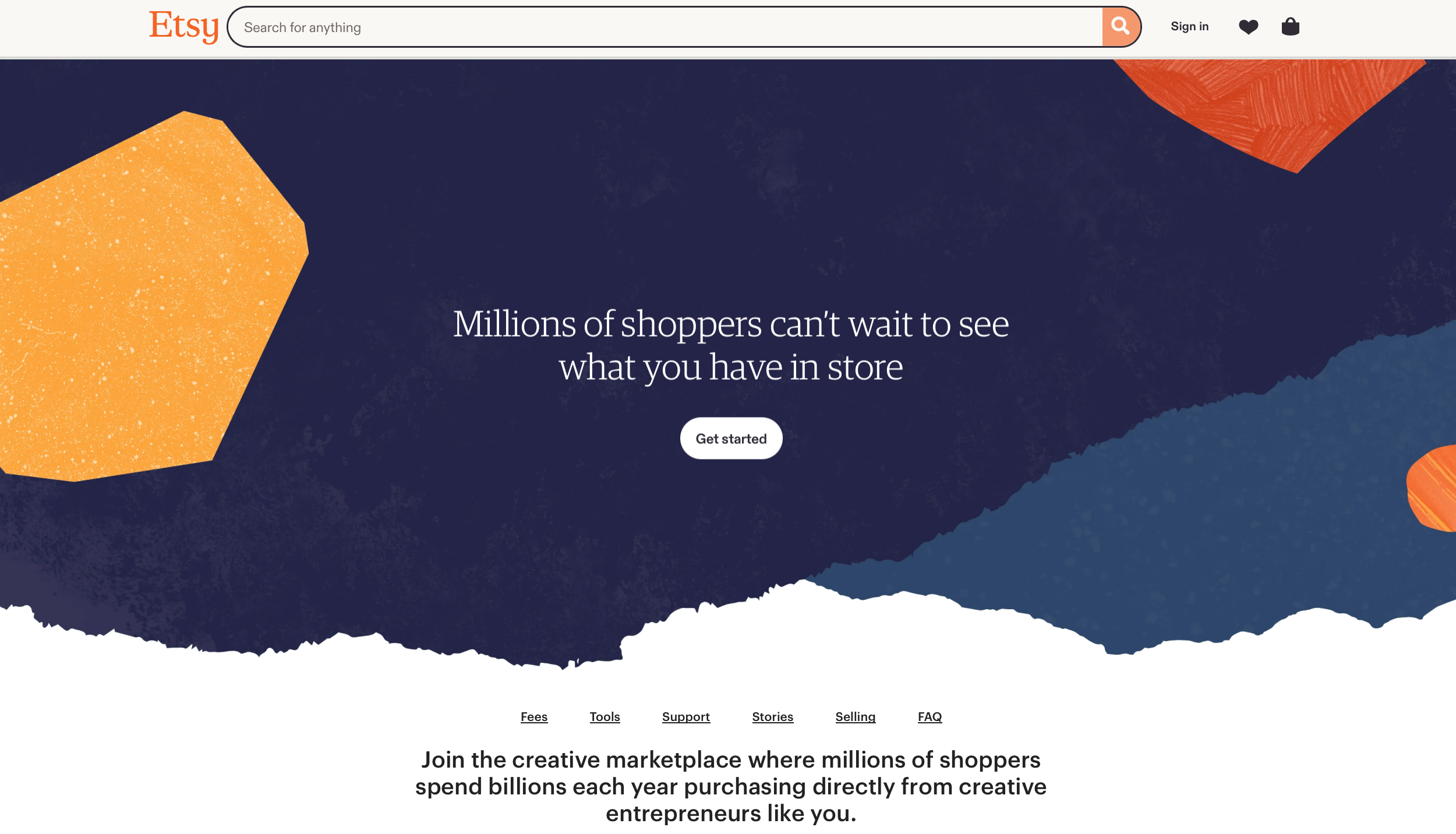
- Create your Etsy account at etsy.com — use an email dedicated to the business, not your personal one. Everything (fees, payouts, verification) hangs off this account.
- Go to “Sell on Etsy” → “Open your Etsy shop.” You’ll answer onboarding questions about what you plan to sell. Be aware that some new sellers are charged a one-time shop setup fee (Etsy shows the amount — typically in the $15–29 range, varying by region — before you complete setup; some sellers aren’t charged at all).
- Set shop preferences. Country: Pakistan. Currency: note that your Payoneer deposits arrive in USD regardless, so many Pakistani sellers list in USD to avoid an extra conversion layer — check the currency fee implications for your setup before locking it in. Language can’t be changed later, so choose carefully.
- Name your shop. Memorable, spellable, and check it’s not trademarked. Your URL becomes yourname.etsy.com.
- Create your first listing. It doesn’t need to be perfect — a draft listing is required to proceed, and you’ll refine it later. $0.20 per listing, active for four months or until sold.
- Enroll in Etsy Payments → connect Payoneer. This is the Pakistan-specific step. You’ll be prompted to sign in to an existing Payoneer account or create one, uploading your CNIC, selfie, and proof of address. Triple-check that your name and address are identical across both platforms.
- Set up billing — add your card — and open the shop. You’re live.
The whole process takes an hour or two, plus however long Payoneer verification takes (usually days, not weeks, if your documents match). Opening the shop is genuinely the easy part — which is exactly why every guide stops here. Let’s keep going.
How the Money Actually Reaches You (And What It Costs)
Here’s the payment chain for a Pakistani seller, honestly labeled with where money leaks out:
- Buyer pays Etsy — by card, PayPal, Apple Pay, whatever they prefer. You never touch this part.
- Etsy takes its fees — the listing fee you already paid, a transaction fee on the sale amount (including shipping), payment processing, and the Offsite Ads fee if the sale came through one of Etsy’s external ads. Verify the current rates on Etsy’s fee page before pricing your products — they’ve changed more than once.
- Etsy deposits to Payoneer weekly — available funds go out each Monday, in USD, to your Payoneer Payment Account. Note: Payoneer countries have deposit minimums and fee thresholds — if your balance is small, it may wait, or incur a deposit fee. Adjusting your deposit schedule to let sales accumulate can dodge the threshold fee.
- You withdraw from Payoneer to your Pakistani bank — this is where the conversion fee lives, typically in the 1–3% range for USD→PKR, landing in your account in a business day or two.
Add it up before you price anything. Between Etsy’s cut and Payoneer’s conversion, the gap between your listing price and your bank balance is real — and pricing without accounting for it is how new sellers end up “busy but broke.” Run the math on one product, line by line, before you list ten.
The Shipping Problem — And the Route Around It
Now the part the celebration posts don’t dwell on. Most Etsy buyers are in the US and Europe, and they’ve been trained to expect fast, cheap shipping. Shipping a physical product from Pakistan means international courier costs (DHL and FedEx are reliable but expensive; Pakistan Post EMS is cheaper but slower), long delivery windows, and customs unpredictability. For genuinely unique items — Pakistani handicrafts, textiles, truck art, calligraphy — buyers will wait, and that’s exactly the category where sellers from Pakistan have a real edge nobody else can copy. For everything else, shipping economics can quietly eat the business.
There are two honest ways to play it:
Route 1 — sell what only Pakistan can make. If your product is genuinely distinctive, price the shipping reality in, set honest delivery expectations in your listings, always add tracking, and let uniqueness justify the wait. Under-promising on delivery time and beating it is worth more reviews than any discount.
Route 2 — skip shipping entirely with print on demand or digital products. With POD, a service like Printful connects directly to your Etsy shop: you upload designs, and when someone orders, Printful prints and ships from fulfillment centers near the buyer — in the US and Europe. Your location becomes irrelevant to delivery speed. You design from Tharparkar; the customer in Texas gets their shirt in days. Digital downloads (planners, templates, art prints, SVGs) go one step further: no shipping exists at all, and margins are nearly pure.
If you’re weighing the POD route, we’ve already done the margin math in detail — see our breakdown of Printful on Etsy vs Shopify (the $25 shirt math), which shows exactly what lands in your pocket per sale on each platform.
How Pakistani Sellers Get Suspended (Avoid These)
Official support doesn’t mean relaxed enforcement. The suspensions that still happen mostly trace back to five avoidable mistakes:
- Mismatched identity details between Etsy, Payoneer, and your documents. Same name, same spelling, same address — everywhere.
- Selling outside the allowed categories. Etsy is for handmade, vintage, craft supplies, digital, and POD. Reselling mass-produced items as “handmade” is the fastest ban on the platform, and enforcement has gotten stricter.
- Ignoring messages. Slow responses and unshipped orders tank your metrics — and metrics trigger reviews of your account.
- No tracking on physical orders. International orders without tracking generate “item not received” cases, and enough cases end a shop.
- Leftover workaround habits — logging in through VPNs, mixed-country details from an old setup. Now that you can be fully legitimate, be fully legitimate.
FAQ
Can I sell on Etsy from Pakistan without a VPN?
Yes — and you shouldn’t use one. Pakistan is officially on Etsy’s eligible countries list, with payments through Payoneer. VPN-based workaround accounts violate Etsy’s rules and risk suspension for no benefit.
How do I receive Etsy payments in Pakistan?
Through a Payoneer Payment Account — it’s required for Pakistani sellers, not optional. Etsy deposits available funds weekly in USD; you withdraw to your Pakistani bank in PKR, paying Payoneer’s conversion fee (typically 1–3%).
How much does it cost to start an Etsy shop from Pakistan?
Possibly a one-time setup fee (shown before you finish setup; not everyone is charged), $0.20 per listing, and per-sale fees (transaction, payment processing, and Offsite Ads when applicable). Check Etsy’s current fee page for exact rates — they change.
Do I need PayPal?
No — and that’s the point. PayPal doesn’t operate in Pakistan, which was the old blocker. Buyers can still pay with PayPal on their side; it routes through Etsy Payments and reaches you via Payoneer.
What should I sell from Pakistan?
The strongest plays are either uniquely Pakistani physical products (handicrafts, textiles, calligraphy — where the origin is the selling point) or location-independent products: digital downloads and print-on-demand, where fulfillment happens near the buyer and Pakistan’s shipping costs never enter the equation.
The Bottom Line
The door is open — officially, finally, no tricks required. What hasn’t changed is everything after the door: verification demands precision, the Payoneer chain takes its cut, shipping from Pakistan needs either a unique product or a POD workaround, and Etsy’s rules apply to you like everyone else. Set it up right the first time — matched documents, honest listings, tracked shipping or no shipping at all — and you’ll have something thousands of Pakistani sellers spent years risking suspensions to get: a legitimate storefront in front of millions of international buyers.
Start with one product and the full fee math done honestly. Everything else grows from there. ☕
Affiliate disclosure: This post contains affiliate links. If you sign up or buy through our links we may earn a commission at no extra cost to you. We only recommend tools and services we’d genuinely use ourselves. Platform policies, fees, and country availability reflect 2026 information and can change — always confirm current details on Etsy’s and Payoneer’s official pages. See our full affiliate disclosure and editorial policy.