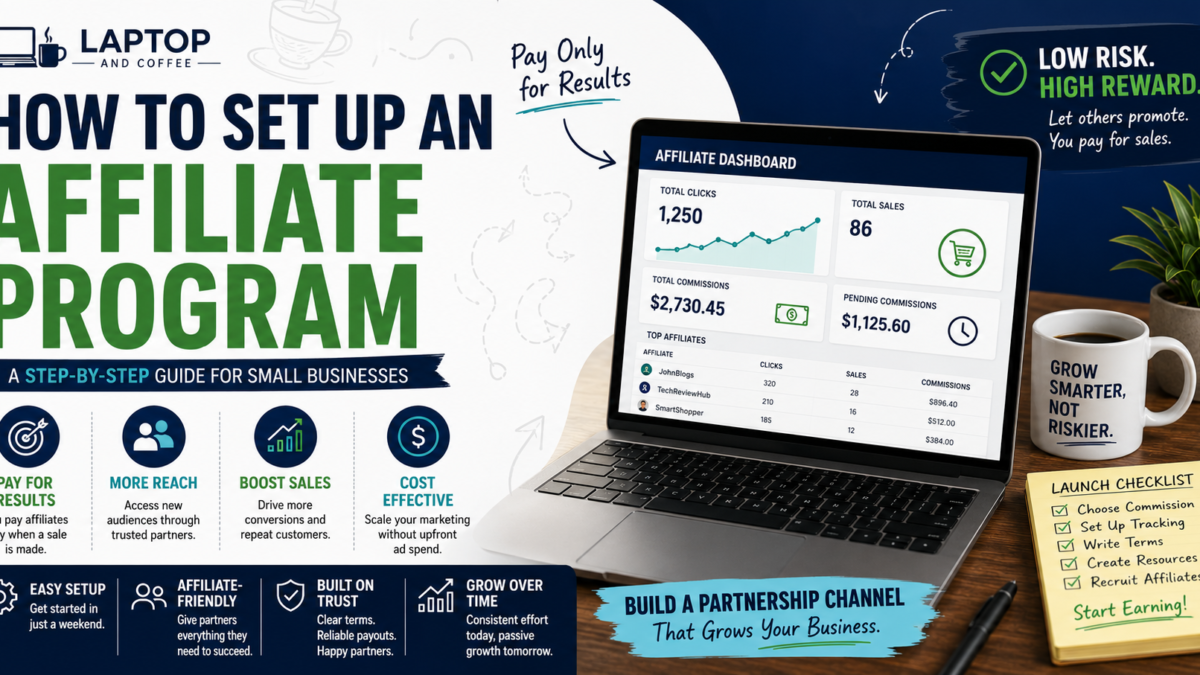
Paying for marketing usually means paying first and hoping the sales show up. An affiliate program flips that order. Other people promote your product, and you pay them a cut only when a sale actually happens. For a small business with a limited budget, that’s about as low-risk as customer acquisition gets — which is why so many owners eventually ask how to set one up.
I’ve been around this from a few angles. I promote products as an affiliate through several networks, I’ve set up and run a program for one of our own ecommerce brands, and affiliate program management is part of what I do for clients. So this guide is the version I’d give a friend who owns a small store: what to decide before you build anything, how to actually launch, and the parts that quietly determine whether affiliates promote you or ignore you.
📋 In this guide
1. First, check whether you’re ready for one
2. Decide the commission before anything else
3. Software or network: how to run it
4. Terms, tracking, and the boring essentials
5. What makes affiliates actually promote you
6. Finding your first affiliates
7. Running it month to month
8. When to hire help instead
9. FAQ
First, Check Whether You’re Ready for One
An affiliate program multiplies what already exists. If your product sells and your site converts, affiliates pour fuel on that. If your product doesn’t sell yet, affiliates will send you traffic that bounces, conclude your offer is weak, and quietly stop promoting — and word travels among affiliates faster than most owners realize.
Three questions to answer honestly before building anything:
- Do your margins have room? You’ll be giving away a meaningful slice of each sale — often 10–30% for physical products, more for digital. If your margins are thin, the program eats your profit instead of growing it. Do this math first; everything else depends on it.
- Does your site already convert? Affiliates deliver clicks; your product page has to close them. If your own traffic converts poorly, fix that before inviting partners to watch it convert poorly at scale.
- Is it really affiliates you need? If your best promoters would be your existing happy customers, a simple referral program (a discount or credit for bringing a friend) may serve you better than a commission-based program built for professional marketers and creators. They’re different tools; plenty of businesses that “need an affiliate program” actually need the other one.
Decide the Commission Before Anything Else
The commission is the product you’re selling to affiliates, so it deserves more thought than it usually gets. Work from your margin downward, not from a random percentage upward: take your profit per sale, decide how much of it you’d happily trade for a sale you’d otherwise never get, and remember that a new customer often buys again — so a commission that looks painful on the first order can be cheap across the customer’s lifetime.
Two practical anchors. First, look up what programs in your niche pay — affiliates certainly will, and if your rate sits well below the going rate, your program is invisible no matter how good the product is. Second, when in doubt, launch generous. It’s far easier to attract your first affiliates with a strong rate and adjust later for new partners than to relaunch a program that nobody joined. When I set the payout for our own product, I went noticeably above the category norm on purpose — attention from good affiliates is the scarce resource early on, and the rate is how you buy it.
Software or Network: How to Run It
There are two ways to operate a program, and the right choice depends on where your future affiliates will come from.
Self-hosted software — an app or plugin on your own store that handles links, tracking, and payouts. On Shopify that’s apps like UpPromote or GoAffPro; on WordPress/WooCommerce, plugins in the AffiliateWP family. Costs are low (free tiers exist, paid plans typically run $20–$100/month), you keep control, and you keep the full margin. The catch: nobody finds you. You recruit every single affiliate yourself.
An affiliate network — marketplaces like ShareASale, Awin, Impact, or CPA networks like MaxBounty, where thousands of affiliates already browse for offers. You get discovery and built-in payment handling, but networks charge setup fees, monthly minimums, and a percentage override on top of every commission. For a very small business, network costs can exceed the value of discovery in year one.
My general advice for a first program: start with self-hosted software and manual recruiting. It keeps costs near zero while you learn what works, and you can always graduate to a network once the program has proof behind it. The exception is a product with mass appeal and strong margins, where a network’s reach justifies its fees from day one — that’s the route we took with our own brand, and the fees were worth it precisely because the offer could carry them.
Terms, Tracking, and the Boring Essentials
Before going live, a handful of unglamorous pieces need to exist:
- Program terms. What affiliates may and may not do: no bidding on your brand name in ads, no spam, no fake discount codes, honest disclosure of affiliate links (which regulators require of them anyway). Templates exist online as a starting point; have a lawyer look over the final version if real money will flow through it.
- Cookie window. How long after a click a sale still credits the affiliate. Thirty days is a common, fair default. Shorter windows save you pennies and cost you partners — affiliates check this number before joining, always.
- Payment schedule and threshold. Monthly payouts with a modest minimum (say $25–$50) is standard. Decide it now and honor it religiously; nothing kills a program faster than late payments.
- A refund holding period. Hold commissions until your refund window closes, so you’re not paying commission on returned orders. Every serious program does this; affiliates expect it.
- An affiliate resources page. Your product images, logo, approved descriptions, and links in one place. Affiliates promote the prepared programs first because they can start in ten minutes.
What Makes Affiliates Actually Promote You
Speaking as someone who evaluates programs from the promoting side regularly: an affiliate deciding whether to feature your product looks at a short, ruthless checklist. A competitive commission. A cookie window that isn’t insulting. Evidence the product converts — because our income depends on your checkout, not your promises. Ready-made creatives. And payment reliability, which we check by reputation before writing a word about you.
Notice what’s not on that list: your passion for the product, your founding story, your growth plans. Affiliates hear those in every recruitment email. What moves them is the math and the ease. If you want a window into how your future partners think, our post on why affiliate links get clicks but no sales shows the diagnosis affiliates run on merchants — including the moment they decide a merchant’s landing page is the problem and swap to a competitor. Don’t be the merchant that gets swapped.
Finding Your First Affiliates
Your first ten affiliates come from effort, not discovery. The places to look, roughly in order of conversion: your own customers who already post about you (they believe in the product and have proof); bloggers and small YouTubers already covering your niche — the ones writing “best X” posts your product belongs in; micro-influencers whose audience matches your buyer; and creators in adjacent niches whose followers overlap yours.
Keep the outreach short and lead with their benefit: what you pay, what the product is, proof it converts, and a one-click way to join. Recruitment outreach is a craft of its own and deserves its own full post — for now, know that ten personal emails to well-chosen partners outperform a hundred copy-pasted ones, every time.
Running It Month to Month
A launched program isn’t a finished program. The recurring work, honestly sized at a few hours a month for a small operation:
- Review applications. Approve real promoters; decline coupon-site clones and empty accounts. An open-door program fills with partners who add nothing and skim commissions from sales you’d have made anyway.
- Watch for fraud. Self-purchases through their own links, cookie stuffing, misleading ads in your brand’s name. Small programs get tested by these constantly. Your terms are what let you remove offenders cleanly.
- Pay on time. Every time. Worth repeating because it decides your reputation among affiliates more than anything else you do.
- Talk to your top partners. A short monthly note — what’s selling, new creatives, a seasonal push — keeps you in their plans. Most programs go quiet after launch; the ones that don’t are the ones that grow.
When to Hire Help Instead
Everything above is learnable, but it’s also a real workload on top of running your actual business. If the setup or the monthly management is the thing stopping you, this is a well-established freelance category: on Fiverr you can hire program setup (software configured, terms drafted, resources page built) as a one-time project, or ongoing program management by the month. The same rules apply as hiring for anything else — make sure accounts are created in your name, ask what’s included, and expect to still own the relationship with your top affiliates yourself, because partners promote businesses, not middlemen.
FAQ
How much does it cost to start an affiliate program?
With self-hosted software, often under $50/month plus commissions on actual sales. Joining an affiliate network adds setup fees and monthly minimums that can run into hundreds — usually a later-stage move, not a first one.
What commission should a small business offer?
Enough to compete in your niche — commonly 10–30% for physical products and higher for digital, but the honest answer starts from your own margin math and what nearby programs pay. Launch on the generous side; obscurity is more expensive than commission.
How long until an affiliate program produces sales?
Expect a quiet first few months while you recruit and your partners create content. A program with steady recruiting typically shows real movement over one to two quarters, not weeks. Anyone promising faster is selling something.
Affiliate program or referral program — what’s the difference?
Referral programs reward your existing customers for bringing friends, usually with discounts or credit. Affiliate programs pay cash commissions to outside marketers, bloggers, and creators. If your best advocates already buy from you, start with referrals; if you need reach beyond your customer base, affiliates.
Do affiliates have to disclose that they earn from my links?
Yes — disclosure is a legal requirement for affiliates in most major markets, and your program terms should require it explicitly. It protects them, you, and honestly, it converts fine; readers don’t mind disclosed links from sources they trust.
The Bottom Line
An affiliate program is one of the few marketing channels where a small business pays only for results — but it’s a partnership machine, not a vending machine. The build is a weekend: margins checked, commission set, software configured, terms written. The growth is a habit: recruit steadily, pay reliably, keep your partners equipped. Do the unglamorous parts for two or three quarters and you end up with something most marketing budgets can’t buy — other people with audiences, choosing to sell for you. ☕
Affiliate disclosure: This post contains affiliate links. If you sign up or buy through our links we may earn a commission at no extra cost to you. We only recommend tools and services we’d genuinely use ourselves. Pricing and platform details reflect 2026 information and change often. See our full affiliate disclosure and editorial policy.