Ask ten software vendors what an “AI agent” is and you’ll get ten different answers, most of them marketing copy. Here’s the plain version: a chatbot answers questions. An agent finishes tasks. It can look something up, make a decision about what to do next, take an action in another app, and keep going without you approving every step.
If you’ve already got a chatbot handling FAQs on your Shopify store or your WhatsApp line, this is the layer above that — and in 2026, it’s where a lot of the small business AI conversation has moved.
Before the pitch, though, here’s the part most “best AI agents” roundups skip.
The Reality Check First
Analyst firm Gartner is projecting that more than 40% of agentic AI projects will be scrapped by the end of 2027. The top reasons aren’t that the technology doesn’t work — it’s integration problems with existing systems, poor data quality, and implementation costs running higher than expected.
That matters because most of what you’ll read about AI agents this year is written like the outcome is guaranteed. It isn’t. It works well in specific, narrow situations and fails in exactly the way you’d expect anything automated to fail: when the task is messy, low-volume, or full of edge cases nobody planned for.
So before you look at tools, look at cost. Off-the-shelf agent tools generally run $50–$200 a month per tool. If you end up running a small stack of two or three, budget $200–$500 a month total. Custom-built agents wired into your specific systems cost a lot more — think thousands upfront plus ongoing fees — and that route rarely makes sense for a small store or solo operation.
Where Agents Actually Pay Off
The data that exists so far points to a fairly narrow set of use cases where agents are worth the setup time:
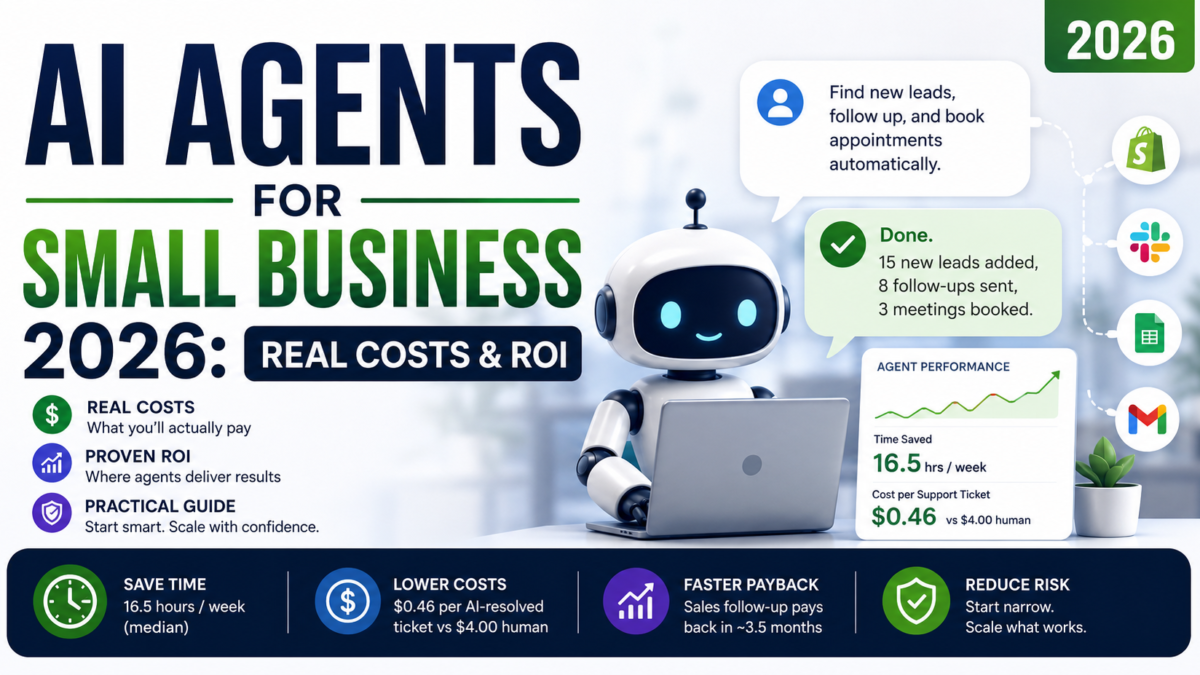
- Sales follow-up. This is reportedly the fastest category to pay for itself — typically inside three and a half months.
- Customer support. An AI-resolved support ticket costs somewhere around 46 cents, compared to roughly $4 for a ticket a human handles start to finish. That gap is why support is usually the first place businesses point an agent.
- Admin and scheduling. Inbox triage, meeting notes, appointment booking — the repetitive stuff that eats a Sunday evening.
- Weekly reporting. Pulling numbers from sales or accounting tools into something readable, instead of exporting three spreadsheets by hand.
One industry survey found small businesses using AI tools save a combined median of around 16.5 hours a week across the owner and staff. That’s a real number, but it’s a median across businesses that picked the right task for the tool — not a guarantee.
Where They Fail
The pattern in every teardown of failed agent projects is the same: someone tried to hand over something too broad, too irregular, or too dependent on messy internal data.
The deployments that actually stick share one trait — narrow scope with clear boundaries. Not “manage my business,” but “draft a reply to every WhatsApp message that comes in after hours” or “flag any lead that hasn’t replied in five days.”
The advice from people who’ve tested a lot of these tools is worth repeating here: add a second agent only once the first one is stable. Running two or three untested tools at once multiplies the number of things that can quietly break, and you won’t know which tool caused the problem.
Three Tools Worth Knowing About
This isn’t a full review of any of these — just enough to orient you before you go looking.
Zapier Agents — The cheapest entry point if you’re already using Zapier for anything. Its Professional plan sits around $29.99/month and covers multi-step automation. Less “intelligent” than the AI-native tools below, but predictable, and it connects to thousands of apps you probably already use.
Lindy AI — Built specifically as an AI agent that makes decisions rather than following rigid if-this-then-that rules. Repriced in 2026 to three tiers — Plus at $49.99, Pro at $99.99, Max at $199.99 — billed on a credit system. Worth knowing going in: per-step costs aren’t visible until after the agent runs, which is the most common complaint in user reviews. Good fit for inbox management, meeting prep, and lead research.
Microsoft Copilot (agentic mode) — If you’re already paying for Microsoft 365, this is worth activating before you buy a separate tool. The 2026 version can execute multi-step tasks across apps — for example, pulling numbers out of Excel, dropping them into a Word report, and emailing it through Outlook, from a single instruction.
How to Actually Start
Skip the “deploy five agents across the business” plan you’ll see in some of the hype-driven guides. A simpler approach holds up better:
- Pick one workflow that’s repetitive, high-volume, and annoying — not a one-off task.
- Run it with one tool for 30 days before adding anything else.
- Track what it actually saved you in hours or in ticket/lead volume, not just whether it “felt” useful.
- Only then decide whether a second agent earns its subscription.
This is close to the same approach behind the chatbot rollout on our own stores — start with one narrow job, get it solid, then decide if it’s worth building on. Chatbots and agents solve different problems, but the rollout discipline is identical. You can read how that’s going in our Tidio for Shopify setup review.
Should You Bother in 2026?
If you can point an agent at one stable, repetitive, high-volume task — support tickets, lead follow-up, inbox triage — yes, and the payback numbers above back that up. If what you actually want is something that runs your business end to end with no oversight, that product doesn’t exist yet, and the failure-rate data says a lot of people are finding that out the expensive way.
FAQ
What’s the difference between a chatbot and an AI agent?
A chatbot answers questions. An agent finishes tasks — it can look something up, decide what to do next, and act, without you approving each step.
How much does an AI agent cost for a small business?
Most ready-made tools run $50–$200 a month each. A small stack of two or three usually lands around $200–$500 a month.
Are AI agents actually worth it in 2026?
Yes, if you give one a single steady job like support tickets or lead follow-up. No, if you’re expecting it to run your whole business unsupervised — that doesn’t exist yet.
What’s the biggest reason AI agent projects fail?
Handing them a job that’s too broad, too irregular, or built on messy data. Gartner expects over 40% of agentic AI projects to be shut down by the end of 2027 for exactly this reason.
Sources referenced: Gartner agentic AI project cancellation forecast (via Taylance Tech, 2026); SBE Council 2026 small business AI usage survey; agent tool pricing verified via vendor comparison sites (Zapier, Lindy AI) as of July 2026.