Here is a number that made me sit up: voice actors have collectively earned more than $5 million by letting an AI company use copies of their voices. Not by recording in studios. Not by chasing clients. They recorded their voice once, uploaded it, and got paid every time someone else used it.
The company is ElevenLabs, and the program is called the Voice Library. And no, you do not need to be a professional voice actor to join it. You need a decent microphone, a quiet room, and about a weekend of setup.
In this guide I will walk you through exactly how to sell your voice to AI as a complete beginner: how the money works, what it costs to start, what you can realistically earn, and — because this is Laptop & Coffee and we do not do hype — the honest reasons this might not be worth your time. Read the cons before you spend a rupee or a dollar. Deal? Let’s go.
Quick note: some links in this post are affiliate links, which means I may earn a commission if you sign up — at no extra cost to you. I only recommend tools I have researched properly.
What does it actually mean to sell your voice to AI?
Think of it like renting out a house, except the house is your voice.
ElevenLabs is one of the biggest AI voice companies in the world. As of early 2026 it is valued at around $11 billion, backed by investors like Sequoia and Nvidia, and pulling in over $330 million a year in revenue. Its main product turns written text into spoken audio that sounds genuinely human — creators use it for YouTube videos, audiobooks, podcasts, ads, and phone assistants.
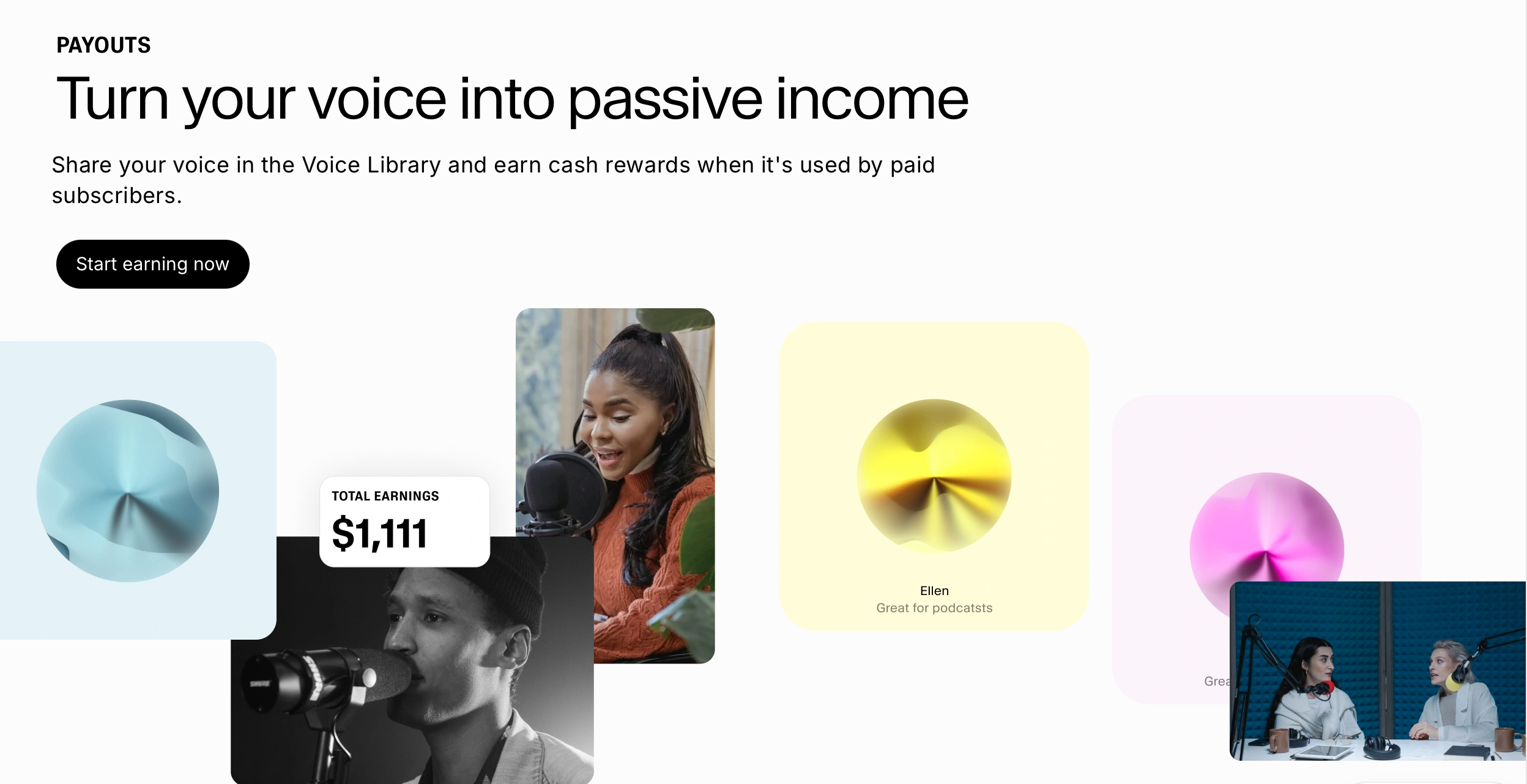
All those AI voices have to come from somewhere. That is where the Voice Library comes in. It is a public catalog of voices that real people have cloned and listed. When a paying ElevenLabs user picks your voice to narrate their video or audiobook, you earn a small royalty. Automatically. While you sleep, cook, or work your day job.
You are not signing away your voice forever, and nobody can legally clone you without your consent — ElevenLabs requires verified permission before a voice can be cloned, and impersonating someone without consent is against their rules. You stay in control of your listing.
How the money actually works
This part is refreshingly simple, and it is measured in something you might not expect: characters. Not characters like movie characters — characters as in letters and spaces of text.
Every time a paying user generates audio with your voice, ElevenLabs counts how many characters of text were converted. You earn a fixed fee per 1,000 characters. The default rate sits around $0.03 per 1,000 characters, and established voices can set a custom rate up to a platform cap.
Quick mental picture:
1,000 characters is roughly 150–180 spoken words — about one minute of narration. So if someone uses your voice to narrate a 10-minute YouTube video, that is roughly 10,000 characters, which earns you around $0.30 at the default rate. Small per use. The whole game is volume: hundreds of users, thousands of generations, month after month.
Payouts go through Stripe Connect, which you link to your ElevenLabs account. One important detail beginners miss: only usage by paying subscribers counts. If someone on the free plan uses your voice, you earn nothing from it. Keep that in mind when you see your voice getting “used” but the earnings crawl.
What you need before you start
Four things. That is the whole shopping list.
1. An ElevenLabs Creator plan ($22/month). The free plan lets you play with the tool, but to create a Professional Voice Clone — the high-quality clone type that can be listed in the Voice Library — you need the Creator plan or higher. And to keep receiving payouts, you must stay on at least the Starter plan ($5/month). Yes, that means this side hustle has a running cost. I will address whether that is worth it in the cons section — do not skip it.
2. A decent microphone. You do not need a studio. A USB mic in the $50–$80 range, or even a good phone with a quiet room, can produce a clean sample. What matters most is background noise — the AI clones everything it hears, including your ceiling fan.
3. About 30 minutes of clean voice recording. Professional Voice Clones are trained on a longer sample. Read naturally — a book chapter, a blog post, anything. Consistent pace, no shouting, no whispering.
4. A Stripe account for payouts. Free to set up. If Stripe does not support direct payouts in your country, check their supported-country list first — this matters for readers in Pakistan and similar markets, and there are workarounds like Payoneer-linked setups, but verify before you invest the subscription money.
Setting it up, step by step
Step 1 — Create your account and upgrade to Creator. Sign up at ElevenLabs, then upgrade so the Professional Voice Clone option unlocks.
Step 2 — Record your sample. Quiet room, steady distance from the mic, 30+ minutes of natural reading. Record at your normal energy level — the clone will sound like whatever you feed it.
Step 3 — Create the Professional Voice Clone. Upload your recording and verify your identity with a spoken consent statement. This is the consent safeguard I mentioned earlier — it protects you as much as it protects them. Training takes a few hours.
Step 4 — Publish to the Voice Library. Give your voice a clear name and description. Be specific: “warm South Asian male English, calm explainer style” gets found; “my voice” does not. Choose your reward setting — default rate, or a custom rate where available. A longer notice period (how much warning you give before pulling your voice) generally earns a better rate.
Step 5 — Connect Stripe and forget about it. Link your payout account, then go live your life. Earnings accrue in the background as people use your voice. Check monthly, not hourly — this is a slow-drip income stream, and watching it daily will only frustrate you.
What can you realistically earn?
Here is where most blogs start lying to you. I am not going to.
The $5 million paid out sounds huge, but it is spread across thousands of voices over roughly two years. The distribution is lopsided: a small number of popular voices earn the majority, and most voices earn pocket money, especially in their first months.
Three honest scenarios at the default rate (~$0.03 per 1,000 characters):
Quiet month: your voice gets light use — 200,000 characters → about $6. Does not even cover your Starter plan and a coffee.
Steady month: your voice finds a niche audience — 2 million characters → about $60. Now it is real, recurring money for work you did once.
Breakout month: a few YouTube channels adopt your voice for regular content — 10 million+ characters → $300+. This happens, but it is the exception, not the promise.
The pattern that separates earners from quitters: earnings compound with visibility. Every creator who adopts your voice keeps generating characters month after month. Your first $10 is the hardest. Your hundredth is automatic.
The honest cons — read this before you pay for anything
Con 1: You pay before you earn. The Creator plan costs $22/month, and early earnings will likely be under $10/month. You could be net-negative for your first few months. If $22/month is painful for your budget, wait until it is not.
Con 2: It is a visibility lottery. The Voice Library is a marketplace, and marketplaces have winners and long tails. A generic voice with a lazy description will sit unused. Distinctive accents, languages, and delivery styles have a real edge — a natural Urdu or Pakistani-English voice is far rarer in the library than another American male narrator.
Con 3: Free users generate nothing for you. Your dashboard may show usage that never turns into money, because only paid-subscriber usage pays out. Expect the earnings number to look smaller than the activity number.
Con 4: It is passive, which also means uncontrollable. You cannot force people to pick your voice. You can improve your recording quality and description, then you wait. If you need income you can push harder on this month, freelance voiceover gigs on Fiverr or Upwork — using the very same tools — give you more control.
Still interested after all that? Good. That means you have the right expectations, and people with right expectations are the ones who stick around long enough to earn.
Ready to put your voice to work?
Start on the free plan, test the voice quality yourself, and upgrade to Creator only when you are ready to publish your clone.
Affiliate link — supports the blog at no extra cost to you.
Who should skip this
Skip the Voice Library if you need money this month — it is too slow. Skip it if you cannot record in a genuinely quiet space — a noisy clone will never get picked. And skip it if the monthly plan cost would stress your budget — no side hustle should start with financial pressure.
Better fits for those situations: freelance voiceover services (active income, faster), or getting paid to train AI models — I have covered the platforms that accept international workers elsewhere on this blog. And if you are building a faceless YouTube channel, ElevenLabs works from the other direction too: instead of selling your voice, you use their voices to narrate your videos. Two sides of the same tool.
Frequently asked questions
Can I really sell my voice to AI as a beginner?
Yes. The ElevenLabs Voice Library is self-serve — no agent, no contract negotiation. You record a sample, create a Professional Voice Clone, publish it, and earn a royalty whenever paying users generate audio with it.
How much does ElevenLabs pay per 1,000 characters?
The default reward is around $0.03 per 1,000 characters (roughly one minute of speech). Established voices can set custom rates, and longer notice-period commitments generally earn better terms.
Do I need a paid plan to earn?
Yes. You need the Creator plan ($22/month) or higher to create and publish a Professional Voice Clone, and at least the Starter plan ($5/month) to keep receiving payouts.
Is it safe? Can someone steal my voice?
ElevenLabs requires verified spoken consent before a voice can be professionally cloned, and cloning or impersonating someone without permission violates their policies. You control your listing and can remove it, subject to your chosen notice period.
How do I get paid in Pakistan or other countries?
Payouts run through Stripe Connect. Check Stripe’s supported-country list for your region before subscribing; some creators route payments through supported business setups or services like Payoneer. Verify your path first — do not pay for a plan you cannot get paid from.
Affiliate Disclosure
Laptop & Coffee is reader-supported. This post contains affiliate links to ElevenLabs, which means we may earn a commission if you sign up through them — at no additional cost to you. We only recommend tools we have researched thoroughly, and we always tell you the downsides before the sign-up button. That is the deal here: no hype, just truth. Sip. Click. Earn.