You’ve seen the screenshots. “$4,000 in my first month with a faceless channel!” But nobody shows you what months 1-3 actually look like for most beginners. Let’s talk real numbers — faceless YouTube channel realistic earnings, no hype.
Month 1: Why Most Channels Earn $0 (And That’s Normal)
Here’s the uncomfortable truth: YouTube requires 1,000 subscribers and 4,000 watch hours (or 10 million Shorts views in 90 days) before you can even turn on monetization. Most beginners don’t hit that threshold in month 1 — which means most faceless channels earn $0 in direct ad revenue during their first month, regardless of how good the content is.
What you’re actually building in month 1 is the foundation: your niche, your first 10-15 videos, and your upload rhythm. If you’re still deciding on production tools, our InVideo AI review breaks down whether it’s worth it for faceless YouTube specifically, before you commit to a monthly tool cost this early.
Plan B while you wait for monetization: Most beginner creators supplement month 1-2 with affiliate links in video descriptions (tools, courses, software you actually use) rather than waiting on AdSense alone. If you don’t already have an affiliate network set up, our MaxBounty review covers approval odds and payout details for exactly this kind of early-stage income. Sign up to Maxbounty here
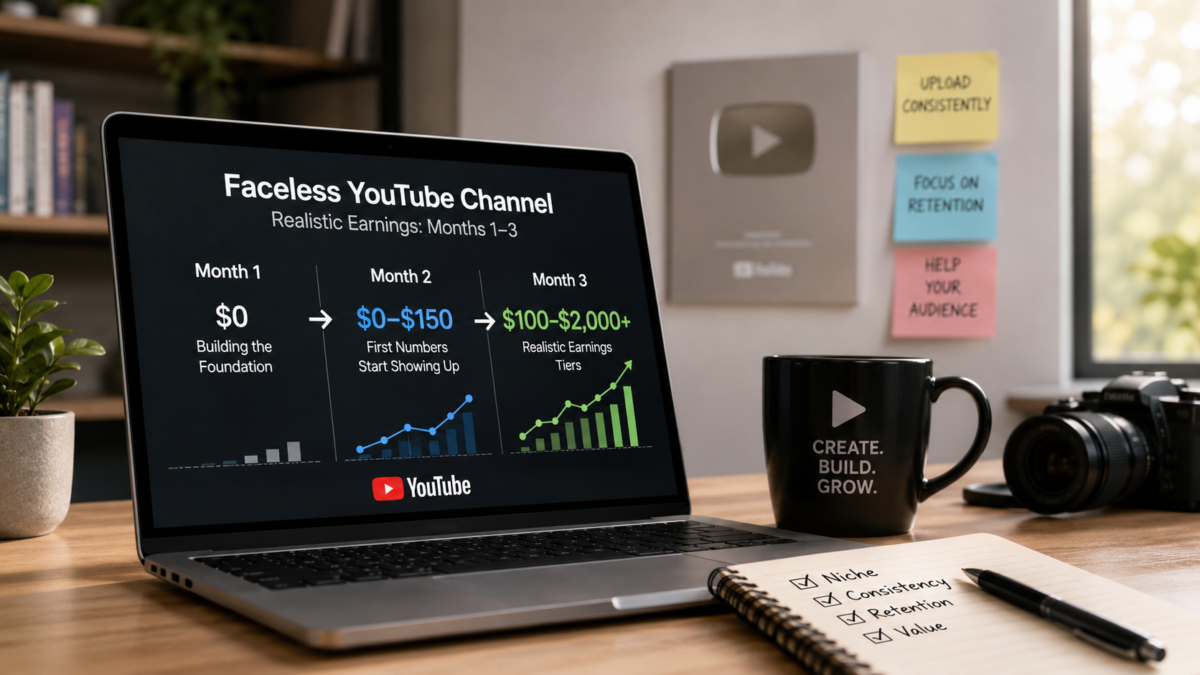
Month 2: The First Real Numbers Start Showing Up
If you’ve been consistent (2-4 videos/week is the common benchmark among active automation creators), month 2 is typically when you’ll see:
- 200-800 subscribers for a niche channel with decent retention
- First AdSense approval, if you crossed the watch-hour threshold
- Early revenue in the $0-$150 range for most beginners — high-CPM niches (finance, AI tools, tech) trend toward the higher end; entertainment/story niches trend lower
This is also the point where a lot of people quit, because the numbers still look small next to the effort. The creators who keep going past month 2 are the ones who treat it as a system, not a bet on one video going viral.
Month 3: Where Realistic Earnings Actually Land
By month 3, with consistent uploads and a reasonably low-competition niche, realistic faceless YouTube channel earnings tend to fall into a few tiers:
- Slow-growth channels: $0-$50/month — still building watch hours, inconsistent uploads, or a saturated niche
- Steady-growth channels: $100-$500/month — consistent uploads, decent retention, mid-CPM niche
- Fast-growth channels: $500-$2,000+/month — high-CPM niche, strong hook/retention, sometimes one video that outperforms
The “$4,000 in month 1” screenshots you see online are the outlier, not the median. That doesn’t mean they’re fake — it means they’re not the realistic baseline to plan around.
What Actually Speeds This Up
- Pick a low-competition niche instead of the most popular one — less competition means your early videos have a real shot at ranking in search/suggested
- Upload consistently — 2-4x/week outperforms 1 “perfect” video/month, since the algorithm rewards consistency over polish early on
- Add affiliate income in month 1-2 — don’t wait on AdSense alone to see any return. If script-writing or editing gigs interest you as a parallel income stream while you build, sites like Fiverr with less competition are worth a look too
- Track retention, not just views — a video with 40% average view duration will out-earn one with more views and 15% retention
FAQ
Do faceless YouTube channels really make money in the first month?
Rarely in direct ad revenue, since most channels haven’t hit the monetization threshold yet. Affiliate links and sponsorships are the more realistic month-1 income source.
How many videos do I need before I start seeing real numbers?
There’s no fixed number, but most creators who see meaningful traction by month 3 have published 20-40 videos by that point.
Is a low-competition niche actually better for earnings?
Usually yes for the first 3 months — it’s easier to rank and get discovered, even if the ceiling on view count is lower than a broad, saturated niche.
Disclosure: This post may contain affiliate links. If you click through and make a purchase, we may earn a small commission at no extra cost to you. We only recommend tools and resources we believe are genuinely useful for beginner creators. See our full Affiliate Disclosure.