A friend asked me recently how people are making money “doing AI automations,” because he kept seeing it on YouTube. I started explaining and realized halfway through that the useful answer is longer than a chat message. So here it is properly.
I use automations every week. They handle parts of this blog and parts of the two small ecommerce stores I run, and automation-related work is part of what I sell as a freelancer. So I can tell you what the work is like from the inside — what businesses pay for, what a beginner can charge, where the first client tends to come from, and the handful of mistakes that cause most people to quit within a couple of months.
This guide contains affiliate links — full disclosure at the end.
📋 In this guide
1. What this work actually is
2. What you need to learn first
3. Picking your first service
4. What to charge
5. Finding the first client
6. Mistakes that cost people this business
7. A realistic first three months
8. FAQ
What This Work Actually Is
Every small business has tasks that repeat all week. Someone fills the contact form and waits a day for a reply. Finished customers never get asked for a review. Orders from one platform get retyped into another. The owner knows this is costing money. They don’t have anyone to fix it.
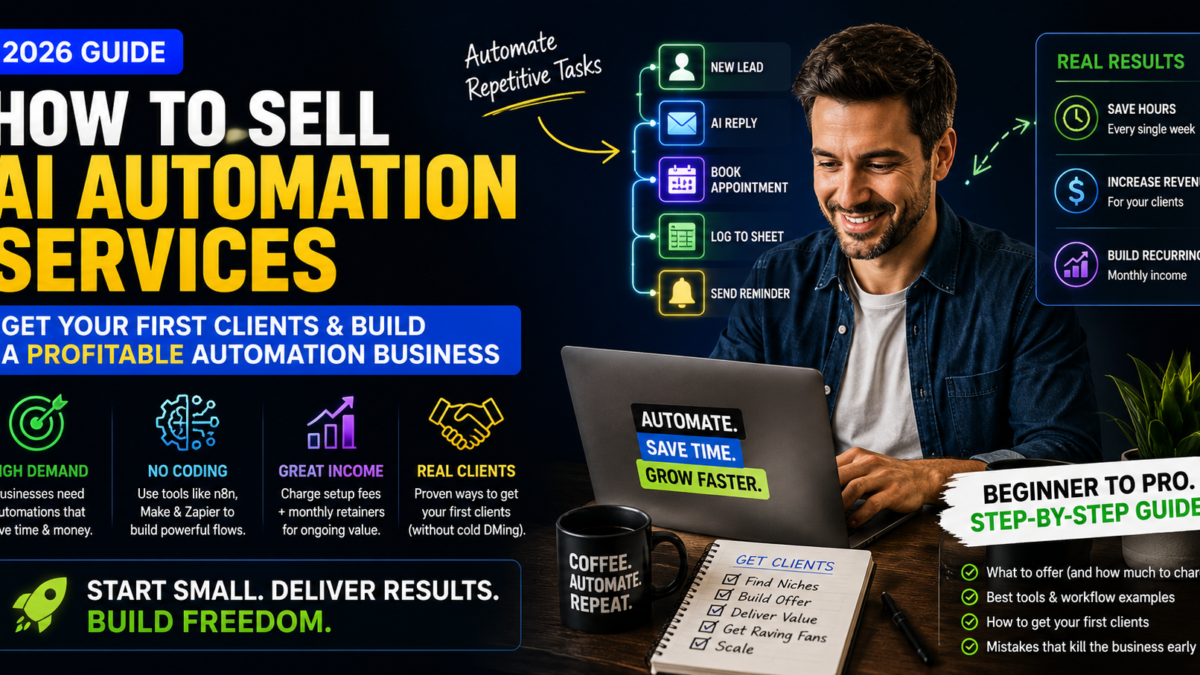
Your job is connecting the tools they already use so those tasks happen on their own. When a lead comes in, a reply written by AI goes out within minutes and the lead lands in a spreadsheet with a follow-up reminder attached. When a job is marked complete, the customer gets a thank-you with a review link. When an order arrives, it syncs everywhere it needs to be. None of this is dramatic. It’s plumbing. Businesses pay for plumbing because it saves them hours every single week, and hours are the one thing an owner can’t buy more of anywhere else.
Chatbots that answer repetitive customer questions belong to this same family, and they’re often the first thing a business buys. If you’ve read our post on how AI agents work, this is the small-business end of that shift: systems doing the repetitive part while a person keeps the judgment calls.
What You Need to Learn First
You don’t need to write code. Tools like n8n, Make, and Zapier let you build workflows visually: choose a trigger, add steps, drop in an AI node wherever language or a decision is needed. I build mine in n8n for blog and store tasks, and the tool itself took me a few weekends to get comfortable with.
The tool is the smaller half of the job, though. Three other things matter more than most beginners expect.
First, you have to get the process out of the owner’s head. Most business owners have never written down how their lead handling or booking actually works — it lives in habit. Sitting with someone and mapping their process is a skill, and it’s the one clients end up valuing most.
Second, things break. An API changes, a form field gets renamed, an AI step starts producing odd replies. Fixing broken workflows is part of the service, and it’s also where the monthly income comes from, so treat debugging as a feature of the business rather than an annoyance.
Third, safety rails. An automation that sends the wrong message to a client’s customers hurts a real business with real people in it. Test runs, approval steps for anything sensitive, and spending caps on AI usage should be in every build from the start.
A sensible way in: pick one tool and automate three things in your own life or work before selling anything. Those three working systems become your portfolio, and you’ll have made your early mistakes on yourself instead of on a paying client.
Picking Your First Service
“I sell AI automation services” means nothing to a salon owner. “I set up a system that replies to your missed inquiries within two minutes” means everything. Sell one specific outcome, to one type of business, and expand later.
The easiest starting point is the AI chatbot. The deliverable is clear, businesses already search for it on freelance platforms, and the setup work has natural boundaries. We covered what to charge for chatbot setup in detail — if you’re starting from zero, start there and treat this post as what comes after.
Because here’s the pattern that took me a while to appreciate: growth in this business mostly happens inside clients you already have. The shop that bought a chatbot also loses leads to slow replies. The clinic that bought lead follow-up also forgets to collect reviews. Every automation you add makes the monthly relationship bigger, and one client buying four automations over six months is better than four clients buying one — better money, far less selling.
What to Charge
Numbers I’d consider realistic for someone starting now:
- One automation, set up and tested: $150–$500 depending on complexity. Your first couple of projects will sit near the bottom of that range while you build proof, and that’s normal.
- Monthly maintenance: $50–$200 per client for monitoring, fixes, and small improvements. This line is the actual business. Setups pay for your month; retainers pay for your year.
- Bigger packages — several automations bundled for $1,000+ — become possible once you’ve built the same workflows enough times to deliver them quickly. That’s a later stage, not a starting one.
One piece of common advice I’d steer you away from: working free to collect testimonials. I understand the logic, but free work mostly attracts people who aren’t serious. They ghost mid-project, never launch what you built, and a testimonial from someone who didn’t use the thing isn’t worth having anyway. Charge something, even a small early-days rate, and say plainly that it’s discounted while you build your portfolio. A client who paid treats the work like it matters, and those are the only clients who teach you anything.
Finding the First Client
A lot of advice in this space starts with cold outreach — message thirty businesses a day, walk into local shops. Some people can sustain that. Most beginners send messages for two weeks, hear nothing, and quit. So this is the order I’d actually work in:
Start where demand already exists. Businesses search Fiverr and Upwork every day for chatbot setup, Zapier work, and n8n workflows. On a marketplace you skip the hardest part of any new business — convincing strangers the thing is worth buying — because the buyer arrived already convinced. The platform fee is the price of that shortcut, and early on it’s worth paying.
Then people who already know you. Past clients from other services, business owners in communities you’re genuinely part of, the friend of a friend with a shop. One warm conversation tends to outperform fifty cold messages, partly because trust is most of what’s being bought here — you’re asking a business to hand you the keys to their customer communication.
Then show, don’t pitch. A thirty-second screen recording of a lead arriving and the follow-up going out by itself is more persuasive than any sales page. Post that where your niche spends time. It builds slowly, but it’s the channel that eventually brings people to you.
Cold outreach after you have proof. With a portfolio piece and a testimonial behind you, targeted outreach to one niche can work well. Without them, it’s mostly a way to get discouraged.
Mistakes That Cost People This Business
Promising too much. An automation handles defined, repetitive work. It doesn’t replace an employee’s judgment, and a client who was sold that idea will be unhappy no matter how well your workflow runs. It’s easier to delight a client you under-promised than to calm one you oversold.
Building everything from scratch. If every project starts on a blank canvas, your hourly rate quietly collapses. The second lead-follow-up system you build should take a third of the time the first one did, because you saved the first one as a template. Reuse is the entire economics of this work.
Skipping the maintenance talk. Hand over an automation with no ongoing arrangement and you’ve scheduled a future emergency with your name on it. When it breaks, you’ll either fix it free forever or watch the relationship go sour. Even a small monthly fee, agreed on day one, prevents both.
Taking every client. A client with chaotic processes and no patience will eat the time of three good ones and leave your only bad review. The discovery call goes both ways; you’re allowed to say no.
Forgetting the running costs. AI steps cost money each time they run. Estimate the client’s monthly usage before quoting, write it into the proposal, and set caps. Nobody forgives a surprise bill.
A Realistic First Three Months
Month one, you’re learning the tool and automating your own tasks. Income: zero. That’s not falling behind; that’s the actual schedule. Month two, your first offers go out — a marketplace gig goes live, you have a few conversations, maybe one small discounted project lands. Month three, if things go reasonably, you have one to three small clients, your first monthly retainer, and total earnings somewhere in the hundreds of dollars.
The reason to continue anyway is the shape of the curve. Retainers stack — client four doesn’t replace client three, it adds to it. Templates compound, so each project gets faster and more profitable than the last. And small businesses are falling further behind on this every year, not catching up. Most people who make real money here are simply the ones who kept going through a quiet first quarter. If you plan for the quiet quarter, everything after it feels like a bonus.
FAQ
Do I need to know how to code to sell AI automation services?
No. Visual tools like n8n, Make, and Zapier cover most of what small businesses need. You’ll still need to learn your chosen tool well, understand how the client’s business runs, and be able to fix workflows when they break.
How much can a beginner charge?
Around $150–$500 for a single automation setup and $50–$200 a month for maintenance. Larger bundled packages come once you’ve done the same work enough times to deliver it quickly.
Is this market already too crowded?
The videos about it are crowded. The work isn’t. Millions of small businesses have repetitive problems and nobody technical on staff, and most people posting about automation never actually deliver services to any of them.
Which tool should I learn first?
One, not three. Zapier is the easiest entry. n8n takes a bit longer to learn but costs much less to run, which matters once you’re maintaining workflows for several clients at once.
What’s the best first service to offer?
Something with one clear outcome. Chatbot setup is the common entry point because businesses already search for it and the deliverable is easy to define. Lead follow-up automation is a close second.
The Bottom Line
This is a real, learnable business with a slow first quarter and a good curve after it. The demand exists, the tools are learnable in weeks, and the monthly fees are what turn it from gig work into income you can count on. Start by automating three things in your own life this month. Sell the first one next month, at a modest price, to someone who actually pays. Keep that client happy and build from there. It’s slower than the version in the ads — and it has the advantage of actually happening. ☕
Affiliate disclosure: This post contains affiliate links. If you sign up or buy through our links we may earn a commission at no extra cost to you. We only recommend tools and platforms we’d genuinely use ourselves. Pricing and platform details reflect 2026 information and change often. See our full affiliate disclosure and editorial policy.